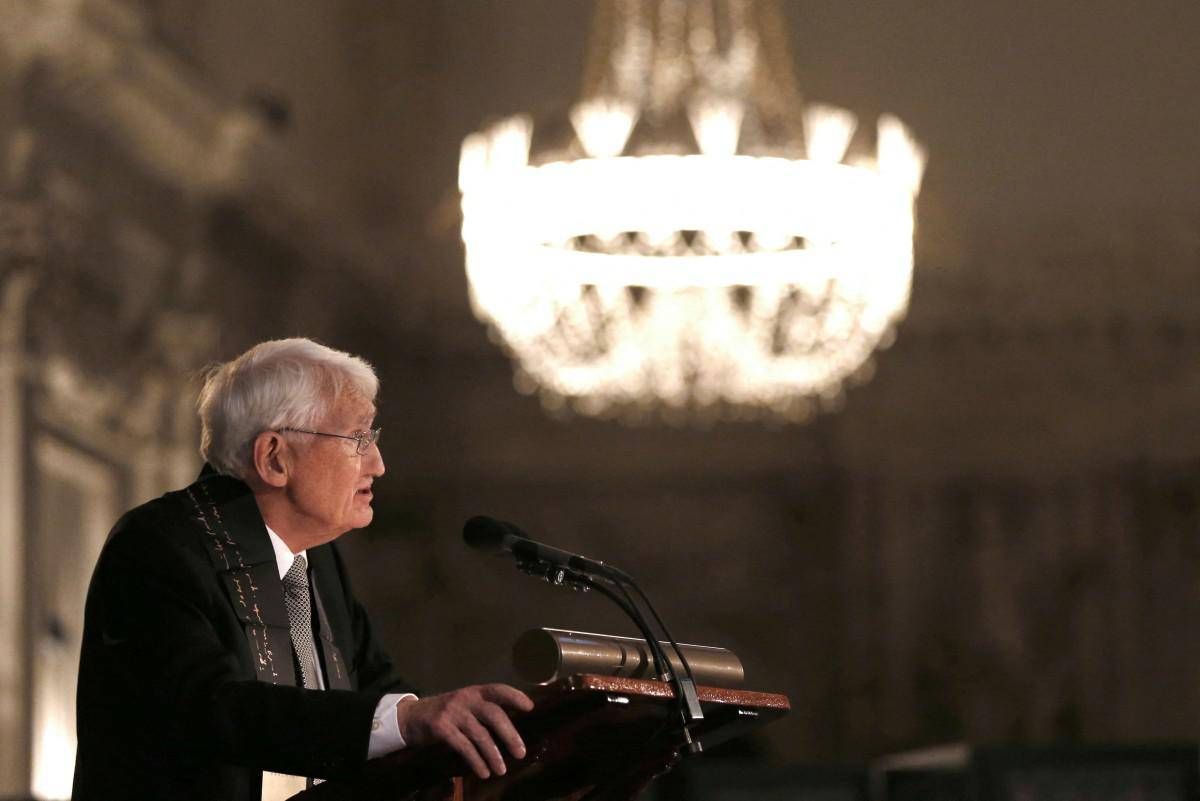
German philosopher and sociologist Jürgen Habermas, considered one of the giants of critical reflection on contemporaneity, has died at 96 in Starnberg, a town in southern Bavaria, not far from Munich. The announcement of his death was made by his family through a spokesperson for his publishing house, Suhrkamp Verlag. He moved to Starnberg in 1971 where he directed the Max-Planck-Institut zur Erforschung der Lebensbedingungen der wissenschaftlich-technischen Welt (“Max Planck Institute for research on the living conditions of the scientific-technological world”) until 1981.
Heir of critical theory and central figure of the second generation of the ‘Frankfurt School’ – at the Institute for Social Research he was a student of Theodor W. Adorno – Habermas, considered the greatest German thinker of the last half century, it highlighted the problems of communication and the function of public opinion in contemporary societyclaiming the political role of rationality as a dialogue not subject to conditions of domination.
Emeritus professor at the University of Frankfurt am Main, where in 1964 he obtained the chair of philosophy and sociology that had been held by Max Horkheimer, among his many works translated into Italian are ‘Culture and criticism’ (Einaudi, 1980), ‘Morale, law, politics’ (Einaudi, 1992), ‘Multiculturalism. Struggles for recognition’ (with Charles Taylor, Feltrinelli, 1998), ‘The postnational constellation’ (Feltrinelli, 1999) and ‘The future of human nature’ (Einaudi, 2002 and 2010).
His most important work is ‘Theory of communicative action’ (1981, published in Italian by Il Mulino in 1986) in which he elaborates the concept of communication free from power relations. The essay develops three research directions: the first focused on a concept of ‘cognitive rationality’ which ‘opposes the cognitive-instrumental simplifications of reason’, the second investigating the attempt at a reconstruction of the concept of society through the integration of the paradigms of ”life world” and ”system”, the third relating to a ‘theory of modernity’ in which the most significant contributions of social research converge.
In his writings, the epistemological issues inherent to the foundation of the social sciences reinterpreted in light of the ‘linguistic turn’ of contemporary philosophy occupy a central position; the analysis of industrial societies in mature capitalism; the role of institutions in a new emancipatory dialogic perspective in relation to the legitimacy crisis that undermines contemporary democracies and consensus-building mechanisms.
Born on June 18, 1929 in Düsseldorf, Jürgen Habermas lived until obtaining his high school diploma in Gummersbach, where his father ran the local branch of the Cologne Chamber of Commerce and Industry. He studied at the Universities of Göttingen (1949/50), Zurich (1950/51) and Bonn (1951-54) where he graduated in 1954 with a thesis entitled ‘The Absolute and History. On ambivalence in Schelling’s thought. He obtained his teaching qualification in 1961 in Marburg with the thesis ‘Changes in the structure of public opinion. Research on a category of civil society’, subsequently published in Italy as ‘History and criticism of public opinion’ (Laterza, 1971).
From that moment he began an extraordinary career as a professor of philosophy at the University of Heidelberg, where he taught until 1964. From 1964 to 1971 Habermas was professor of philosophy and sociology at the Goethe-Universität in Frankfurt. During the 1968 student uprising, Habermas was perceived as a supporter, but he rejected the radicalization of the movement. In 1971 he moved to Starnberg where together with Carl Friedrich von Weizsäcker he led the Max-Planck-Institut ‘for research into the vital conditions of the technical-scientific world’.
In 1983 he returned to the University of Frankfurt where he was assigned the chair of philosophy with specialization in social philosophy and philosophy of history and in 1994 he was appointed professor emeritus. Since 1983 Habermas has been editor of the monthly political science magazine ‘Blätter für deutsche und internationale Politik’. In 2001 he was awarded the Peace Prize of the German Booksellers’ Association; in 2003 he was awarded the Prince of Asturias Award; in 2004 the Kyoto Award for Lifetime Achievement; in 2012 it won one of the most prestigious German awards, the Heinrich Heine Preis.
Habermas’ philosophical research proposed to interpret all human progress in the light of the ‘constellation of faith and knowledge’. Among the books in this area: ‘Reason and faith in dialogue’ (Marsilio, 2005, tradition by Giancarlo Bosetti), born from reflections on the interrelationships between democracy and religion developed in a meeting with Cardinal Joseph Ratzinger, future Pope Benedict XVI, in Munich at the Katholische Akademie; ‘Between science and faith’ (Laterza, 2006), where he investigates the theme of the relationship between religion and secularism and proposes overcoming the atavistic fracture that separates them; ‘Verbalize the sacred. On the religious legacy of philosophy’ (Laterza, 2015), essay on the issues of secularisation.
Habermas dedicated many articles, essays and conferences to a critical reflection on the fate of Europe and the West, also developing close analyzes on the precarious balance between European states and the USA. A miscellany of these interventions was collected in the volume ‘The divided West’ (Laterza, 2005).
The analysis then continued with ‘The role of the intellectual and the cause of Europe’ (Laterza, 2011), where he returns to deal with the situation relating to the West; with ‘In the technocratic spiral. This Europe is in crisis’ (Laterza, 2014), where he argues that Europeans must recognize that their model of welfare state and the national variety of their cultures can only survive thanks to a common effort: ‘giving up the European Union would mean taking leave of world history’. (by Paolo Martini)
https://telegra.ph/httpswwwfarmpallycomabout-us-03-12
https://hedgedoc.envs.net/s/6yRqondcO
https://pinshape.com/users/8925407-alexandermartinez22?tab=designs
https://www.40billion.com/profile/176463614
https://promosimple.com/ps/4677f/esmkywykhi
https://promosimple.com/ps/4677e/qryvmgjpkj
https://telegra.ph/httpschakttyneocitiesorg-03-12
http://www.fanart-central.net/user/qryvmgjpkj/profile
https://www.gta5-mods.com/users/NathanDiaz75
https://kumu.io/esmkywykhi/chaktty#untitled-map
https://telegra.ph/httpswwwmovieboxproscom-03-12
https://www.40billion.com/profile/628420066
https://wallhaven.cc/user/qryvmgjpkj
https://www.divephotoguide.com/user/HenrySmith20
https://www.chordie.com/forum/profile.php?section=about&id=2480778
https://graph.org/httpsbuyredaccountcomproductbuy-reddit-account-03-12
https://givestar.io/profile/236a1b97-a700-4de3-81d3-21e2414cead7
https://gratisafhalen.be/author/LeviMartin32/
https://www.annuncigratuititalia.it/author/LeoRamirez54/
https://disqus.com/by/qryvmgjpkj/about/
https://www.40billion.com/profile/409811367
https://forum.ircam.fr/profile/milesmartinez81/
http://www.activewin.com/user.asp?Action=Read&UserIndex=4829199
https://www.dziennikwiadomosci.pl/plaza-kleopatry-najslynniejsza-plaza-w-alanyi/
https://www.infomo.pl/najlepsze-parki-rozrywki-i-aquaparki-w-antalyi/