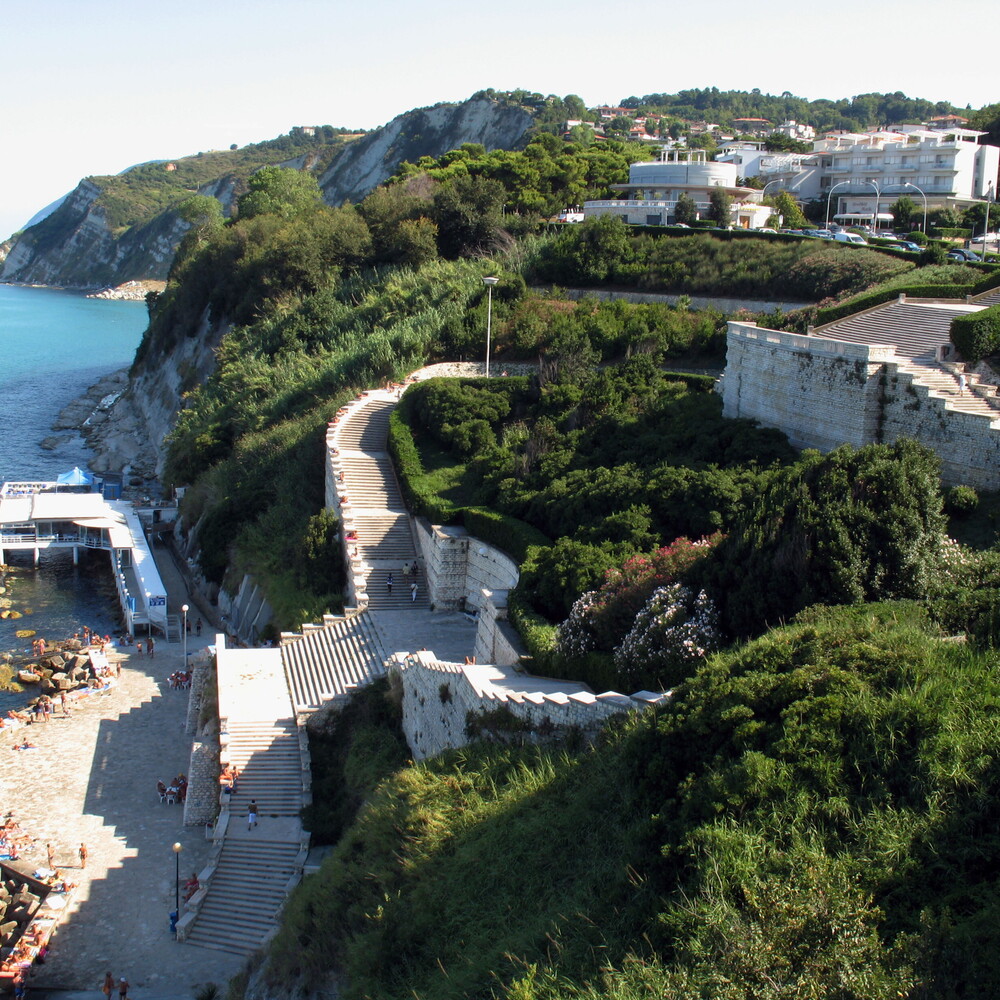
“Ancona is the city where you can admire both the sunrise and the sunset over the sea, in a cycle that smacks of a daily miracle and also of infinity”. Annalisa Trasatti puts the beautiful image of the tall and solitary woman on the cover Romanesque cathedral of San Ciriaco above the Adriatic Sea for his book ‘Ancona’ (Claudio Ciabochi publisher). “Ancona – writes Trasatti – is a city with an oriental flavour, a Greek polis, a real Acropolis, which reminds you why the ancients chose the highest panoramic points to build their temples and celebrate their beauty”.
Born and resident in the historic district of Capodimonte, current Coordinator of the services of the Omero State Tactile Museum (Italian excellence and in the world where “it is forbidden not to touch”), Trasatti declares her love for her city by quoting Casper, the father of Johann Wolfgang Goethe: “After ascending to the Citadel which dominates the city, we saw the most beautiful view in the world and thus my effort was rewarded.” The work, on coated paper, It has beautiful photos of the riches of Ancona: “More than any other city in Italy – he wrote the British Edward Hutton – resembles Spain with its so virile and imperious appearance, which always retains something mystical, and can even give you the impression of a city of the East, in its moments of gaiety or in the hours of sleepy abandonment and bitter tiredness”.
For Trasatti, Ancona is simply “Gateway to the East, springboard towards distant, exotic worlds. From here, Emperor Trajan and Saint Francis set sail towards the East and Greeks, Armenians, Jews and Slavs have coexisted for centuries”. “Ancona – continues Trasatti – is an anarchic city, so much so that even Nature seems to have noticed it, growing luxuriant and tenacious here, to the point of wanting to cover, at times, History and its monuments as if they were wounds”.
He also noticed it Pier Paolo Pasolini that precisely: “A city without seafronts, crowded, with perfection, on a point on whose summit there is the Cathedral, and which means that Ancona overlooks two seas. But the walk, on Sundays, takes place on the great road that joins the two seas, from which the two seas cannot be seen: there is a walk on land… But the beach of Ancona that I will remember, will be the one I saw in the middle of the night, at two o’clock, at three o’clock, with an abandoned moon in the sky and in the sea, up there. To the Jewish camp, that is, to the Jewish cemetery, also abandoned, with the gravestones torn, uprooted, scattered in the large concave meadow, and immediately next to it, a ravine, on the sea, where still, distant, hostile, the lights of the port and the city tremble, finally, as perhaps it would like, lifeless”.
https://nv-casino.co.de/spiele/sweet-bonanza/
https://nv-casino.co.de/spiele/plinko/
https://nv-casino.co.de/spiele/poker/
https://nv-casinobonus.de/bonus/
https://nv-casinobonus.de/bonus/ohne-einzahlung/
https://nv-casinobonus.de/bonus/freispiele/
https://nv-casinobonus.de/login/
https://nv-casinobonus.de/app/
https://nv-casinobonus.de/auszahlung/
https://nv-casinobonus.de/spiele/
https://nv-casinobonus.de/spiele/sweet-bonanza/
https://nv-casinobonus.de/spiele/plinko/
https://nv-casinobonus.de/spiele/poker/
https://nvcasino-bonus.de/bonus/
https://nvcasino-bonus.de/bonus/ohne-einzahlung/
https://nvcasino-bonus.de/bonus/freispiele/
https://nvcasino-bonus.de/login/
https://nvcasino-bonus.de/app/
https://nvcasino-bonus.de/auszahlung/
https://nvcasino-bonus.de/spiele/
https://nvcasino-bonus.de/spiele/sweet-bonanza/
https://nvcasino-bonus.de/spiele/plinko/
https://nvcasino-bonus.de/spiele/poker/
https://nvcasino-de.eu/bonus/
https://nvcasino-de.eu/bonus/ohne-einzahlung/