Entering ‘Blu e sale’ means letting yourself be carried inside a world made of memories and emotions. Giacomo Pilati takes us on an intimate and sincere journey, where childhood, family, the sea, the scents of Sicily and the bond with one’s land become living story material.
The pages of the novel speak of growth, discovery, deep affections and everything that, even with the passage of time, continues to live within us. Trapani is the background of the story and togethera constant presence, full of light and contradictions, capable of leaving a mark in the soul of the protagonist and the reader.
Without anticipating the most intense moments of the book, it can be said that it is a work that touches universal chords, because it speaks of the need not to lose what made us who we are. In this interview, through the author’s words, we enter even more closely into the heart of the novel and the emotions that gave rise to it.
If today you could really sit next to the child who appears at the beginning of the book, what would you say to him and what would you not have the courage to tell him?
That child is always there next to me, he never leaves me. I nourished it with the nostalgia that serves to keep the memory adrift of memories, to keep it firm to the amazement that is difficult to recover in adults and in any case we have to deal with it later in a different way. I talk to him continuously, sometimes I even hug him, I hold him tightly to my chest until I feel his heart merge with mine in a single beat made up of thoughts, emotions. I continued to look after that child, I saw him grow, I accompanied him by the hand through dreams and pain. Perhaps out of fear of losing him, of no longer seeing him swallowed up by the abyss of the loss of innocence, deep holes from which it is difficult to climb back out. If I could sit next to him today I would tell him that the time to play is not over yet and that the present is dictated by daily birth marked by small objectives that when put together become big. I wouldn’t have the courage to tell him that I wasn’t able to remain a child forever which is what I wanted when I had shorts. But on the other hand I have been close to that absurd goal and I continue to touch it with the words I know. A magic that transforms feelings into geometric shapes.
In your book Trapani is not just a background, it almost seems like a living character: what is the place in the city that holds its soul the most and that still excites you today?
Trapani is the essential scene of my Sicilian education. Among the alleys and spaces flooded by the light of the sea I discovered the first beautiful stories, the ones that represented the building blocks of all my explorations. A collection of faces, lights and stones that still illuminate my dreams and my words today. And even if I no longer smell the smells of cooking on the street, the freshly baked bread, the water with soap thrown on the pavements, I imagine them the same and I can even smell them as if they were still there under my nose. The presence of those moments is still so strong today. Which remained stuck to the skin, moved inside the head, went straight to the stomach, like mush. The sun, the darkness, the stones, the faces. What was happening. But also the wait for the things that were to come. And in between the happy and aware childhood. As only children know how to experience it. Glued to the hours that like a caterpillar crossed the body, slowly modifying it, sculpting small grooves that touched the infinite.
Of all the memories you told, was there one that hurt you the most to rewrite and one that brought you happiness back?
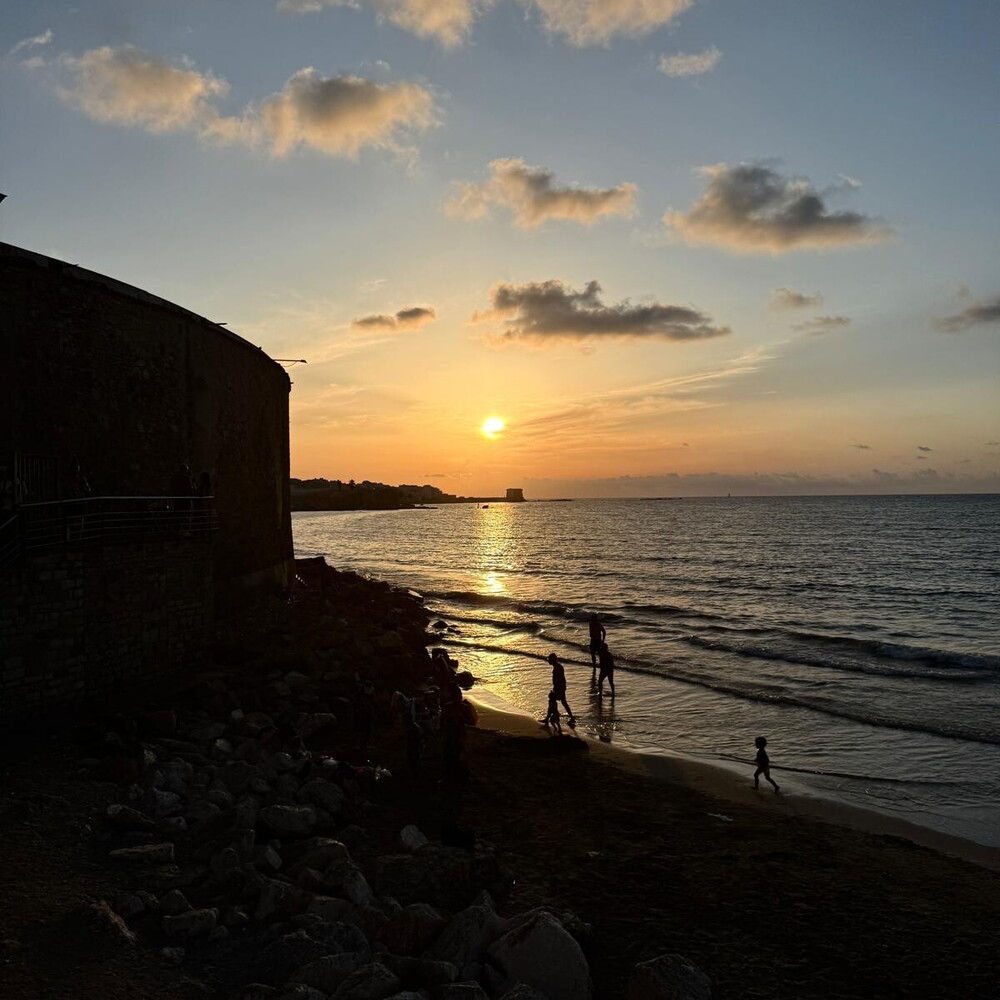
My mother’s death is one of the reasons that made me face the need to deal with feelings of guilt. With those scents lost too soon, with a joy exchanged for an irregular, out-of-form pain. Of those that are easy to talk about when they belong to others but when they happen to you, words are no longer enough and it takes time to look for the right ones capable of settling the accounts with the emotions, with that pain that pierces my stomach every time I think about it. My mother who hid her illness so as not to ruin my wedding days. She who sacrificed her end to see my beginning, to share it, skimming it from the tragedy that would soon take place on her body attacked by cancer. A gesture that belongs to the world of women, to mothers, to the heart of this land. It brought me happiness back to see the sunset with my father while he stood there explaining to me that that was the beauty. The changing colors, the disappearance of the fireball in the sea, and then the evening that arrived suddenly like a consoling embrace.
In the novel we feel a lot of love for his land, but also disappointment for its silences and wounds: did you write this book more out of nostalgia, anger or the need for truth?
I started talking about this land on TV and in newspapers when I was 17; I lived through the terrible 80s as a reporter, I touched the wounds, I saw that blood, I reported it: the murder of judge Ciaccio Montalto, the mafia war in Alcamo, the Pizzolungo massacre, the murder of Mauro Rostagno with whom I worked on TV until the last of his days. The hope that one day everything could change was extinguished with the unfortunate generational leap that did not take up the baton of those roaring days in which it seemed that all that slaughter would provoke a reaction, an uprising of consciences. And instead those who came later were forced to leave the city, to plan a future outside of here. In the end there was almost no one left and the pawns of the game of goose returned to the starting square. Because there are no longer anyone who rolls the dice. Yes, in the end it is this anger encysted by nostalgia that pushed me to follow the thread of the things I saw, aware that elsewhere they would have had another color, perhaps they would never have happened.
After closing the book, what do you hope remains in the heart of a reader: the image of the child he was, the man he became or the Sicily he talks about?
I would like readers to feel accompanied by the hand in a story where it is easy to recognize themselves but also to get lost in the story of a child who witnessed events that changed him and the place where he grew up. The protagonist, at least this is what I would like to come out, is Sicily. Not so much its contradictions, the rhetoric of its universal story, but all that blue that has possessed me since I opened my eyes and that I still chase to see where it ends up.
https://www.talentedladiesclub.com/articles/how-to-prepare-for-moving-when-buying-or-selling-a-home/
https://www.safesearchkids.com/how-to-choose-a-private-school-a-practical-guide-for-parents/
https://www.safesearchkids.com/how-bilingualism-enhances-cognitive-development-in-children/
https://pestcontrol.performaze.com/pest-centipedes.html
https://szklarskieklimaty.pl/szklo-zbrojone-w-nowoczesnym-domu-powrot-klasyki-w-bezpiecznym-wydaniu/
https://refleksomonia.pl/inhalacje-wodorem/
https://famoid.com/tiktok/
https://nationaldppcsc.cdc.gov/s/profile/005SJ00000kZVOD
https://open.mit.edu/profile/01KM258NC3V5JAB7J0W2T3JP33/
https://musabasequt.sgn.cornell.edu/solpeople/personal-info.pl?sp_person_id=2391&action=view
https://independent.academia.edu/JoanMckenzie2
https://blog.sighpceducation.acm.org/wp/forums/users/joan485l1/
https://stempreacademy.hawaii.edu/members/joan485l1/
https://adept.missouri.edu/members/joan485l1/
http://www.stes.tyc.edu.tw/xoops/modules/profile/userinfo.php?uid=3925332
https://engage.alaska.edu/uas/page.aspx?pid=534&messageid2366=97886&tid2366=74135&dgs2366=3
https://pad.itiv.kit.edu/s/l3NcQDswl#
https://pandora.nla.gov.au/external.html?link=https://famoid.com
https://dados.justica.gov.pt/user/joan485l1?__no_cache__=True
https://www.wcs.edu.eu/profile/joan485l1/
https://rciims.mona.uwi.edu/user/joan485l1?__no_cache__=True
https://data.carpathia.gov.ua/user/joan485l1?__no_cache__=True
https://data.gov.ua/user/joan485l1?__no_cache__=True
https://wiki.ling.washington.edu/bin/view/Main/JoanMckenzie
https://www.classaction.sites.tau.ac.il/profile/joan485l174661/profile