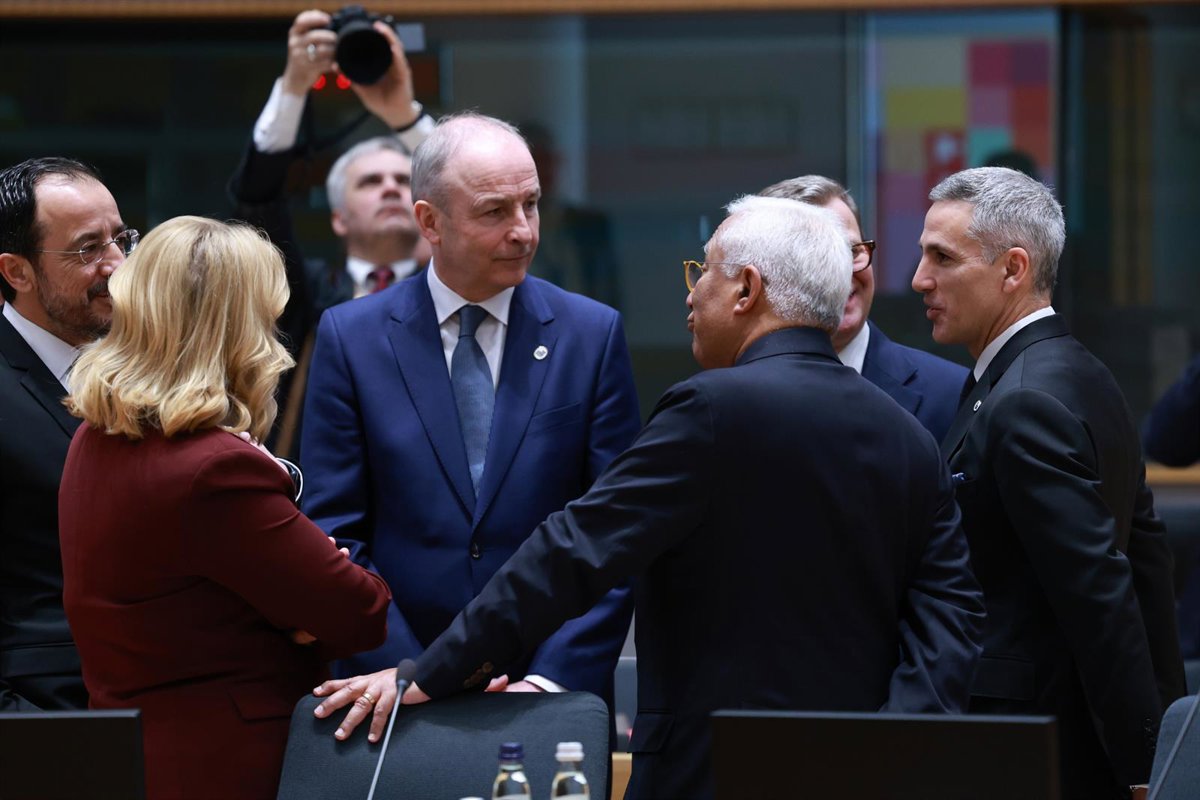
The leaders of the Twenty-Seven Member States of the European Union have pointed out the need for a de-escalation in the Middle East to give “an opportunity” to a negotiating process between Iran and the United States and Israel, which have been at war since last February 28 in a conflict that has spread to the entire region.
At the European Council that brings together the heads of Government and State of the EU countries this Thursday, several voices have urged the “cessation of hostilities” and the unblocking of the Strait of Hormuz, blocked by Tehran in response to US and Israeli attacks, and which is leading to an increase in energy prices around the world.
One of the voices that have called for a de-escalation has been the president of France, Emmanuel Macron, who in statements to the media before the summit has indicated that “all tempers should calm down” and that “the fighting should stop” even for a few days to try to “give the negotiations a chance.”
Macron has supported “a moratorium on civilian infrastructure and the civilian population in this conflict” and a “rapid de-escalation” so that “all bombings and attacks” against gas, oil or even aquifer facilities cease, as recently proposed by the president of the United States, Donald Trump.
The German Chancellor, Friedrich Merz, has expressed himself in similar terms, stating that the community bloc is “willing to help” in a negotiating process, but that to do so “hostilities must cease” and also “an international mandate is needed” which currently does not exist.
“We can only get involved when the guns fall silent. Then, we will be in close contact not only with Israel, but also with the Gulf States (…). And then we will be able to do many things, including regarding the sea routes and keeping them open,” he added.
In this sense, the President of the Spanish Government, Pedro Sánchez, has been “convinced” that if Europe defends the multilateral order it will be able to “end this war soon, we will be able to return to the table those parties that are currently in conflict and find peaceful solutions to conflicts that, unfortunately, are not only costing human lives, but also refugees.”
In Sánchez’s opinion, “in times of turbulence” and “a lot of fog” like the current ones, what is relevant is that politicians defend “the principles and values that have brought us here with decades of peace, with decades of prosperity and with decades of certainty.”
AN OPERATION WITHOUT PROTECTION UNDER INTERNATIONAL LAW
The High Representative of the European Union, Kaja Kallas, has avoided commenting on how long she believes the conflict in the Middle East will last, because she does not have “a crystal ball to say when the war will end”, although she has defended that what the European Union wants is to “see the end of this war” as soon as possible.
“We are seeing the chaos it is causing in the Middle East, but also the ramifications it has in the rest of the world,” added the head of European diplomacy, pointing to the increase in energy prices and the danger of fertilizer shortages.
Kallas recalled that, so far, the EU does not know “what the objectives are” of the operation initiated by the United States and Israel against Iran and that, furthermore, “it is not protected by International Law”, since for the use of force to be legitimized it must be in legitimate defense or be protected by a resolution of the UN Security Council.
The president of the European Council, António Costa, has not expressly commented on negotiations for the conflict in the Middle East, although he has claimed the multilateral system as the “fundamental instrument” to protect the rules-based international order.
“It is clear that there is no alternative to this order, because the alternative is war in Ukraine. The alternative is unfair competition in trade, it is a threat to sovereignty in Greenland and other parts of the world. Therefore, if we want to preserve stability and peace, we must defend International Law and strengthen the multilateral system,” he claimed.
A VERY VOLATILE MOMENT FOR A MISSION IN HORMUZ
The recently appointed Prime Minister of the Netherlands, Rob Jetten, has also spoken about the conflict in Iran, and in statements to the press before attending his first European Council, he has maintained that although he understands that “the brutal regime in Iran” poses a threat to Europe and other countries in the Middle East, “the war started by the United States and Israel” is not “a war of which we are part.”
“But at the moment there is no clear indication of whether there is a proposal for a mission in the strait, and also the situation to start a mission in Hormuz is at the moment too volatile. So we need to focus on de-escalating the war and then looking for measures that we can adopt,” he continued in his explanation.
The Prime Minister of Cyprus, Níkos Christodoulídis, the country that holds the rotating presidency of the EU Council this semester, has detailed that the leaders will discuss during the summit the role that the community bloc should play in the face of a de-escalation.
“We have some ideas that I want to tell you that I debated yesterday with the Secretary General of the United Nations, António Guterres. This is, from a technical point of view, a consensus with an unprecedented political dimension,” he advanced without giving more details.
In the opinion of Austrian Chancellor Christian Stocker, “the actions of the United States are difficult to predict” and its strategy “is barely recognizable.” Thus, after the criticism launched by Trump against the Europeans for not agreeing to support a mission in Hormuz, he stressed that “Europe and Austria are not going to allow themselves to be blackmailed.”
For his part, the Slovenian Prime Minister, Robert Golob, has defended that the EU must do “everything possible to protect the energy infrastructure and so that this senseless war ends as soon as possible”, after admitting that the situation in Iran “is becoming unsustainable.”
In parallel, the Prime Minister of Belgium, Bart De Wever, has indicated that the EU must play an active role in any negotiating process to end the conflict, considering it incoherent for it to assume the bulk of support for kyiv without participating directly in the talks.
https://aviator-india-official.com/about-us/
https://aviator-india-official.com/privacy-policy/
https://aviator-india-official.com/responsible-gaming/
https://aviator-india-official.com/terms-and-conditions/
https://aviator-india-official.com/cookies-policy/
https://aviator-india-official.com/en-in/
https://aviator-india-official.com/en-in/dafabet/
https://aviator-india-official.com/en-in/crickex/
https://aviator-india-official.com/en-in/baji-live/
https://aviator-india-official.com/en-in/withdrawal/
https://aviator-india-official.com/en-in/bonuses/
https://aviator-india-official.com/en-in/what-is-aviator/
https://aviator-india-official.com/en-in/tips-and-strategies/
https://aviator-india-official.com/en-in/responsible-gaming/
https://aviator-india-official.com/en-in/cookies-policy/
https://darthelicopterservices.com/
https://darthelicopterservices.com/1win/
https://darthelicopterservices.com/dafabet/
https://darthelicopterservices.com/batery/
https://darthelicopterservices.com/crickex/
https://darthelicopterservices.com/baji-live/
https://darthelicopterservices.com/jeetbuzz/
https://darthelicopterservices.com/mega-casino-world/
https://darthelicopterservices.com/pin-up/
https://darthelicopterservices.com/odds96/