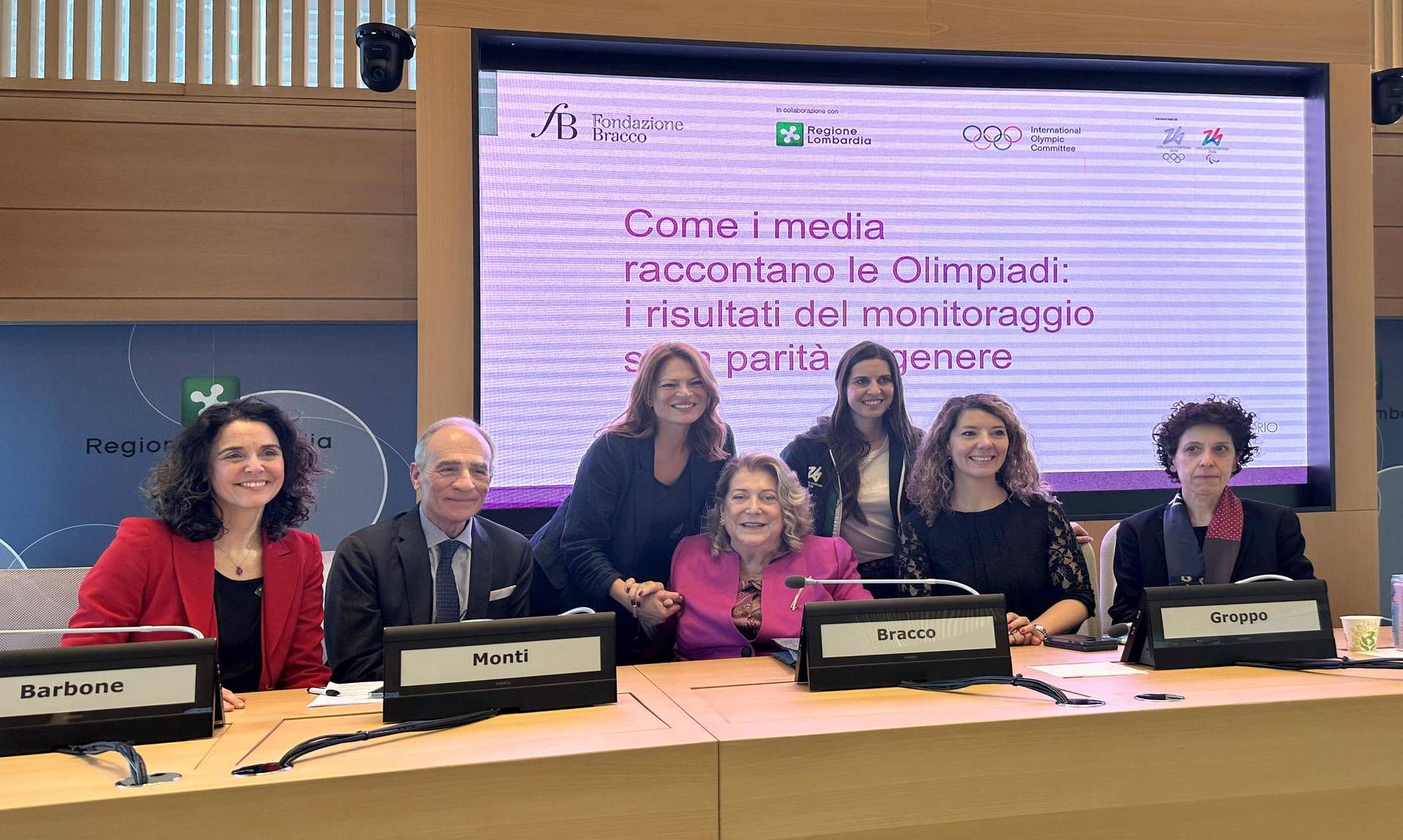
How were the Milan Cortina Winter Olympics and Paralympics covered by the Italian television media? What images, languages and protagonists emerge in the mainstream narrative of the Games? Are women and men represented equally? These questions are answered by the research “Gender equality and representation in the media: from Paris 2024 to Milano Cortina 2026” promoted by the International Olympic Committee and the Bracco Foundation, in collaboration with the Milano Cortina 2026 Foundation.
The Olympic and Paralympic Games have always represented a global platform, helping to shape the way sport is described and perceived. The research, carried out by the Pavia Observatory – an independent research institute specialized in the study of information content – analyzes how sport and its protagonists are described in Italian television news, with specific attention to the presence and narration of female athletes in sports information. Conceived as a real path of observation over time, the study analyzed media coverage in different phases, focusing on the national television representation between July 2024 and March 2026: from the Paris Games, through a year of ordinary information, up to the Milan Cortina 2026 Games. This allowed us to obtain, for the first time, an organic and in-depth vision of the media story. The result is not only an accurate snapshot of the present, but also a precious legacy of knowledge and good practices, to help guide future editions of the Olympic and Paralympic Games.
“Of these Olympics and Paralympics in Milan and Cortina I will always carry in my heart, above all, the faces of the many Italian athletes who won an extraordinary number of medals with merit and commitment,” stated Diana Bracco, President of the Bracco Foundation. “It was a great emotion to admire the exploits of our champions, starting with Chiara Mazzel, a Paralympic skier who won 1 gold and 3 silvers, making a decisive contribution to the Italian team’s record of podiums; but naturally I also rejoiced for the extraordinary feats of Federica Brignone, Francesca Lollobrigida, Sofia Goggia, Arianna Fontana and Lisa Vittozzi. Courageous girls, who with tenacity, determination, sacrifice, determination they have written memorable pages of Italian winter sport. And who, supported by an unshakable passion, have also managed to gain the attention of the media”.
“The Milan-Cortina 2026 Games recorded one of the highest levels of female participation in the Winter Olympics: 47.9% of the athletes were women, the absolute protagonists of the medal table,” recalled the Undersecretary for Sport and Youth, Federica Picchi. “Lombardy expresses great pride in the Italian Olympic and Paralympic athletes, from Federica Brignone to Chiara Mazzel, from Francesca Lollobrigida to Arianna Fontana. Fontana himself, a short track skater, female, young, from Valtellina, with 14 medals is among the most successful champions – men and women – in the history of the Winter Games. His colleague Lollobrigida is also a phenomenon, with two golds in Milan-Cortina 2026 in her pocket, and her son in her arms during the victory, she spoke about the support she received from the FISG during her maternity leave, hoping that all the Federations will do the same, with the Lombardy Region and CONI we are creating a fund to encourage the conciliation between sporting careers and maternity, the same commitment that we are putting into the creation of dual career paths with all the CUS Lombardi”.
“Thanks to the Olympic movement as a whole, we have achieved the most gender-balanced Winter Olympic Games in history with over 47% female athletes,” underlined Charlotte Groppo, Head of Gender Equality, Diversity and Inclusion at the International Olympic Committee. “This progress is more than just a statistic: it is a reflection of expanding opportunities, barriers that continue to fall, and a future where every girl can see herself on the playing field.”
“We have just experienced the extraordinary experience of the Olympics and Paralympics, which Milan welcomed with great responsiveness, and we carry in our eyes and hearts the images of the great athletes protagonists of talented events,” declared the Mayor’s delegate for gender equality, Elena Lattuada. “We hope that this presence will be maintained over time, because, as highlighted by the Pavia Observatory, great media coverage during competitions is often followed by silence. Precisely because of the ability and courage demonstrated, this silence must no longer exist”, underlines Lattuada. “If the Olympics have received widespread prominence, the Paralympics have received less attention, despite the stories of great courage and determination. The invitation is not to forget this event and to valorise those who make sport an expression of talent, resilience and strength, especially among male and female athletes with disabilities.”
“Since the application phase, the Milano Cortina 2026 Foundation has decided to make a strong commitment to promoting gender equality within the organization and towards all external stakeholders, recognizing it as a fundamental component of lasting and significant change.”, stated Diana Bianchedi, Chief Strategy Planning & Legacy Officer, Milano Cortina 2026 Foundation. “Projects have been developed along the entire path leading up to the Games. Thanks also to the support of the IOC, the Winter Olympic Games 2026 marked a historic record, with the highest participation of female athletes ever and the highest number of female officers and heads of mission. We hope that these results can serve as an inspiration for future generations. Only by working together will we be able to achieve even greater and more significant goals.”
The results of the study were presented in preview in the Press Room of Palazzo Regione Lombardia in the presence of Diana Bracco, President of the Bracco Foundation, Charlotte Groppo, Head of Gender Equality, Diversity and Inclusion of the International Olympic Committee, Attilio Fontana, President of the Lombardy Region, Federica Picchi, Undersecretary with responsibility for Sport and Youth of the Lombardy Region, Elena Lattuada, Delegate of the Mayor of the Municipality of Milan for Gender Equal Opportunities, Andrea Monti, Chief Communications Officer, Fondazione Milano Cortina 2026, Greta Barbone, Human Rights Manager, Fondazione Milano Cortina 2026, Valentina Marchei, Olympic athlete, Head of Ambassador Program of Fondazione Milano Cortina 2026, President of the Coni Athletes Commission, and Monia Azzalini, Head of the Diversity, Equity and Inclusion sector of the Pavia Observatory.
Carried out by the Pavia Observatory, the research analyzes the narrative of the Olympics and Paralympics in the main television newspapers, examining images, languages and voices involved in news dedicated to sport, from a quantitative and qualitative point of view. The research investigates how the media system contributes to shaping the narrative of sport, evaluating whether and to what extent television narratives manage to be inclusive and sensitive to the issue of gender equality. Launched on the occasion of the Paris 2024 Games and developed up to the Milan Cortina 2026 Olympics and Paralympics, the monitoring tracks the main trends in media coverage of sport, highlighting progress, critical issues and new perspectives.
During the Paris 2024 Games, the coverage of Italian TV news (to which 75% of the news is dedicated) showed a relatively balanced attention between women’s and men’s sports and a significant presence of female athletes in the narration of the event. In those days, disciplines, stories and protagonists that rarely find space in daily sports information entered the media story, contributing to broadening the public’s gaze on sport. The analysis of the Paris 2024 Paralympic Games also returned valuable indications on how sport is represented in the media. Despite the presence of more limited coverage, the attention dedicated to the 2024 Paralympics has allowed us to observe specific narrative dynamics, including the persistence of stereotypes linked to disability or gender, which forcefully raise the issue of the quality of the media story.
In the so-called ordinary time, that is, when attention shifts from major events to “ordinary” sport, the picture changes. The analysis of the year following the Paris Games showed how television coverage returns to focus on a few dominant disciplines and on protagonists already consolidated in the media system. In this specific context, the presence of women’s sport and its protagonists tends to decrease again, signaling how the effect of openness and greater visibility generated by the Games does not always manage to translate into a truly structural change in the way in which sport is described
The Milan Cortina 2026 Winter Games bring women’s sport back to the center of attention with an increase in the visibility of female athletes (58% vs. 42% of athletes) and of female sports disciplines within Italian news. Furthermore, Milan Cortina 2026 was the most balanced edition of the Winter Olympic Games ever, with 47% women and 53% men and the Italian female representation was 47%, perfectly in line with the international quota. Coverage between women’s and men’s competitions was balanced. Most of the services analyzed reported on the competitions without a clear gender prevalence: 53% of the news covered both men’s and women’s disciplines, while 24% concerned women’s competitions and 23% men’s competitions. Female and male voices were also balanced: 49% female respondents vs. 51% of men.
The language was correctly declined (84% of the news uses language correctly declined according to gender) although in some cases the narration insisted on biographical or family elements (motherhood as a recurring key). Metaphors extraneous to the sports field are highlighted which end up attributing success to a symbolic dimension rather than to technical competence. Alongside these representations, some television reports have also proposed narratives that question traditional stereotypes linked to gender. In particular, some news reports gave space to the athletes’ emotions, showing moments of emotion or strong personal involvement after the races.
Differently, the story of the Milan Cortina 2026 Paralympic Games develops within a limited information space and is characterized by a strong selectivity in the construction of contents. Within this framework, the distribution of visibility highlights the presence of marked hierarchies. Female athletes, who represent only 26% of the participants, see their presence further reduced in the media story, where they stop at 14% of the news. In this context, the coverage of the competitions focuses in particular on three disciplines – alpine skiing, cross-country skiing and snowboarding – within which only the first two offer space for women’s competitions. The result is a representation in which the presence of the athletes is not only limited, but also strongly dependent on the very structure of the most talked about disciplines and the results achieved.
In summary, the observation process highlighted a recurring dynamic: the visibility of women in sport tends to expand coinciding with moments of greater media attention. On these occasions the story opens up to a greater plurality of disciplines, stories and protagonists, contributing to enriching the public’s gaze on the world of women’s competitions. A final note of attention concerns the setting of the sports story. In several cases, attention shifts towards dimensions collateral to competitive performance, focusing on personal, aesthetic or symbolic elements that reduce the centrality of sporting skills and results. The Olympics demonstrated that Italian sport, both female and male, has made important steps forward. Now the challenge is to build an even fairer narrative for those who talk about the world of sport.
https://app.talkshoe.com/user/dashking88
https://www.gta5-mods.com/users/DK88casino
https://www.bandlab.com/dashking88
https://gifyu.com/dashking88
https://qiita.com/DK88Casino
https://www.magcloud.com/user/dk88casino
https://f319.com/members/dk88casino.1076189/
https://www.checkli.com/dk88casinodashking88
https://wakelet.com/@DK88CasinoDashking8843179
https://findaspring.org/members/dashking88/
https://wakelet.com/@DK88CasinoDashking8843179
https://www.passes.com/dashking88
https://pxhere.com/ru/photographer-me/4943536
https://kktix.com/user/8506750
https://myspace.com/dashking88
https://www.natthadon-sanengineering.com/forum/topic/82951/recommendation-for-a-site-with-entertainment
https://www.tapatalk.com/groups/bbtravel/viewtopic.php?f=3&t=14988&from_new_topic=1
https://www.swap-bot.com/swap/show/362448#comment-1043546
https://www.reverbnation.com/page_object/page_object_blogs/artist_9718487
https://www2.archivists.org/news/2009/what-did-you-do-to-%E2%80%9Csave-our-archives%E2%80%9D#comment-28118
https://www.ana-white.com/community-projects/pull-out-drawer-upgrade-tall-pantry-cabinet#comment-155886
https://ravingreferrals.com/groups/seo-company-in-gurgaon/forum/topic/online-gaming-53/#post-14244
https://www.copalretreat.com/group/instructor-profiles/discussion/70f74b75-8a22-4bb2-93e7-92b77bc2cf87
https://www.ecolestlandry.org/group/le-bureau-front-office/discussion/05d30669-723b-4683-b340-7a43d72bfb3a
https://www.driedsquidathome.com/forum/topic/118827/online-gaming