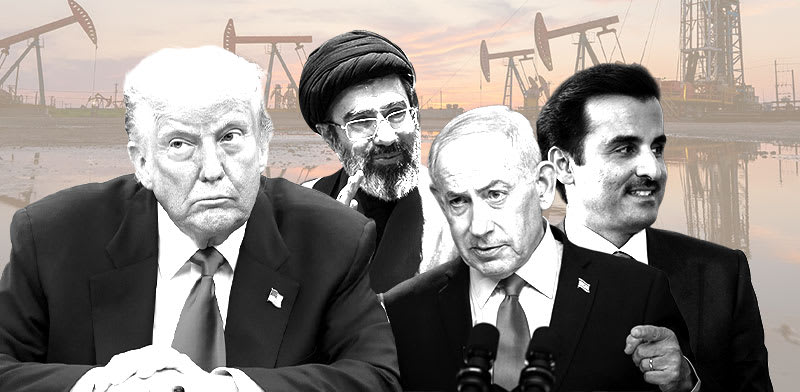
Dozens of gas and oil production, transmission and liquefaction sites were attacked in the first three weeks of Operation Hari’s Roar, most of them by Iran, but some also by Israel – most of them froze their activities, some were no longer usable. The shutdown of the energy plants, along with the closure of the Straits of Hormuz, led to a 58% increase in the price of oil since the war began, while the prices of liquid gas rose only this morning by 25%. Which production site resulted in the newest increase in prices, and which countries managed to export oil despite the blockade of the Straits of Hormuz? Globes is in order.
South Fars gas field, Iran and Qatar
Yesterday (Wednesday) Israel carried out – apparently in coordination with the USA – a dramatic attack against the world’s largest gas field, South Pars, located in the heart of the Straits of Hormuz, on the maritime border between Iran and Qatar. It is a field shared by both countries, but the Israeli attack was aimed at a rig and a transmission facility on the Iranian side and at refineries on the coast of Iran that receive and process the liquid gas from the field, at a site called Asalaviya.
In the day after the Israeli attack on the large gas field, Iran attacked a number of energy centers throughout the Middle East, including Ras Lafan in Qatar – the site where it produces the gas it flows from southern Fars, at the port of Yanbu in western Saudi Arabia, and at the Bazen production site in Haifa. This morning (Friday), Bazen’s stock jumped 7% after it was updated that the damage was localized and that it is expected to return to full operation in a few days.
As of today, the Israeli attack on South Fars is one of the most dramatic since the start of Operation Hagar Hari – if not the most dramatic. Liquid gas prices rose at once this morning (Thursday) by 25%, and it is expected to be reflected immediately in the pockets of the residents of Europe, India or China, who rely on liquid gas to generate electricity from the Qatari part of the field. The attack was carried out, according to the assessment, as a threat to the Iranians: if they do not open the Straits of Hormuz soon, the damage to the gas field will deepen, a threat that has not yet been answered in any way – with the exception of continued Iranian damage to gas and oil infrastructure in the Gulf countries.
The importance of South Fars is twofold: it serves as a source of liquefied gas for Iran and Qatar (where it is called the North Field) and each of the countries depends on it in a different way. “For Qatar, this is the main and only gas field from which it produces liquefied gas and exports it to Asian and European countries,” explains Prof. Yehoshua Krasna, director of the Forum for Regional Cooperation at the Dayan Center at Tel Aviv University, and an expert on the Gulf countries and geo-economics. In Iran, the story is different, because it has several other large gas fields, but its electricity sector is very dependent on the gas that comes from South Fars. So Qatar, a country of 3 million inhabitants, depends on it for its main export industry, while for Iran, a huge country of 90 million people, this is a threat that may further burden its fragile electricity infrastructure.”
Iran is also an exporter of natural gas – to Iraq, for which Iran is its main gas supplier and is one of the main victims of the attack in the Gulf, and Turkey, for which Iran is the second largest source of gas, after Russia.
The Israeli attack was carried out exclusively on the Iranian side of the gas field, seemingly nothing that should harm the Qataris. Despite this, the Qataris were enraged: the threat of expanding the attack on the field could also harm the Qataris in the long term, and in the shorter term – one of Iran’s responses to the attack was another attack on the industrial town of Rosh Lafan, north of Doha, the place where Qatar produces natural gas and from which it exports it to the world.
The South Fars gas field as seen on Saturday / photo: ap, IRIB
Ras Lafan, Qatar
Shortly after the Israeli attack in South Fars, the Iranians sent five ballistic missiles to the industrial city of Ras Laffan in what was defined by Qatar as a dangerous escalation and a blatant violation of sovereignty. Out of the five, one missile hit the facilities severely, but the site has not been producing gas since the third day of the war. “Ras Lapan is the largest gas liquefaction facility in the world,” notes Krasna.
“It was already closed after, in the first days, Iran sent a number of UAVs towards the site that did not cause much damage – but led the Qataris to the conclusion that it was not worth their while to take a risk and it was worth it for them to close the entire plant, after all it is impossible to transport the gas through the Straits of Hormuz and there is nowhere to store it. There is a double damage here, because in addition to stopping the gas export, the plant itself is damaged: the very act of turning off the liquefaction mechanism creates a situation where, in order to restart it, to lower the production mechanism to such a low temperature the next time, additional time will be required for evaluations. No less than oil, the damage to the gas export industry from Qatar is a global blow to the major gas importers – China, India, Japan, South Korea, Great Britain and Germany – while the USA, which is a natural gas exporter itself, may benefit from the price increase.”
According to the estimate of the CEO of Qatar Energy to Reuters, the Iranian attack wiped out 17% of Qatar’s gas export capacity for a period of 3-5 years in the first two and a half weeks of the war.
Fujairah, United Arab Emirates, and Bafco Complex, Bahrain
The United Arab Emirates, apparently a prominent financial partner of Iran, which holds most of its private capital in its banks, is also a significant victim of Iranian attacks. In the last week, Iran has been moving the bulk of its attacks in the United Arab Emirates from luxury towers in Dubai and Abu Dhabi to the industrial complex in the Emirate of Fujairah, next to which is the main complex in the country engaged in the production and export of oil. The complex is also an oil storage terminal – an estimated 70 million barrels – and serves as the eastern end of the Emirati oil pipeline connecting it to Dubai and Abu Dhabi. In the last week, the compound suffered from repeated attacks by Iranian drones, it was partially shut down for several days but returned to work.
However, due to the blockade of the Straits of Hormuz and the lack of storage facilities, oil production and refining in the country has dropped to a low rate. In small Bahrain, which produces no more than 150,000 barrels of oil per day, the situation is worse: Bafco, the country’s oil producer, was hurt and decided to stop its operations altogether – something that is a blow to the weak principality in the Persian Gulf.
Ras Tanura, Saudi Arabia
The oil city of Ras Tanura is on the eastern coast of Saudi Arabia, 200 kilometers as the crow flies from Ras Lafan, Qatar. It also stopped producing oil in the first week of the war due to the firing of anti-aircraft missiles at the facilities and the Saudi reluctance to take a risk and operate the facility anyway, and due to the fear that there would be nowhere to store it. However, for the Saudis, a solution bypasses the Straits of Hormuz in the form of an oil pipeline from the east to the west of the peninsula, which theoretically allows the flow of oil to the port city that will flow into the Red Sea.
“Saudi Arabia, which before the war produced 15 barrels of oil a day, is now moving to produce 7 million barrels a day – which is the capacity of the oil pipeline to the west,” says Krasna. “But of this, it consumes about 2.5 million barrels for the needs of the Saudi economy, so in practice it can only export about 4-5 million barrels through Yanbua in the Red Sea, that is, about a third of the amount that the market was used to in the days before the war. Still, its situation is better than that of Kuwait, Qatar, the United Arab Emirates and Iraq, which stopped producing oil. This morning (Thursday) the Reuters website reported on an Iranian attack on Yanbua, which led to the cessation of oil exports in the country. A short time later, the kingdom promised that oil exports would soon return to normal and that the damage was temporary. At the same time, the Houthis’ joining the war could significantly increase the price of oil exports from Saudi Arabia.
For oil prices, the export of oil is as important as its production. It is estimated that if Saudi Arabia proves that it knows how to export 5 million barrels a day through the port of Yanbua in the Red Sea, this may bring the price of oil closer to its original price on the eve of the war.
As of Monday, the closure of the Straits of Hormuz has reduced the export of 3.3 million barrels of oil per day from Iraq, 1.3 million barrels from Kuwait and 700 thousand from Qatar. “Oil prices can be lowered due to the alternatives that exist, both from new producers in the US and South America, and also through bypass oil export channels to the Straits of Hormuz,” says Krasna. “But the more serious shortage is in natural gas that is already sold to many countries through advance purchase contracts, mainly to East Asia. The fact that in China, for example, they made sure to purchase gas ahead of time, may raise it for the other countries as well, also in Europe for example.”
For your attention: The Globes system strives for a diverse, relevant and respectful discourse in accordance with the code of ethics that appears in the trust report according to which we operate. Expressions of violence, racism, incitement or any other inappropriate discourse are filtered out automatically and will not be published on the site.
https://alawin.com.de/
https://alawin.de.com/
https://alawin.co.it/
https://alawin.pt/
https://betwinners.es/
https://dudespinpl.com/
https://glorion.hu/
https://glorion.co.uk/
https://glorion.uk/
https://legiano.co.it/
https://legianoit.com/
https://legiano.org.es/
https://spinoloco.org.gr/
https://spinolocopt.com/
https://spinoloco.net.pl/