Many recent major floods on rivers were not forecast accurately, the reason experts say is model limitations, lack of synchronization of input data and information lag.
At the workshop “Solutions and new technologies in hydrological and water resource forecasting and applicability in operations” organized by the Department of Hydrometeorology on the morning of March 23, experts pointed out many limitations in flood forecasting in recent times.
At the end of August 2025, a period of heavy rain with a common volume of 600-700 mm caused the water flow to Hoa Binh Lake to increase rapidly. The flood peak is forecast at about 6,000-7,000 m3/s, but in reality the flow tends to be higher in the peak phase.
A similar situation also occurred at Ban Ve Lake (Nghe An) at the end of September 2025, when the rainfall was 200-350 mm, in some places over 400 mm, causing floods to rise rapidly with a peak of about 2,500-3,000 m3/s, while the forecast did not completely follow the actual developments. This hydropower plant had to discharge up to about 4,200 m3/s – a high level for many years of operation, causing the downstream flow to change rapidly, causing additional challenges for forecasting.
These deviations, according to experts, are not unique, but reflect systematic limitations in current flood forecasting.
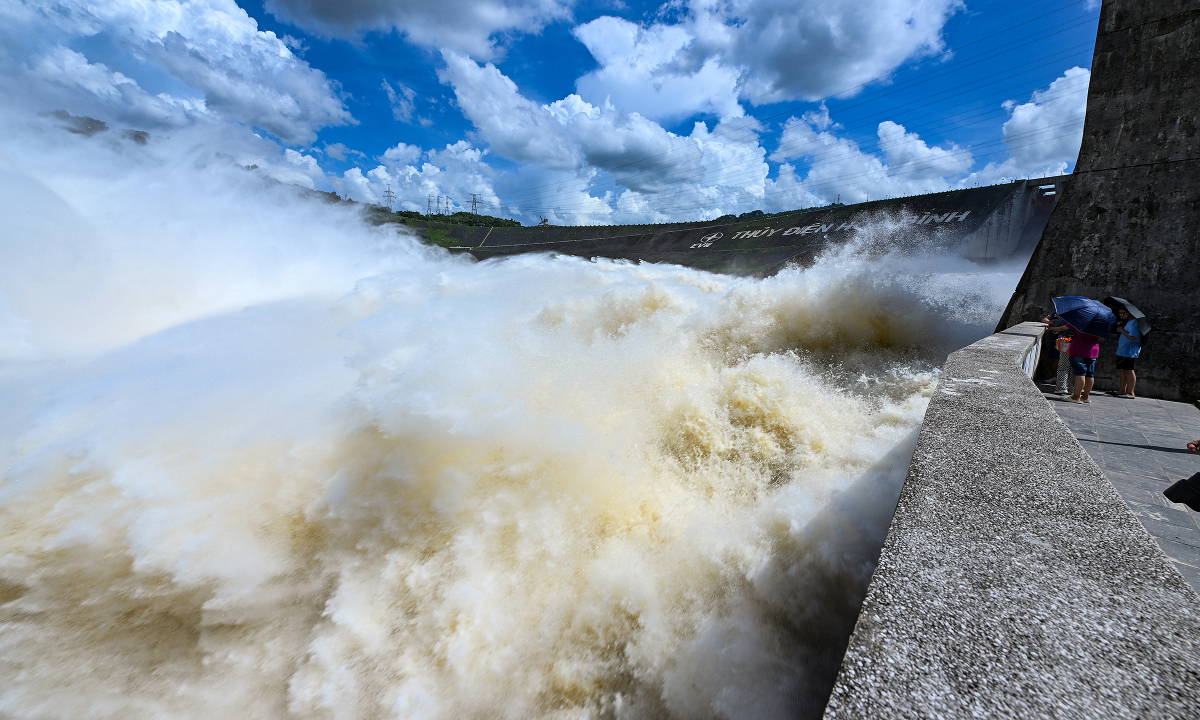
Hoa Binh hydropower plant releases floodwaters. Image: Giang Huy
First, about the prediction model that has an important influence on the results. According to Mr. Hoang Van Dai, Deputy Director of the National Center for Hydro-Meteorological Forecasting, hydrological forecasts depend greatly on rain forecasts, the most important input factor of the models. However, global and regional quantitative rain forecast models still have high uncertainty, especially during heavy rains.
There are situations where models give very different, even contradictory, results regarding rainfall. In reality, the model can correctly identify areas with rain but has significant errors in rainfall, leading to errors in flow and flood peak calculations. In particular, with local rain and rain during thunderstorms, which often cause rapid flooding – the ability to accurately predict is still limited.
Second, input data and reservoir operations are also major bottlenecks. Mr. Nguyen Thuong Hien, Director of the Department of Meteorology and Hydrology, said that currently data between agencies is not really synchronized. Despite the same system, the data provided to units may not be consistent, leading to different forecast results.
Notably, reservoir operation information is often only provided a few hours before flood discharge, leaving forecasting agencies in a passive position. “There are cases where we almost have to receive flood discharge information and update forecasts in a very short time,” Mr. Hien said.
He also expressed concerns about the ability to verify data and transparency in information sharing. According to him, if operational data and flood discharge timing cannot be controlled, it is difficult for forecasts to accurately reflect reality.
From a technical perspective, Mr. Hoang Van Dai added that the monitoring system still lacks real-time data in many basins, especially upstream. Meanwhile, reservoir operating data, an increasingly dominant factor in flow, has not been fully integrated into the forecast model.
According to Associate Professor Dr. Trinh Quang Toan, Vietnam Institute of Irrigation Sciences, a root cause is that current river basins have changed significantly due to the appearance of reservoirs, hydropower and land use changes. These factors cause the flow to no longer follow natural laws as before, while forecast models have not fully integrated real-time reservoir operating scenarios.
Floods from upstream caused the ancient town of Hoi An (Da Nang City) to flood in November 2025. Image: Van Dong
It is necessary to build an integrated forecasting system
Faced with this reality, experts believe that hydrological forecasting needs to change its approach, from providing information to supporting decision-making, especially in reservoir operations to reduce floods downstream and ensure construction safety.
According to Mr. Nguyen Thuong Hien, it is necessary to improve the data system towards continuous updates, reduce latency and increase sharing capabilities between agencies. He also emphasized that the concept of “real-time forecast” needs to be understood properly, because the flood formation process depends on many factors such as soil moisture, land cover and water storage capacity.
From an application perspective, weather expert Nguyen Ngoc Huy believes that one of the current weaknesses is that the gap between research and practice is still large, many technologies exist but have not been widely deployed. He cited that if increased investment in natural disaster monitoring, forecasting and warning could help reduce 30-40% of damage in major risk scenarios.
Mr. Huy proposed building an integrated forecasting system, connecting data from radar, satellites and ground measuring stations in real time with meteorological and hydrological models. At the same time, artificial intelligence is applied to correct errors and identify flow trends, contributing to improving forecast accuracy.
Expert Nguyen Ngoc Huy spoke at the conference. Image: Gia Chinh
He also suggested shifting strongly to impact warnings, which means not just stopping at rain or water level information, but must specifically point out which areas and times are at risk of flooding and what the impact will be so that people can act early. The meteorological agency needs to shorten the flood forecast update cycle, from 3-6 hours to one hour in emergency situations, and take advantage of communication channels such as social networks to convey information faster to people.
According to Mr. Huy, the current forecast newsletter is still heavily technical and difficult to reach the community. Therefore, converting to simple, easy-to-understand language associated with specific actions will help improve the effectiveness of warnings.
In addition, he also emphasized the need for inter-sectoral and inter-agency coordination in forecasting and operations, instead of each unit focusing on only one part of the problem. “Natural disasters are an integrated system, which cannot be solved by single studies,” he said.
https://www.sutori.com/en/user/relx-nikotinru-ri?tab=profile
https://skiomusic.com/relxecigarette
https://www.branchriverair.com/profile/tifixi91633306/profile
https://nl.pinterest.com/relxecigarette/_profile/
https://willysforsale.com/author/relxecigarette/
https://www.zazzle.com/mbr/238000406008909687
https://comicvine.gamespot.com/profile/relxecigarette/
https://letterboxd.com/relxecigarette/
https://mez.ink/relxecigarette
https://www.triptipedia.com/user/relxecigarette
https://sites.google.com/view/japan-relx-discover-premium-v/home
https://diigo.com/0124wa9
https://penzu.com/p/298b9cc059ac5af6
https://zaaini123.blogspot.com/2026/03/japan-relx-experience-innovation-in.html
https://www.pearltrees.com/ansari74/item786111122
https://ansari77.bloggersdelight.dk/2026/03/17/japan-relx-elevate-your-vaping-lifestyle/
https://app.box.com/s/xpxn9b8btymdsf2gyth4547l440lvlrc
https://padlet.com/zainiansari131/my-fierce-padlet-lgoncrmlzv1yt8vm/wish/mDRxWBqXB2GLZjb1
https://www.liveinternet.ru/users/muhammadzaid2/post514722137/
https://demo.jcow.net/blogs/viewstory/109440
https://uberant.com/article/2158464-japan-relx-explore-high-quality-vape-option/
https://quicknote.io/fa8f1260-21df-11f1-abfb-67f183722efa/live
https://articlescad.com/japan-relx-enjoy-a-clean-and-smooth-vape-47591.html
https://notebook.zohopublic.com/public/notes/3kk3b421c3b640ea64bbc9d0c08a784f04339
https://logcla.com/blogs/1332460/Japan-Relx-Discover-the-Art-of-Vaping