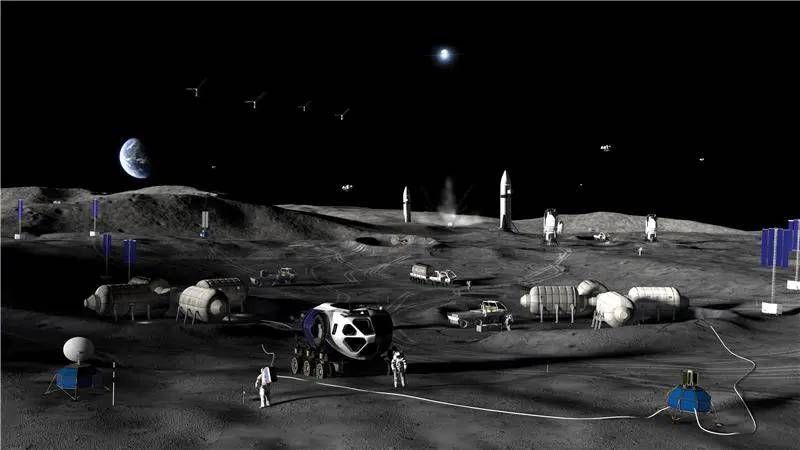
The change in leadership at NASA brings with it a radical revision of plans for satellite exploration. Jared Isaacman, the billionaire entrepreneur chosen by the White House to lead the agency, has announced the allocation of around 20 billion dollars for the construction of a fixed lunar base. This decision entails the immediate suspension of the Gateway project in its current form: the orbiting station that was supposed to act as a bridge to outlets on the surface is put aside in favor of direct infrastructure on the ground. The new course aims to convert the technologies already developed to accelerate the time spent on the satellite, shifting the focus from orbital flight systems to the surface logistics necessary for a long-lasting presence.
The roadmap outlined by Isaacman envisages development in three distinct phases, articulated through dozens of missions over the next seven years. Initially, efforts will focus on establishing communications and navigation networks, supported by sending robotic landers for mapping and moving cargo. Subsequently, the operational phase will see the systematic return of astronauts to the surface, until the consolidation of a long-lasting human settlement. Despite the known environmental criticalities, from cosmic radiation to extreme temperature variations to the absence of gravity which alters human physiology, the investment aims to create an outpost capable of supporting life and research activities in the long term.
The urgency expressed by Isaacman does not only respond to scientific needs, but is part of a context of geopolitical competition with China. Beijing has already set the deadline for putting its men on the Moon at 2030, a deadline that has pushed Washington to remodulate its priorities so as not to lose its technological lead. According to the administrator, success in this challenge will be measured on the ability to react quickly, overcoming the delays that have recently affected the Artemis program, whose moon landing was postponed to 2028. The rhetoric of American exceptionalism thus returns to the center of space strategy, with the Moon seen as the first outpost necessary for the subsequent projection into the unknown.
In addition to the lunar dossier, NASA is already looking towards Mars with the launch of the Space Reactor-1 Freedom. It is the first nuclear-powered interplanetary spacecraft, designed to reach the red planet by the end of 2028. Once it arrives at its destination, the carrier will release a fleet of advanced helicopter drones, based on the design of its predecessor Ingenuity which operated on Mars in 2021. The integration of nuclear technology represents the qualitative leap needed to reduce travel times and guarantee sufficient energy for complex operations far from Earth, marking the beginning of a new era of interplanetary exploration.
https://www.manuelsanssegarra.com/
https://kybernes.it/
https://www.lesmotardsontducoeur.com/
https://www.stepsbackthrutime.ie/
https://labrador-dalmatian.gr/kunst-der-spielgestaltung-wie-grafiken-und-klange-wirken/
https://gemacondadoripoll.es/die-verantwortung-von-stargames-live-dealer-emotionen-hautnah/
https://www.vacanzescalve.it/2026/03/23/so-funktioniert-verantwortungsvolles-spielen-sei-intelligent/
https://academie-aparte.com/die-vorzuge-des-vip-programms-bei-stargames-entdecken/
https://darc-productions.com/erbeite-dir-boni-und-loyalitatsvorteile-clever-investiert/
https://www.zeilenfluss.com/slots-und-tischspiele-bei-stargames-%e2%80%92-spielspass-ohne-ende/
https://cgps.cz/2026/03/23/strategisches-spielen-skill-und-taktik-vereint/
https://www.mwm-medien.de/stargames-und-die-wichtigkeit-von-vertrauen-bei-spielern/
https://ambassadair.net/zahlungssicherheit-im-online-casino-sehe-dich-abgesichert/
https://global-luxury-properties.com/die-mobile-gaming-revolution-bei-stargames-erleben/
https://abogadoherenciasalamanca.com/
https://abogadoherenciavalencia.com/
https://incoindustry.ro/
https://www.ahernbros.ie/
https://www.drheatingplumbing.com/
https://gigericeira.com/
https://lovilave.com.ua/access/blago-credit