The world has experienced two oil crises in less than 10 years, shaking the global economy.
The war between the US, Israel and Iran is pushing the global energy market into a state of unprecedented tension, when the Strait of Hormuz shipping route, through which nearly 20% of the world’s oil and gas supply passes, is paralyzed. Energy prices skyrocketed, major economies began to face inflationary pressure and declining growth.
The current context is reminiscent of the two oil shocks of 1973 and 1979, when the geopolitical conflict in the Middle East quickly turned into an energy crisis, leading to a global economic recession and changing the order of power in the oil market for decades afterward.
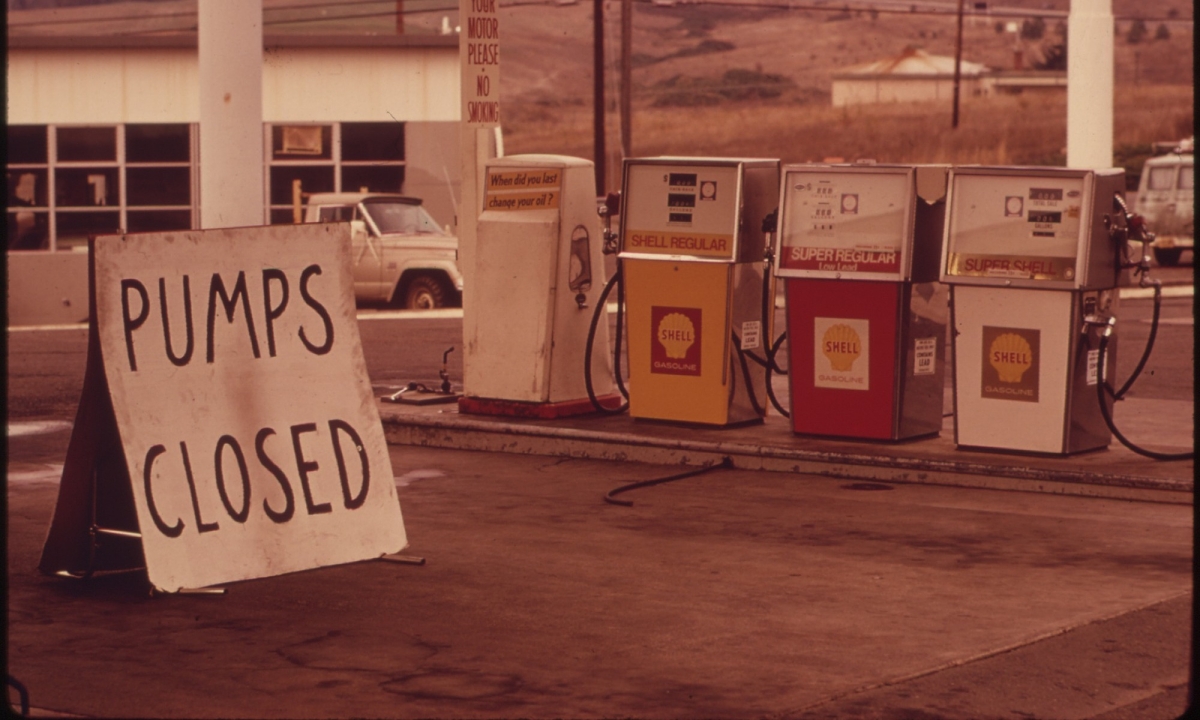
“Out of gas” sign at a gas station in Lincoln City, Oregon in the fall of 1973. Photo: Wikimedia Commons
In 1948, Britain ended its mandate over the Palestinian territories, leading to the birth of the State of Israel. However, most Arab countries in the region refused to recognize Israel, leading to small conflicts that turned into wars in the following decades.
In early October 1973, the Yom Kippur War broke out when Egypt and Syria attacked Israel on the Jewish holy day of Yom Kippur. After the Soviet Union began providing weapons to Egypt and Syria, US President Richard Nixon also provided military supplies to Israel. In response, the Organization of Arab Petroleum Exporting Countries (OAPEC) reduced production and imposed an embargo on oil shipments to the US and the Netherlands, two main supporters of Israel.
The Yom Kippur War ended in late October of the same year, but OAPEC still maintained embargoes and production restrictions, leading to a global energy crisis.
The US once assumed that the Gulf countries would “beat their backs” when imposing an embargo, but reality shows that Washington was wrong, because rising oil prices compensated for reduced output. In the three months after the embargo was announced, oil prices increased from $3 to $12 per barrel. Americans, from enjoying abundant supply and growing demand, are facing fuel shortages, leading to long lines at gas stations.
US officials immediately implemented energy saving measures, such as requiring gas stations to close on Sundays. The crisis also hit the US auto industry hard, causing the country to be surpassed by Japan with more compact and fuel-efficient car models.
In Europe, rising oil prices have led to an energy crisis even more serious than in the United States. Most industrialized countries are heavily dependent on imported oil. Even the United States, though less vulnerable than Western Europe, imports up to 35% of its energy needs. Meanwhile, OPEC accounts for half of the world’s oil exports.
Countries such as the UK, Germany, Switzerland, Norway and Denmark impose restrictions on driving, sailing and flying. The British Prime Minister even urged people to only heat one room in the house in winter.
The embargo was lifted in March 1974, but oil prices remained high, causing consequences from the energy crisis to last for many years.
In the US, the crisis prompted subsequent presidents to make energy security one of their top priorities. The US has boosted domestic oil production while reducing its dependence on fossil fuels and seeking alternative energy sources, such as renewable energy and nuclear power.
During the 1970s, many laws were enacted to change the way America used energy, from the Emergency Oil Distribution Act of 1973 to the creation of the Department of Energy in 1977. One notable measure was the establishment of the Strategic Oil Reserve in 1975, which currently has a capacity of 714 million barrels.
Other Western economies also gradually adapted to high oil prices and inflationary pressures, beginning to relax the extreme adjustment policies they implemented immediately after the 1973 oil crisis. However, this confidence disappeared when the next crisis broke out in the Middle East.
In January 1979, Iranian King Mohammad Reza Pahlavi was overthrown in the Islamic Revolution, leading to protests, disrupting the oil industry, causing the global market to lose 3-4 million barrels a day of supply. When the new government in Iran resumed oil exports, Tehran’s output was unstable and lower than before, causing oil prices to increase.
Saudi Arabia and other OPEC countries have increased production to offset this decline, but total output is still down about 4%. However, widespread panic has pushed oil prices much higher than would have been expected under normal conditions.
In September 1980, Iraqi leader Saddam Hussein launched a war with Iran, taking advantage of the time when the neighboring country was still unstable, leading to an 8-year war, the oil production activities of both Baghdad and Tehran were seriously cut. The world lost an additional supply of about 3 million barrels a day from Iraq.
Oil prices skyrocketed, from 16 USD per barrel in January 1980 to 36 USD per barrel at the end of September of the same year. This increase of 20 USD per barrel seriously impacts the global economy. Western oil-importing countries quickly adopted strict monetary policies to cope with new inflationary pressures, leading to the world economic recession of 1980-1982.
The economies of many countries have plummeted, the unemployment rate in many industrial countries has skyrocketed to double-digit levels, the highest since World War II. In the US, this rate exceeded 10% in 1982, while in the UK and European countries, prolonged stagnation caused millions of people to lose their jobs.
Oil prices began to cool down as other countries increased production to make up for this shortfall. Oil prices continued to decline steadily over the next 20 years, except for a brief increase during the Gulf War. Compared to 1980, oil prices in the 1990s decreased by about 60%.
“One lesson learned from the 1970s is that everyone must have emergency reserves in case of a crisis like this one,” said Pavel Molchanov, an analyst at Raymond James.
“Cease to operate” sign at a gas station in Oregon in the fall of 1973. Photo: Wikimedia Commons
Executive Director of the International Energy Agency (IEA) Fatih Birol warned on March 23 that the crisis the world is facing is even more serious than that.
On March 11, the IEA said that 32 members of the organization had agreed to pump a total of 400 million barrels of oil from reserves to the crude oil market, equivalent to 1/3 of the total oil in their reserves to cool the energy market. This is the IEA’s largest warehouse release, more than twice the number of 182 million barrels when the war in Ukraine broke out in February 2022.
Observers warn that pumping oil reserves into the market is only a short-term measure and that even when the Strait of Hormuz reopens, oil prices may still be anchored at high levels.
“Will Hormuz reopen and how long will it be open?”, commented Phillip Braun, professor of finance at Northwestern University. “There is too much uncertainty about the next developments. Even when the Strait returns to normal, oil prices are still expected to increase in the short term.”
https://www.leconomistemaghrebin.com/2020/04/13/covid-19-projet-transformation-train-hopital-mobile
https://www.leconomistemaghrebin.com/2020/05/14/covid-19-fragilise-secteur-l-artisanat-tunisie
https://www.leconomistemaghrebin.com/2020/08/04/hassouna-nasfi-le-pays-a-besoin-dune-treve-politique
https://www.leconomistemaghrebin.com/2020/07/19/la-stb-mobilise-300-md-au-profit-des-entreprises-impactees-par-la-crise-de-covid-19
https://www.leconomistemaghrebin.com/2020/05/27/djerba-bacs-les-dessertes-reprendront-partiellement
https://www.leconomistemaghrebin.com/2020/12/20/tozeur-les-affrontements-entre-les-protestataires-et-les-forces-de-securite-mettent-a-mal-le-secteur-touristique-a-quelques-jours-des-vacances
https://www.leconomistemaghrebin.com/2020/05/08/fonds-sante-pour-tous-10-projets-retenus-aujourdhui
https://www.leconomistemaghrebin.com/2020/12/23/covid-19-1605-nouvelles-contaminations-et-38-nouveaux-deces-recenses
https://www.leconomistemaghrebin.com/2020/12/13/hichem-mechichi-promet-dasseoir-un-cadre-institutionnel-rassemblant-les-tre
https://www.leconomistemaghrebin.com/2021/02/13/covid-19-32-deces-supplementaires-977-nouvelles-contaminations-24-heures
https://www.leconomistemaghrebin.com/2020/09/07/covid19-le-bilan-salourdit-avec-265-nouvelles-contaminations
https://www.leconomistemaghrebin.com/2020/08/27/gabes-covid-19-prolongation-couvre-feu-a-el-hamma-el-hamma-ouest
https://www.leconomistemaghrebin.com/2020/08/19/covid-19-deces-de-deux-personnes-a-el-hamma
https://www.leconomistemaghrebin.com/2020/05/15/patrice-bergamini-covid-19-incite-reflexion-solidarite
https://www.leconomistemaghrebin.com/2020/05/11/zouhair-maghzaoui-reproche-a-ennahdha-ses-agissements
https://www.leconomistemaghrebin.com/2021/02/06/tunisie-covid-19-depasse-7000-deces
https://www.leconomistemaghrebin.com/2021/01/08/2-eme-3eme-vague-4-eme-vague-de-covid-19-ou-en-sommes-nous
https://www.leconomistemaghrebin.com/2020/06/02/transtu-reprise-dessertes-itineraires-traversant-place-bardo
https://www.leconomistemaghrebin.com/2020/04/02/covid-19-report-rentree-scolaire-jusqua-nouvel-ordre
https://www.leconomistemaghrebin.com/2020/05/12/covid-19-secteur-promotion-immobiliere-bout-tunnel
https://www.leconomistemaghrebin.com/2020/05/08/oit-travailleurs-informels-mourir-de-faim-ou-du-virus
https://www.leconomistemaghrebin.com/2020/08/29/gouvernement-mechichi-jusqu-ou-peut-il-aller-2
https://www.leconomistemaghrebin.com/2020/06/03/covid-19-nouveau-cas-importe-nouveau-deces
https://www.leconomistemaghrebin.com/2020/08/31/coronavirus-tunisie-113-nouvelles-contaminations
https://www.leconomistemaghrebin.com/2020/11/02/covid-19-medenine-le-bilan-des-deces-porte-a-26