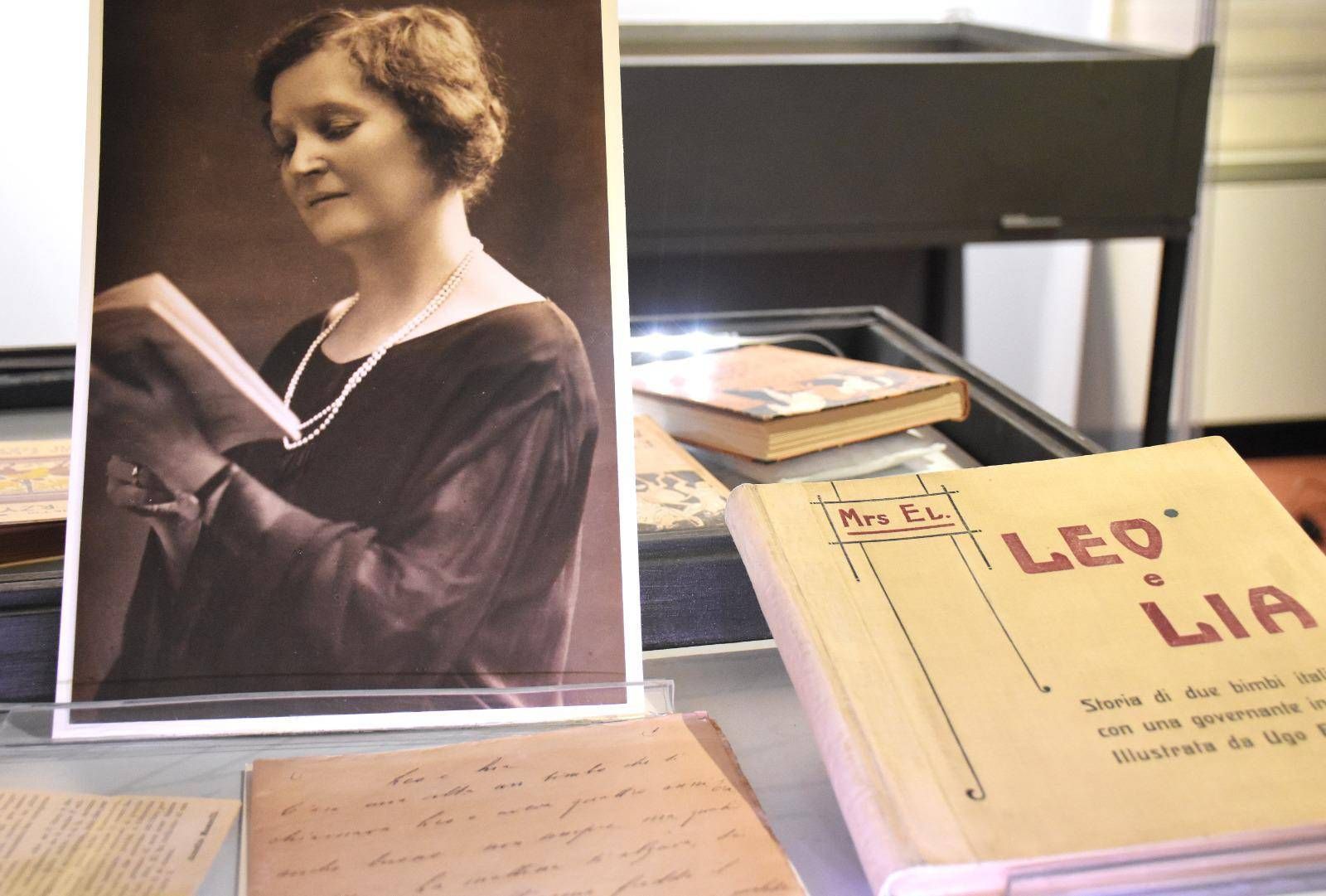
It will be like entering a birthday party: the birthday girl in the centre, surrounded by friends and associates who have shared the love of literature with her, in particular that dedicated to younger people. To celebrate the one hundred and fifty years since the birth of Laura Orvieto (Milan, 7 March 1876 – Florence, 9 May 1953), writer of some key texts of children’s literature and to underline the centrality of a literary production too often relegated to a ‘subcategory’, the Gabinetto Vieusseux of Florence presents, at the “Alessandro Bonsanti” Contemporary Archive, the exhibition “Telling the world. Women, literature and childhood at the Vieusseux. Laura Orvieto, women and children’s literature”: complex authors who mark an era with their works rich in magic, illustrations and colours, but by no means lesser sisters of those intended for adults.
“This exhibition – say Riccardo Nencini and Michele Rossi, president and director of Vieussuex – was born on the occasion of the 150th birthday of Laura Orvieto, key figure of the Literary Scientific Cabinet, not only due to the presence of the vast Orvieto family collection in our contemporary archive, where three rooms of the apartment in which Adolfo Orvieto’s library was kept are reconstructed, but also due to the establishment way back in 1953, the year of death of the writer, of the most important Prize for children’s literature, whose name it now bears, which is celebrated every two years here at the Gabinetto Vieusseux as testimony to the keen interest of our Institution towards the youngest and adults who forget the wonder”.
“It all focuses on the word ‘telling’ which becomes synonymous with ‘knowing’. Stories are not mere entertainment, but a living instrument that teaches life with its joys and its dangers, but also Evil in its most varied aspects, and which guides towards listening and viewing the World”, states the curator of the exhibition Elisa Martini. “It is, in fact, no coincidence that these texts – continues the second curator, Benedetta Gallerini – are dotted by beautiful illustrations, such as those by Ezio Anichini who illustrated almost all of Laura Orvieto’s books or those by Duilio Cambellotti or Aleardo Terzi for Térésah’s books. This exhibition is a unique opportunity to discover and re-discover the fantastic and marvelous of this forgotten literature”.
The exhibition, open to the public from today, March 26, to July 24, places at the center the figure of Laura Orvieto, author of famous books such as Storie della storia del mondo and Leo e Lia, alongside which the names of writers re-emerge who, with their stories and tales, have ‘made Italians’. The intention is to enhance a submerged universe that enters the Institute’s heritage already with the publication, as early as 1836, by Giovan Pietro Vieusseux of the “Educator’s Guide” and with the Books for children column created by Eugenio Vieusseux in the 1870s.
Divided into sections, “Telling the world. Women, literature and childhood at the Vieusseux” presents a chronologically backwards structure. Climbing the staircase of Palazzo Corsini Suarez, home of the Bonsanti archive, you can come across the first display case (The Legacy) dedicated to the «Laura Orvieto Children’s Literature Award», created the day after the writer’s death in 1953, and another small piece, called Towards the Future, in which the writer reviews the newly released book by Bambi and captures its filmic value.
We therefore arrive at the heart of the exhibition, conceived by the curators, and consequently set up, as a traditional bourgeois birthday party of the early twentieth century. In the central cases appears Laura, the “celebrated”, with the first editions of her books and her precious manuscript papers; around, the “guests”. In the Ancestors display case, in addition to the «Educator’s Guide» and the Books for Children column, the works of Rudyard Kipling, Louisa May Alcott, Ida Baccini, Emma Perodi, Carlo Lorenzini, who, a generation before Laura’s, opened the trend of children’s literature and, like Orvieto, had in turn been enrolled in the Gabinetto Vieusseux. Together with them, Rosa Errera, writer and Laura’s teacher. In the windows of Le Amiche Fiorentine and Le Amiche Distante, space is given to Laura’s contemporary writers and illustrators: Amelia Pincherle Rosselli, Maria Bianca Viviani della Robbia, Bona Gigliucci, Lina Schwarz, Sonia Naldi de Figner, Paola and Gina Lombroso, Teresa Corinna Ubertis (aka Térésah), Augusta Rasponi del Sale (Gugù), linked to the Orvieto family, but also to the Archive, which preserves the papers. The last spaces are reserved for children’s magazines and above all for Orvieto’s activity as director of the «Settimana dei Ragazzi», founded at the beginning of 1945 and which ceased publication in 1947. There are many sketches, which bear the signatures – among others – of well-known artists such as Fiorenzo Faorzi, Piero Bernardini, Giancarlo Bartolini Salimbeni and Vinicio Berti.
https://allanarey151.com/questions/
https://allanarey151.com/reach-out/
https://allanarey151.com/videos/
https://bestblondiiecb.com
https://bestblondiiecb.com/about/
https://bestblondiiecb.com/dmca/
https://bestblondiiecb.com/faq/
https://bestblondiiecb.com/get-in-touch/
https://bestblondiiecb.com/photos/
https://bestblondiiecb.com/privacy-notice/
https://bestblondiiecb.com/videos/
https://cuteelsa.com
https://cuteelsa.com/contact-us/
https://cuteelsa.com/dmca/
https://cuteelsa.com/faq/
https://cuteelsa.com/gallery/
https://cuteelsa.com/privacy/
https://cuteelsa.com/profile/
https://cuteelsa.com/recordings/
https://emmaflin.com
https://emmaflin.com/gallery/
https://emmaflin.com/media/
https://emmaflin.com/privacy-notice/
https://emmaflin.com/profile/
https://emmaflin.com/questions/