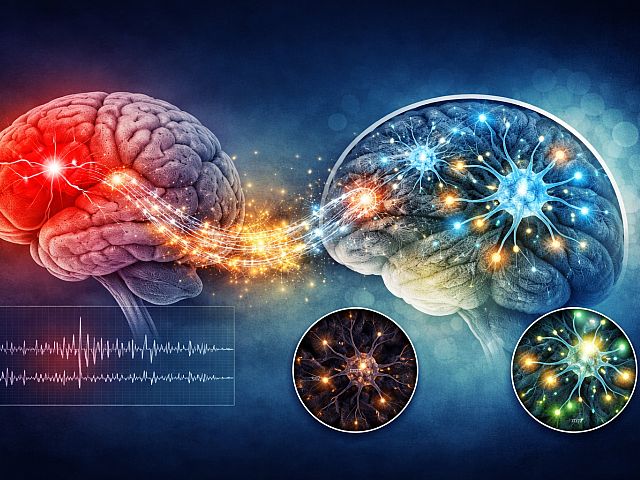
In a study published in The Lancet Digital Health, scientists from the University of Southern California found that the brains of people with severe strokes are able to rewire themselves in unusual ways. As the brain adapts to damage, unaffected areas may develop signs characteristic of a “younger” brain structure.
The work was carried out as part of the international project ENIGMA Consortium, which studies recovery after stroke. The study analyzed MRI images of more than 500 patients from 34 research centers in eight countries. Using deep learning models trained on tens of thousands of images, scientists assessed the “age” of different parts of the brain in both hemispheres to understand how stroke affects its structure and recovery processes. The results showed that larger damage accelerated the aging of the affected hemisphere. However, the opposite, undamaged side of the brain may appear “younger.” This indicates that the brain is able to compensate for lost functions by rebuilding and, as it were, “rejuvenating” intact neural networks.
The researchers used an advanced artificial intelligence technique—graph convolutional networks—to estimate the biological age of 18 different brain regions from MRI data. They compared this “brain age” with the person’s actual age: the resulting difference (brain-PAD) became an accurate indicator of the state of the nervous system. By comparing these data with indicators of physical activity, scientists discovered an interesting trend. In patients with severe motor impairments after a stroke, even after more than six months of rehabilitation, a “younger” age was observed in the areas of the brain opposite the damage zone. This was especially evident in the frontoparietal network, a system responsible for movement planning, attention and coordination.
According to the researchers, this may mean that when motor function is severely damaged, healthy areas of the brain on the other side begin to rewire themselves to try to compensate for the loss. This “rejuvenating” restructuring probably does not reflect complete recovery, but an adaptive mechanism that comes into play when the affected areas can no longer function as before. This approach provides new insights into neuroplasticity, revealing changes that are difficult to detect using traditional imaging techniques.
https://doc.cisti.org/s/H36imcyHA
https://www.hotfrog.com/company/898f6b2a364a2ef2ecf2b5cf3b90f9fd
https://kuula.co/profile/webdesigngeelongau
http://portal.merit.mn/es/user/surfcampgijon
https://codimd.caa-ins.org/s/S10sejP5Wx
https://pad.investigativedata.org/s/tu1FhivXu
https://pad.hackerspace.gent/s/1tAtZVx40
https://hedgedoc.nrp-nautilus.io/s/Pd0xrqMER_
https://itxoft.com/increase-domain-rating-5234/
https://topsitenet.com/profile/webdesignsheppartonau3/1558653/
https://www.penana.com/user/335285/trevongdcabrera
https://raindrop.io/deerfrost26/oneilldrejer2211-68155975
https://wefunder.com/rankonaicomau/about
https://www.tumblr.com/wealth-planning-by-bob-chitratho
https://www.renderosity.com/users/id:1837056
https://pad.grossweber.com/s/NpNzQjCWg0
https://pad.libreon.fr/s/c0tFWgXhX
https://agridata.mascosolutions.com/user/soportesaptecnico
http://www.place123.net/place/dallas-all-on-4-dental-implant-center-irving-united-states
https://hzdlpq.com/b00d004a207aff61be66e2bc0f3839f9/
https://docs.stephtransition.fr/s/GlidAlJNP
https://hedge.grin.hu/s/NZ2G0SvL-
https://support.mozilla.org/en-US/user/seoipswichcomau/
https://md.kif.rocks/s/OLRHIzKyCP
https://www.doyoubuzz.com/ellal-ucas-67