China is considered to have a great advantage in the AI race thanks to its abundant, diverse and cheap energy sources.
Earlier this year, at the World Economic Forum (WEF) 2026 in Davos, Nvidia CEO Jensen Huang likened AI to a multi-layer cake. In particular, AI applications such as chatbots are at the top layer, followed by software, large language models (LLM), and below are the hardware and semiconductor chips needed to train the model.
US-China energy balance
Chinese companies are busy “making cakes”, ByteDance, Alibaba, DeepSeek are said to be preparing to introduce a strong LLM, and Huawei is also about to launch a new AI chip. According to Economistwhat these companies are doing can help China become a major counterweight to the US in the artificial intelligence race. But besides capacity, there is another important thing underlying all the factors that Mr. Huang gives, which is energy.
“The top layer cannot function without the base layer underneath,” Mr. Huang said. “We have invested hundreds of billions of dollars in energy, and will need trillions more.”
Many American companies share concerns about the prospect of energy shortages. Late last year, OpenAI CEO Sam Altman predicted AI costs “will eventually boil down to energy costs,” and warned that China’s advantage could put “America’s AI leadership at risk.” Earlier this year, xAI CEO Elon Musk also said that based on current trends, China will be far ahead of the rest of the world in AI computing capacity thanks to its power grid.
According to experts, this concern is well-founded. To make the model increasingly intelligent, AI data center systems are increasingly expanding and consuming more electricity. Some centers now reach gigawatt (GW) scale, equivalent to the capacity of a nuclear power plant. According to the US non-profit research organization RAND and Goldman Sachs, global electricity demand to operate data centers could skyrocket to 68 GW in 2027 and 327 GW in 2030, equivalent to an increase of 50% and 165% compared to demand in the same period in 2023.
Most of the leading AI companies are headquartered in the US, but this country’s power grid is considered “old” and “struggling”. Having to meet the needs of a long list of data centers can overload the system, push up electricity prices and attract protests from people. To solve this problem, some companies are building independent power plants.
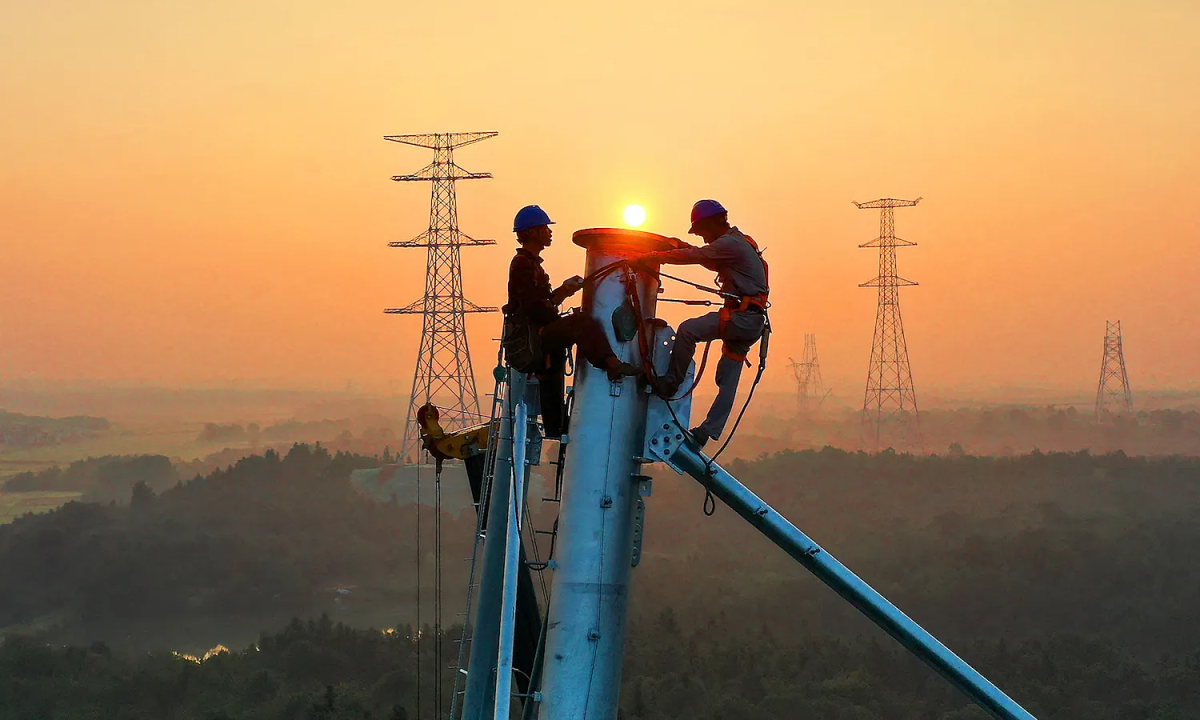
Workers work on a high-voltage transmission pole in Jiangxi province, China, September 2025. Image: Foreign Policy
China does not have similar concerns. According to Reutersthis country currently owns the largest electricity network in the world and is continuing to develop at a breakneck pace thanks to huge investments from the state. Last year alone, the country added more than 500 GW of capacity, bringing the total capacity to 3,800 GW, or twice as much as the US, and is expected to add six times more capacity than its competitors.
China’s energy boom comes from wind and solar power projects. Half of the nuclear power plants being built in the world are in China. Many coal power plant projects were also formed.
As a result, data centers here can buy electricity for about 3 cents per kilowatt hour (kWh), half the price many centers in the US pay. In addition, household electricity prices are also set separately by the government, and people do not object to electricity-consuming infrastructure.
China is mainly at a disadvantage in computing power. The country has abundant electricity sources, but is controlled by the US in terms of access to powerful semiconductor chip systems. It is difficult for them to buy advanced chips with a process of 7 nm or less to operate the latest LLM model, while domestic production capacity cannot keep up. According to Forbeslast year, it was estimated that Chinese technology companies spent $24 billion on AI infrastructure, while American businesses spent more than $350 billion.
Chinese local government data center investments are also poorly managed, with many facilities built to low standards, leading to a significant gap in computing infrastructure compared to abundant energy resources. Yanggao province in northern China clearly demonstrates this reality. It has giant data centers growing on old pig farms, benefiting from many aspects: cheap electricity from wind farms, solar panels and coal-fired power plants, as well as a cold climate that helps with cooling and a river that provides water. However, according to one manager, less than 0.1% of the chips here are capable of performing the intense calculations needed to train AI.
China is starting to take advantage
China also shows that it will soon begin to take advantage of its energy advantage. On March 5, Prime Minister Li Qiang first mentioned “super-scale computing”, meaning giant data centers, in his annual speech on the state of the country, promising to “launch new infrastructure projects, coordinate computing capacity and power supply” this year.
Meanwhile, China’s hyperscale computing service providers are also stepping up investment. Analyst Ken Liu at UBS bank predicts China will build an additional 25 GW of AI data centers by 2029, five times more than the 5 GW built in the past two years. However, this expert also noted that expanding at the above speed will depend on how many more high-end chips China can produce domestically.
After the US introduced a series of restrictions since 2019, China’s efforts to become self-sufficient in semiconductor production have been stepped up and are bringing results. Huawei’s self-produced 7 nm AI chip is not comparable to American products, but helps narrow the performance gap through pairing multiple chips together. This process consumes energy, but this is not a major barrier thanks to cheap electricity prices.
Chipmaker SMIC, which currently processes for companies like Huawei, plans to double its capacity this year. In early March, Reuters reported that Hua Hong, another Chinese chip factory, also started manufacturing 7nm chips.
Chinese authorities also encourage the construction of data centers in western provinces, where there are many wind, solar and hydropower sources, combined with low average temperatures. By 2028, Beijing hopes to connect all these data centers into a network, providing cheap computing resources nationwide.
Expert Lin Boqiang of the China Energy Policy Research Institute at Xiamen University assessed that the above efforts are expected to help China compensate for its chip weakness. “All we need to do is keep building,” Boqiang told Economist.
Currently, the country is trying to bring AI tools into the economy and people’s lives, as well as apply AI to the physical world through self-driving car systems, humanoid robots, and smart factories. Abundant energy sources make it cheaper to operate AI models, thereby accelerating practical application.
For big companies in the US, the energy gap is considered worrying as they continue to place ambitions on AGI super intelligence, which consumes more electricity than today’s most advanced artificial intelligence systems. Some experts believe that with abundant energy resources, China has the ability to reach the AGI “realm” the fastest. The answer remains open, but in October 2025, Alibaba became the first major Chinese company to announce its pursuit of AGI. In early March, the country also announced a five-year plan (2026-2030), which called for “exploring development paths for AGI”.
https://www.tumblr.com/maxx345/811636782140702720/scopri-i-vantaggi-del-gioco-online-sicuro
https://www.ewebdiscussion.com/threads/scommesse-online-guida-per-scegliere-piattaforme-affidabili.379017/
https://groups.diigo.com/group/TechNews/content/scommesse-online-come-evitare-brutte-sorprese-20818171
https://www.fusioncash.net/forum.php?topic=99858.0
https://www.mafiascum.net/social-games/wes-anderson/index.php?topic=13993.0
https://forums.maxperformanceinc.com/forums/member.php?u=242854
https://www.thesims3.com/myBlog.html?persona=Annaa342
https://www.hostboard.com/forums/showthread.php?t=1230463
https://www.keepandshare.com/discuss4/37860/strategie-vincenti-per-il-gioco-responsabile
https://b.cari.com.my/home.php?mod=space&uid=2567658&do=blog&id=603869
https://mb.boardhost.com/medialens/msg/1774547841.html
https://sub4sub.net/forums/topic/il-piacere-delle-scommesse-controllate/
https://community.ops.io/aya_ch_083963bd09004c136d/come-scommettere-in-modo-intelligente-134j
http://fhw.342.s1.nabble.com/Divertirsi-con-le-scommesse-senza-rischi-td10062.html
https://www.tricflash.com/forums/topic/scommesse-online-come-divertirsi-senza-esagerare/
https://resinobsession.com/forums/topic/giocare-online-senza-perdere-il-controllo/
https://intua.net/forums/index.php?p=/discussion/14642
https://www.soundjack.eu/forums/topic/divertirsi-online-senza-esagerare/
http://forum.amzgame.com/thread/detail?id=601791
https://passionford.com/forum/groups/group-d2094-strategie-per-iniziare-a-scommettere-online-in-modo-consapevole.html
https://qjure.com/community/main-forum/strategie-intelligenti-per-migliorare-le-tue-scommesse-sportive/
https://www.harderfaster.net/?sid=a08dac55b94f2276dd30ad116cfb552e§ion=forums&action=showthread&threadid=347835
https://www.aehelp.com/forums/topic/approccio-intelligente-alle-scommesse-sportive/
https://www.jointcorners.com/forums/thread/9718/
https://www.molecularcloud.org/p/come-scegliere-una-piattaforma-di-gioco-sicura-e-affidabile