Trade overview: current reports, trends, indices, stock prices, bonds, foreign exchange and commodities and analyst recommendations
10:55
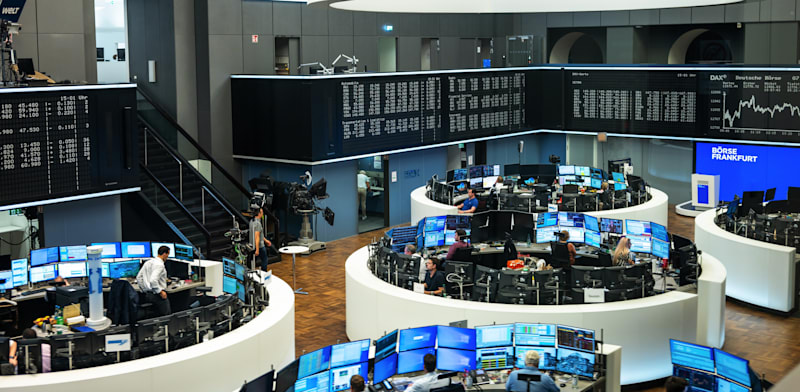
European stock markets are trading at this time with rising rates. The Frankfurt Stock Exchange jumps by about 1%, the London Stock Exchange climbs by about 0.7% and the Paris Stock Exchange adds about 0.5% to its value.
Despite today’s recovery, CNBC reports that stocks in Europe are on track to close their weakest month since 2020. The pan-European Stoxx 600 index is now on track to close with a decline of about 8.5% in March – the largest monthly decline since the Corona epidemic.
In the oil price segment, Brent crude oil is rising slightly and is trading around $113 per barrel, while American crude oil is down about 0.8% and is trading around $102 per barrel.
9:30
Asia
This morning, Asian stock markets, which are particularly sensitive to oil prices, are trading lower, although they have changed direction. The Tokyo Stock Exchange falls by about 1.2%, the Hong Kong Stock Exchange weakens by about 0.5%, the Shanghai Stock Exchange loses about 0.5% and the Seoul Stock Exchange, which has outperformed since the beginning of the year, leads the declines and falls by about 4.3%.
Wall Street futures jumped as much as 0.9% after the Wall Street Journal reported that President Trump told aides he was pushing for an end to the war, even if the Strait of Hormuz remained closed.
Wall Street
On Wall Street, trading closed yesterday in a mixed trend. The Nasdaq index fell by about 0.7%, led by chip stocks; the S&P 500 index weakened by about 0.4%; and the Dow Jones Industrial Average added about 0.1% to its value. At the same time, oil prices continued to climb and the fear index (VIX) traded at over 30 points – a record of about a year.
The trade was conducted against the backdrop of President Trump’s announcement that “the US is in serious talks with a new, more reasonable regime to end its ground operations in Iran.” However, he also noted that if they do not reach a deal soon, which includes the immediate opening of the Straits of Hormuz, the US will “sum up its wonderful stay in Iran by blowing up and completely destroying all their power plants, oil fields And the island of Kharg (and maybe all the desalination facilities too!)”.
At the same time, Fed Chairman Jerome Powell stated yesterday in a conversation held at Harvard University that the central bank should not respond by raising interest rates to the upheaval in energy prices. He noted that despite the current increase in energy prices, “inflation expectations seem to be firmly anchored beyond the short term.” Following his words, trading in Fed interest rate futures reflected a decrease in the probability of an interest rate increase this year from 50% to 5.5%. The ten-year government bond yield decreased by approximately 9 basis points to a level of 4.34%, while the two-year yield decreased by approximately 9 basis points to a level of 3.82%.
Looking at the industry indices of the S&P 500 yesterday, the increases were led by the financial index, with an increase of about 1.1%. Increases were also recorded in defensive sectors such as infrastructure (0.7%), basic consumer goods (0.6%), raw materials (0.4%) and health (0.4%). On the other hand, the technology sector weakened by about 1.5%. Among the stocks that stood out in yesterday’s declines in the technology sector, you can find major names in the fields of chips and AI, among them Micron , Nvidia , AMD , Broadcom , Palantir and many more.
Micron’s stock stood out especially negatively with a drop of about 10%, and it completes a drop of about 30% since the strong reports it published earlier this month. The decrease comes, among other things, against the background of TurboQuant, a new development of Alphabetical (Google) which she says could reduce the amount of memory needed to run large AI models by six times. This, in addition to the general concerns in the AI market around capital expenditure and the development of a possible bubble. The stock also produced a very impressive return of about 260% in the last 12 months.
CNBC reported that the VanEck Semiconductor ETF, which tracks chip stocks, is on track to close its weakest month since December 2022, when it fell a total of about 10.9%. Yesterday it fell by about 3.1% and completed a monthly decline of about 10.8%.
The investor and billionaire Bill Ackman wrote yesterday in a post he published on the X network that the current disruption in the markets has created one of the best entry points for investing in quality companies. Ackman wrote that “some of the highest quality businesses in the world are trading at extremely cheap prices. This is one of the best opportunities in a long time to buy quality. Ignore the bears.”
Ackman specifically marked American mortgage giants like Freddie Mac and Fannie Mae as “totally cheap” (originally: Stupidly cheap). Following his tweet, the shares of these two companies, which trade on the over-the-counter (OTC) market, soared by about 47% and about 51%, respectively. Ekman added that “this is one of the most one-sided wars in history, which will end well for the United States and the world. And we have the potential for a big peace dividend.”
David Wagner, head of equities at Aptus Capital Advisors, who spoke to CNBC yesterday, also took a rather bullish approach. Wagner said he was “not too worried”, and that a sudden jump “could undermine investor confidence and fuel inflation fears, but the shock usually fades as the economy and markets adjust”. Wagner noted that “fundamentals remain very strong, and said that annual earnings growth among S&P 500 companies is significantly above its historical average. “People are trying to turn this into concerns about growth, which is not the case.”
The commodity and currency markets
In the foreign exchange market, the shekel weakened against the dollar and the representative rate was set at 3.17 – a record of about two months, which was mainly influenced by the strengthening trend of the dollar in the world, which traded around an 11-month high. This morning, the shekel strengthened slightly against the dollar and its continuous rate stands at 3.16 shekels.
One of the reasons for the strengthening of the American currency is oil prices, which continue to break records. Brent crude is now on track for its biggest monthly jump ever, while it is currently trading at $114 a barrel. Overall, Brent crude has soared about 55% this month, with its previous monthly high set in September 1990, during the first Gulf War.
American crude oil closed yesterday, for the first time since July 2022, at a price above $100 per barrel (about $104). US crude surged over the past month by about 53% in March and is on track for its strongest month since May 2020.
This morning, as mentioned, following the report on Wall Street that President Trump is aiming to end the war with Iran, the increases recorded earlier this morning were mostly erased, so that now, Brent oil is trading around $113 per barrel and American oil is trading around $102 per barrel.
In the commodity market, gold is also recovering a little this morning following the report and is trading up over 1%, at a price of about $4,560 per ounce. However, it is still more than 20% away from its last peak recorded in January, when it was close to $5,600 per ounce. The price of gold fell by over 13% this month, and thus it is on its way to its sharpest monthly decline since October 2008. The main reasons for the decline lie in the strengthening trend of the dollar and the fading of expectations for interest rate cuts this year in the US, since gold is a non-yielding asset.
For your attention: The Globes system strives for a diverse, relevant and respectful discourse in accordance with the code of ethics that appears in the trust report according to which we operate. Expressions of violence, racism, incitement or any other inappropriate discourse are filtered out automatically and will not be published on the site.
https://hedgedoc.nixc.us/s/YIBfa335K
https://community.fabric.microsoft.com/t5/user/viewprofilepage/user-id/1564496
https://buyandsellhair.com/author/webdesigngeelongau/
https://notes.gutocarvalho.net/s/xmLowGlGD
https://md.eris.cc/s/AyHjNUdlow
https://opendata.gov.ua/en/user/tratamiento-impotencia-masculina-clinica-privada-precio
https://www.divephotoguide.com/user/darwinseoau
https://dados.ifsc.edu.br/es/user/tapicerias-valencia
https://triberr.com/webdesignipswichau2
https://www.magcloud.com/user/webdesignipswichau2
https://pad.grossweber.com/s/oohzCpJHHp
https://magnitt.com/startups/findas-tokenomics-87214
https://md.cybre.town/s/QR662vwgG
https://notes.gutocarvalho.net/s/RozUIZMwh
https://hedgedoc.nrp-nautilus.io/s/RA78Pcfosw
https://civilprodata.heraklion.gr/en/user/cerramientos-plegables-madrid
https://docs.localcharts.org/s/gPLdj8lM-
https://app.innmind.com/viewStartup/kPczKvsYh6SdBfRmR
https://www.instapaper.com/p/17543870
https://www.elmercuriodigital.net/2014/06/smiling-jack-david-gwynn-actuan-este.html
https://www.divephotoguide.com/user/rankonaicomau
https://creativeessayservice.com