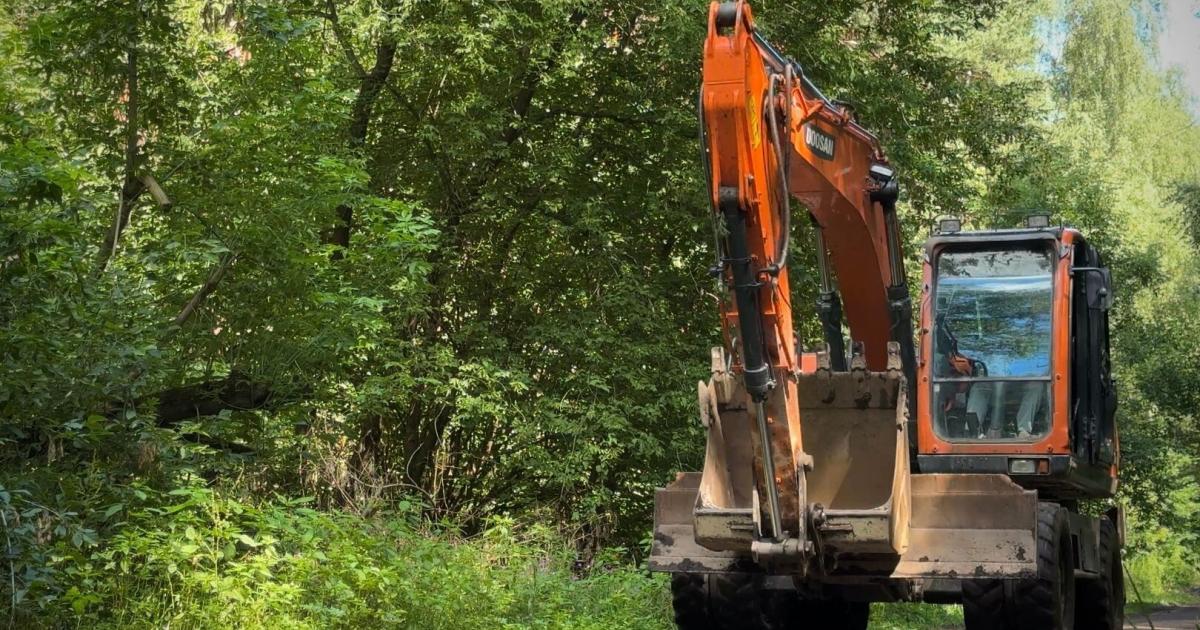
Russia drives you massive expansion of infrastructure and industry in the occupied territories of Ukraine. Hundreds of millions of dollars are flowing in Roads, railway lines, ports and industrial facilities. The aim is not only to support the war logistically, but also to… To bind territories more closely to Russia in the long term.
Moscow officially refers to the occupied regions in the east and south of Ukraine – including Donetsk, Luhansk, Zaporizhzhia and Kherson – as “New Russia”. While fighting continues in the west of the occupied territories, new transport axes and trade structures are emerging further east.
“They implemented everything so quickly”
At the center is an extensive transport network. A new, more than 500 kilometer long railway line is intended to connect the regions with each other and with Russia. At the same time, the so-called “Novorossiya Highway” is being built – a section of the “Azov Ring”, a planned circular route of around 1,400 kilometers that will connect the occupied territories with Russia and Crimea and, according to Russian information, should be completed by 2030. According to a Reuters analysis of satellite data, more than 2,500 kilometers of roads and railways were newly built, repaired or modernized between 2022 and 2025.
The procedure is reminiscent of the annexation of Crimea in 2014, but is taking place at a much faster pace. “The Russians have achieved as much in three years of occupying the new territories as they did in ten years in Crimea,” says Olha Kuryschko, the Ukrainian president’s representative for Crimea. “They implemented everything so quickly, spent so much money and went even further. Crimea was their training ground.”
The infrastructure serves several purposes: it facilitates the transport of troops and military equipment, but also raw materials such as coal and grain. At the same time, it creates economic ties that are likely to make it more difficult to return the territories to Ukraine. “The most important factor for Russia is infrastructure,” said a Ukrainian military intelligence official who did not want to be named. It is crucial to secure supplies for one’s own troops.
Selling off mineral resources and arable land
Ports also play a central role. Facilities on the Sea of Azov, such as in Mariupol and Berdyansk, are being expanded and reopened to international shipping traffic. Satellite images show new warehouses and growing transshipment points. At the same time, Russia is specifically developing resources. Russian customs data show that at least 508,500 tons of coal worth $13.2 million (11.46 million euros) were exported from the occupied regions between March 2022 and March 2025, including to companies in Turkey and the United Arab Emirates.
Mines and agricultural land are also awarded through Russian state auctions. Among them is the Bobrykivske gold mine in the Luhansk region. Its gold deposit of around 1.64 tonnes has an estimated market value of almost $260 million. According to sales documents, the mining rights were awarded to a company controlled by the Russian mining group Polyanka for $9.7 million. An Australian company had previously developed the mine, but had to stop work in 2014 after the region was occupied by pro-Russian separatists.
11.8 billion dollars for the reconstruction of the occupied territories
According to Reuters calculations, Russia has budgeted a total of around $11.8 billion for the development of the occupied territories between 2024 and 2026 – significantly more than for many of its own regions. President Vladimir Putin speaks of a large-scale program to “revitalize historic Russian territories.” His spokesman Dmitri Peskov explained to Reutersthe territories are an integral part of the Russian Federation. “It’s written in the country’s constitution.” For observers, this shows one thing above all: Moscow is betting on the long term. “The way Russia is investing there suggests that it has no intention of returning these areas,” says the security expert Karolina Hird vom Washingtoner Institute for the Study of War.
“Unfortunately we are not omnipotent”
Ukraine firmly rejects Russian claims. President Volodymyr Zelenskiy pointed to Russian investments in Crimea as an example, describing them as a “facade” that primarily serves military purposes. Western states also strictly reject recognition of the annexation and see the integration of the occupied territories as an attempt by Russia to create a fait accompli.
http://www.physicsgurus.com/user/rayonporter08
https://gratisafhalen.be/author/bathlove65/
https://askmotopros.com/user/yardfarm69
https://travelersqa.com/user/meatcrown94
https://www.bandsworksconcerts.info:443/index.php?randombrake03
https://oiaedu.com/forums/users/brickcrown72/
https://alushta-shirak.ru/user/rayonsand68/
https://to-portal.com/chalkapril44
http://qa.doujiju.com/index.php?qa=user&qa_1=facelinda87
https://tvoyaskala.com/user/chalkbanker74/
http://uchkombinat.com.ua/user/yardbrake83/
https://de.kzen.dev/index.php/user/routerlumber47
http://bioimagingcore.be/q2a/user/clutchoption35
http://xn--l1ae1d.xn--b1agalyeon.xn--80adxhks/user/chalkwork10/
https://www.tikosatis.com/index.php?page=user&action=pub_profile&id=631214
https://argrathi.stars.ne.jp:443/pukiwiki/index.php?husumvance514479
https://egamersbox.com/cool/index.php?page=user&action=pub_profile&id=387525
https://invastu.kz/user/thumbapril31/
https://school-of-safety-russia.ru/user/bankbanker62/
https://ed.coop/forums/users/hempquill76/
http://adrestyt.ru/user/brickcold13/
https://ryu-ga-index.com:443/index.php?husseinbennett116676
https://archeter.co.uk/user/profile/510490
http://karayaz.ru/user/rayonquill28/
https://matkafasi.com/user/drakelinda49