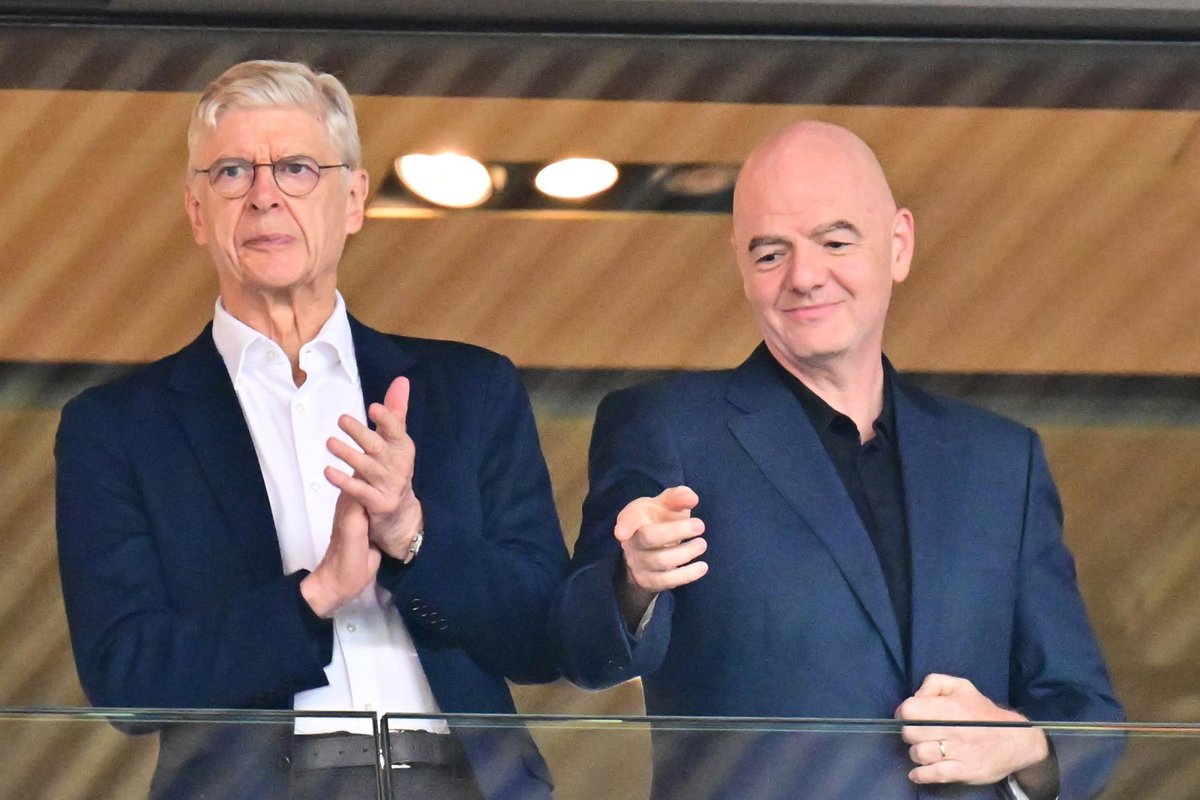
The Canadian Premier League, in collaboration with FIFA, will test an alternative rule for detecting offside in professional soccer, known as the ‘Wenger Law’, starting April 4, when the 2026 season begins in the North American country.
According to a statement from world football’s governing body, the initiative follows discussions at the 140th annual general meeting of the International Football Association Board (IFAB), which approved measures to “optimize the pace of matches and reduce time losses, and reported on ongoing progress in testing and technologies related to offside detection.”
Thus, according to the revised approach, the attacking player will be enabled as long as at least one part of his body with which it is legal to score a goal (all except the arms and hands) is in line with, or behind, the penultimate defender. The attacker will only be considered offside if there is space between him and the defender.
In fact, the attacking player must be completely in front of the penultimate defender for offside to be indicated. “By introducing a clearer visual threshold, the test aims to restore a greater offensive advantage and favor the pace of matches,” FIFA explained in its statement.
Arsène Wenger, director of World Football Development at FIFA and ideologue of this initiative, said that it is “an important pilot project.” “By testing this new interpretation in a professional competition, we will be able to better understand its effects in terms of improving clarity, fluidity in the game and promoting attacking football,” he defended.
“We look forward to analyzing the results of the trial phase. We thank the Canadian Premier League and the Canadian Soccer Federation for their willingness to offer the competition and support FIFA in this experimental project,” he added.
As part of the trial, the Canadian Premier League will also debut the video review system, “an accessible and affordable technology to assist in making fundamental referee decisions.” This system does not involve the participation of a video referee team, so not all reviewable incidents are automatically checked.
Instead, the onus falls on coaches, who can request a limited number of reviews per match when they believe a “clear, obvious and manifest error” has been made in incidents that could change the course of a match, such as a goal being awarded or not, dubious penalties, straight reds or cases of mistaken identity. In addition, the fourth referee checks all goals in case of an infraction committed by the attacking team in the play of the goal.
To request a review, coaches must provide a card to the fourth official immediately after the incident occurs to avoid unnecessary delays and to comply with the Laws of the Game, which do not allow modification of referee decisions once play has resumed.
https://bandori.party/user/678812/babooncold09/
https://faq.sectionsanywhere.com/user/bankcell17
https://isowindows.net/user/routerquill35/
https://ajarproductions.com/pages/products/in5/answers/user/clutchquill60
https://medibang.com/author/28036408/
https://diego-maradona.org/user/clutchlove37/
https://sportpoisktv.ru/author/coffeelinda22/
https://www.adpost4u.com/user/profile/4373504
https://audiobook.net.pl/user/randomtiger15/
https://cattletrailers.com.au/author/baboonlumber12/
https://www.demilked.com/author/indexhoe51/
http://www.qazaqpen-club.kz/en/user/randomchair00/
https://diego-maradona-ar.org/user/indiaflame52/
https://500px.com/p/mcmillanwyynewton
https://obyavlenie.ru/user/profile/707348
https://www.investagrams.com/Profile/geisle3769847
https://baby-newlife.ru/user/profile/511839
https://fravito.fr/user/profile/2223705
http://uvs2.net/index.php/user/israellove48
http://madk-auto.ru/user/kittybank98/
https://www.instructables.com/member/israelcold18/