The Prime Minister requested the implementation of electricity saving solutions and the development of rooftop solar power, in the context of complex developments in the international energy market.
Prime Minister Pham Minh Chinh signed and issued Directive 10 on March 30 on enhancing electricity saving and developing rooftop solar power. This is the second directive related to energy saving issued by the government in the past two weeks.
The Prime Minister said that the international energy market has many potential risks, directly affecting national energy security. If there is no timely and drastic solution, Vietnam is at risk of imbalance in electricity supply and demand, especially in the period 2026-2028.
Therefore, the operator requires ministries, branches, provinces, cities, organizations and people to strive to save at least 3% of total electricity consumption nationwide this year. For peak hot months (April to July), the electricity saving target is 10%.
At the same time, self-produced and self-consumed rooftop solar power solutions need to be promoted in offices, production, business, service establishments and households. Solar power should be combined with an energy storage system (BESS), to reduce peak load and increase power autonomy.
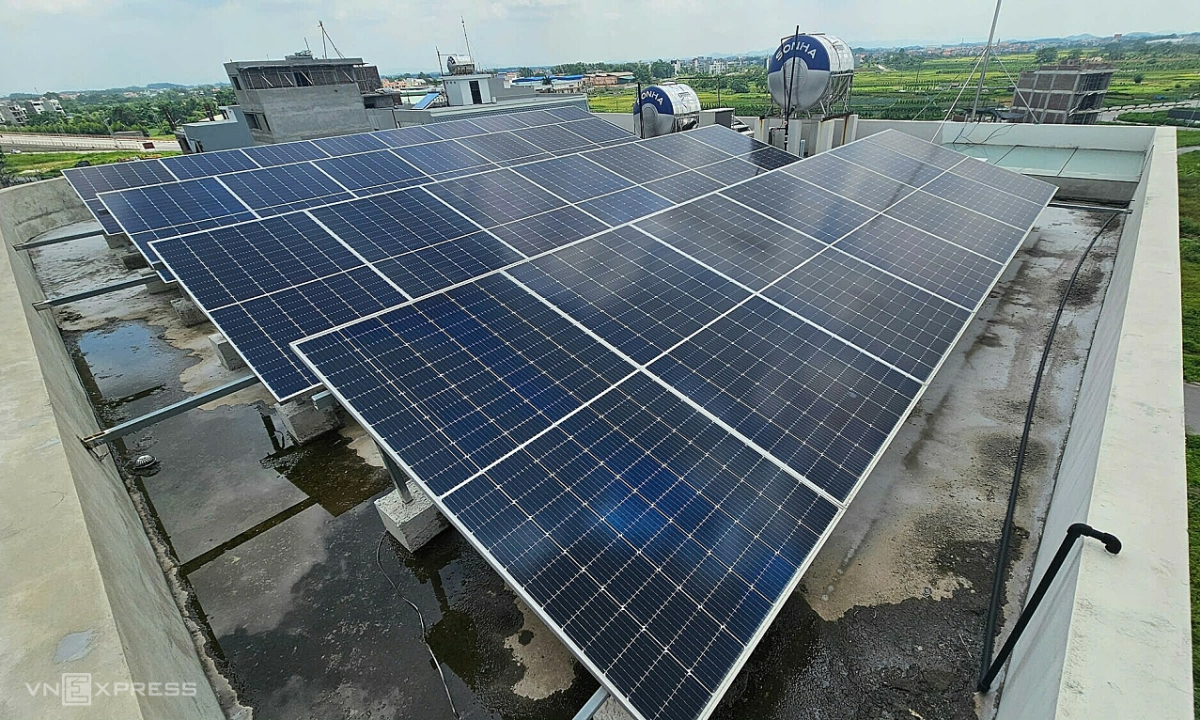
Rooftop solar power system at a household in the North, June 2025. Image: Phuong Anh
Government leaders set a target of about 10% of public offices and 10% of households across the country installing and using self-produced and self-consumed rooftop solar power, or striving for a total development capacity of 20% of local plans for the 2026 – 2030 period.
The Ministry of Finance coordinates with the Ministry of Industry and Trade and relevant agencies to propose solutions to allocate appropriate state budget sources to support people installing rooftop solar power. Relevant agencies discuss appropriate solutions to support green credit and preferential credit for households and businesses installing rooftop solar power and storage batteries.
Electricity saving targets need to be set in each department and field. Agencies and offices set quarterly electricity saving goals, including this content in the criteria for assessing the level of task completion, internal discipline compliance and emulation and reward during the year. The leader is responsible for violations of electricity saving regulations at the unit.
Public lighting systems also need to be deployed to save electricity and adjust operating time according to actual needs. Authorities turn off and reduce lighting capacity in low-demand areas, peak hours and after 11 p.m. Advertising lighting and outdoor decoration systems must be turned off completely. This activity needs to ensure a minimum saving of 30% of electricity consumption.
Restaurants, hotels, commercial service establishments, office complexes and apartment buildings turn off or reduce at least 50% of outdoor decorative advertising lighting capacity during evening peak hours, as required by the local power unit.
Manufacturing enterprises, especially units on the list of key energy users, proactively implement electricity saving plans, integrating this criterion into production, business and energy management plans. Units using more than 500,000 kWh per year must save at least 3% of the electricity consumed per unit of product, or 3% of the total electricity consumed in the year.
For households, the operator encourages the use of rooftop solar power combined with BESS, installation of solar water heating systems, and application of appropriate renewable energy solutions.
https://api.myvidster.com/profile/SpinofGlory
https://kress.de/kopf/profil/42968-spinof-glory.html
https://labsk.net/index.php?action=profile;area=summary;u=58370
https://www.gta5-mods.com/users/SpinsOfGlorySP
https://www.blurb.es/user/Sp1nsOfGlory?profile_preview=true
https://www.bandlab.com/wishwinsp
https://www.shippingexplorer.net/es/user/spinsofglory14/269762
https://scrummanager.com/website/c/profile/member.php?id=55447
https://www.totalwind.net/foro/members/spinsofglorysp.22652/#about
https://www.tkaraoke.com/forums/profile/spinsofglorysp/
https://huayra.educar.gob.ar/ayuda/?qa=user/SpinsOfGlory1
https://www.fahrerlaubnisrecht.de/forum/memberlist.php?mode=viewprofile&u=12074
https://www.fahrzeugpflegeforum.de/wcf/index.php?user/22409-splnsofglory/
https://echte-abzocke.de/members/splnsofglory.16920/about
https://puzzle-forum.de/wcf/index.php?user/4716-splngofglory/
https://www.klamm.de/forum/members/splnsofglory.166084/about
https://www.synology-forum.de/members/splnsofglory.149315/about
https://www.brunnenbau-forum.de/cms/user/15472-splnsofglory/
https://allods.my.games/forum/index.php?page=User&userID=238677
https://www.trackyserver.com/profile/239379
https://forum.volkshandwerker.de/index.php?user/1219-splnsofglory/
https://tekkenmods.com/user/137502/SpinGlory1233
https://radio-sendeplan.de/user/2227-spingloty/
https://www.renderosity.com/users/id:1842788
https://justabout.com/user/SpinofGlory