Crude oil prices raised by the Iran war can bring Russia temporary additional income from the energy trade.
The price of a barrel of Brent oil quality has risen in a month from around 70 dollars to around 110 dollars. Fierce demand has put an end to the discount sales of Russian Urals: the relative price difference to Brent has narrowed, and the spot price of Russian oil has been higher than Brent for a while. The United States has even granted temporary sanctions relief to Russian oil to curb oil supply contraction and rising prices.
At the same time, Ukraine has thrown in the towel to curb Russia’s luck.
According to Reuters calculations at least 40 percent of Russia’s crude oil export capacity was out of action this week following Ukraine’s extensive drone strikes on Russian oil infrastructure. It is about 2 million barrels per day.
As a result of the attacks on Russia, Russia is even more dependent on the Asian market as an export destination for its oil. However, the capacity of the eastern export infrastructure is already being tested, Reuters’ sources say. On the other hand, a possible reduction in the amount of Russian export oil is apt to increase upward pressure on the global price level of oil.
Under the blows, the Ukrainian KSE University of Economics has made the calculations of three different scenarios regarding the growth of Russia’s energy income.
In the medium-level scenario, it is assumed that the active phase of the Iran war will last until the end of May and that the global oil price will rise to $140 per barrel in April-May, after which it would gradually decrease to the level of $80 by the end of the year. Russian oil exports are also expected to grow and the price of liquefied natural gas to rise.
KSE estimates that Russia will then earn 161 billion dollars more from energy exports in 2026 than it would have earned without the Iran war. The pot would bring the Kremlin additional budget revenues of 97 billion dollars.
In an optimistic scenario, the active phase of the war would last until the middle of April, and the price of a barrel of oil would peak around $100. Even then, Russia’s annual energy income would increase by USD 84 billion and the Kremlin’s budget income by USD 45 billion.
In the worst case, the war will drag on for six months and the price of oil will skyrocket. Russia would net 252 billion dollars and the Kremlin’s war coffers would be filled with 151 billion dollars, KSE says.
A glimmer of light in the financial crisis
Reuters calculations give a similar indication of the development: Russia’s budget income from the gas and oil business is expected to grow by 70 percent from March to April, to about 10 billion dollars.
Last year was bad for Russia in terms of energy income. Now Moscow has begun to make fiscal policy changes thanks to the welcome additional funding.
Before the Iran war broke out, the Treasury Department planned to base its budget rule on the oil price cap, which specifies, how big a slice of oil revenue is directed to the country’s welfare fund. Strengthening the depleted fund would have meant automatically cutting spending – excluding the military and social sectors.
According to sources inside Reuters, the change in the budget rule has now been postponed, possibly until next year. Also, there is no longer any need for spending cuts. The Kremlin estimates that even if the Iranian crisis ends quickly, the risk premium for the oil price will linger for some time.
The boost in budget revenues will come to the Kremlin at the time of the count. In 2025, the federal budget remained in deficit of 2.6 percent of GDP. For the current year, there was already time to predict an even tougher 3.5–4.4 percent deficit due to oil market problems.
Own.
During the war, Russia’s oil exports have turned towards major Asian customers. On March 23, an oil tanker belonging to the Russian shadow fleet was anchored near Marseille under the control of the French navy, awaiting an inspection.
KUVA: Gilles Bader / ZUMA Press
Oil sector on the way to wither
The additional income from the special situation still does not provide relief for the problems of the Russian oil business in a broad perspective. The most fundamental of them is the structural investment deficit in harnessing new deposits.
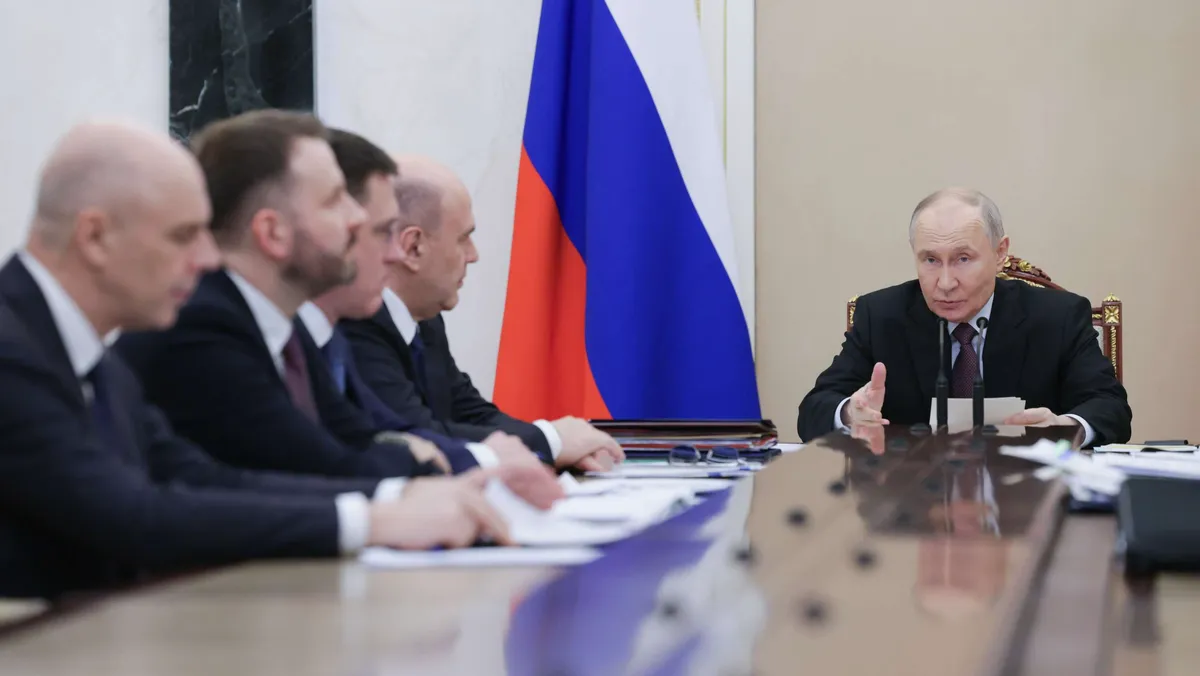
On Monday, the president Vladimir Putin issued a strong appeal to the country’s oil and gas companies: they should use their windfall income to pay off their considerable debts to the domestic banking sector.
Putin left unspoken the obvious reason why solidarity with Russian banks is a “mature decision” right now. The number of problem loans in the portfolios of Russian banks has grown to an alarming level, which is why the Russian economic research institute TsMAKP has stated that the country is already in a systemic banking crisis.
Even if part of the additional income of oil companies turns into drilling investments, it would not change the fundamentals and long-term prospects of the Russian oil industry, states an oil analyst Sergei Vakulenko think tank Carnegie’s in his writing.
With primary sources.
An employee of the Russian oil and gas company Surgutneftegas at their construction site in the Surgut region of the Khanty-Mansia Autonomous District in Western Siberia. Stock photo from spring 2020.
KUVA: Alexei Andronov / ZUMA Press
Russia’s oil production will soon turn to a slow but sure decline, which will progress little regardless of the oil price level, Vakulenko states. In Moscow, an agency has had to be granted. At the turn of the year, the Minister of Finance Anton Siluanov said that the share of the oil and gas sector in the Russian economy will decrease in the medium and long term.
However, Siluanov left the real causes of the phenomenon unexplained. According to Vakulenko, production will decrease due to the federal government’s harsh tax policy, poor investment climate and production restrictions created by the oil cartel Opec+.
There would be enough untouched deposits, but raising them and fully exploiting them is not economically attractive. The profit prospects of expensive projects are uncertain.
Sanctions from Western countries have made the situation somewhat more difficult, as the effective introduction of more challenging deposits requires Western technology and preferably also international funding and cooperation. The core of the problem still lies in Moscow’s own solutions, Vakulenko believes. The federal government could support investments in the oil sector by easing its tax pressure if it wanted to, but it would be out of the Kremlin’s immediate revenue stream.
According to the analyst, at this rate, Russian crude oil production will fall to 8 million barrels per day already in 2030 – and to less than 7 million by 2035. Last year, production averaged 9.2 million barrels per day. At the same time, both export volumes and revenues would decrease.
THE FACTS
The war has been persevered
Russian oil production has remained at a fairly steady pace of just under 10 million barrels per day during the Ukrainian war. Investments in the oil sector have still been under a rock. The international energy organization IEA has warned that even a relatively small drop in investments in oil drilling could be reflected in the future as production volumes stagnate.
During the war, Russia’s oil exports have turned towards major Asian customers. In 2020, China and India bought a total of 35 percent of Russia’s exported crude oil and condensates. In the first half of 2025, the share was already 82 percent.
Russia’s share of world oil production has decreased by only one percentage point, to 11 percent. The share of oil trade has dropped from 13 percent to 11 percent.
https://www.deviantart.com/wishwincz
https://www.themoviedb.org/u/WishWinCZ
https://www.weddingbee.com/members/wishwincz/
https://www.1001fonts.com/users/wishwincz/
https://www.tkaraoke.com/forums/profile/wishwincz/
https://www.fiat500-forum.de/user/5281-wishwindeu/
https://www.blurb.de/user/wischwinDE?profile_preview=true
https://www.heimkinoverein.de/user/9056-wishwindeu/#wall
https://allods.my.games/forum/index.php?page=User&userID=219156
https://www.pagodentreff.de/diskussionsforum/members/wishwinde.14783/
https://clashroyaleforum.de/core/user/11226-wishwinde/
https://www.etcg.de/forum/wcf/index.php?user/119514-wishwinde/
http://www.secretcity.de/Net/profile/view_profile.aspx?MemberId=91028276
https://de.pinterest.com/onewwwin10/?invite_code=90d158cc75cd45bba452b7da3071979a&sender=1119285451048785019
https://www.fahrzeugpflegeforum.de/wcf/index.php?user/22210-wishwinde/
https://www.prad.de/board/core/user/80646-wishwinde/