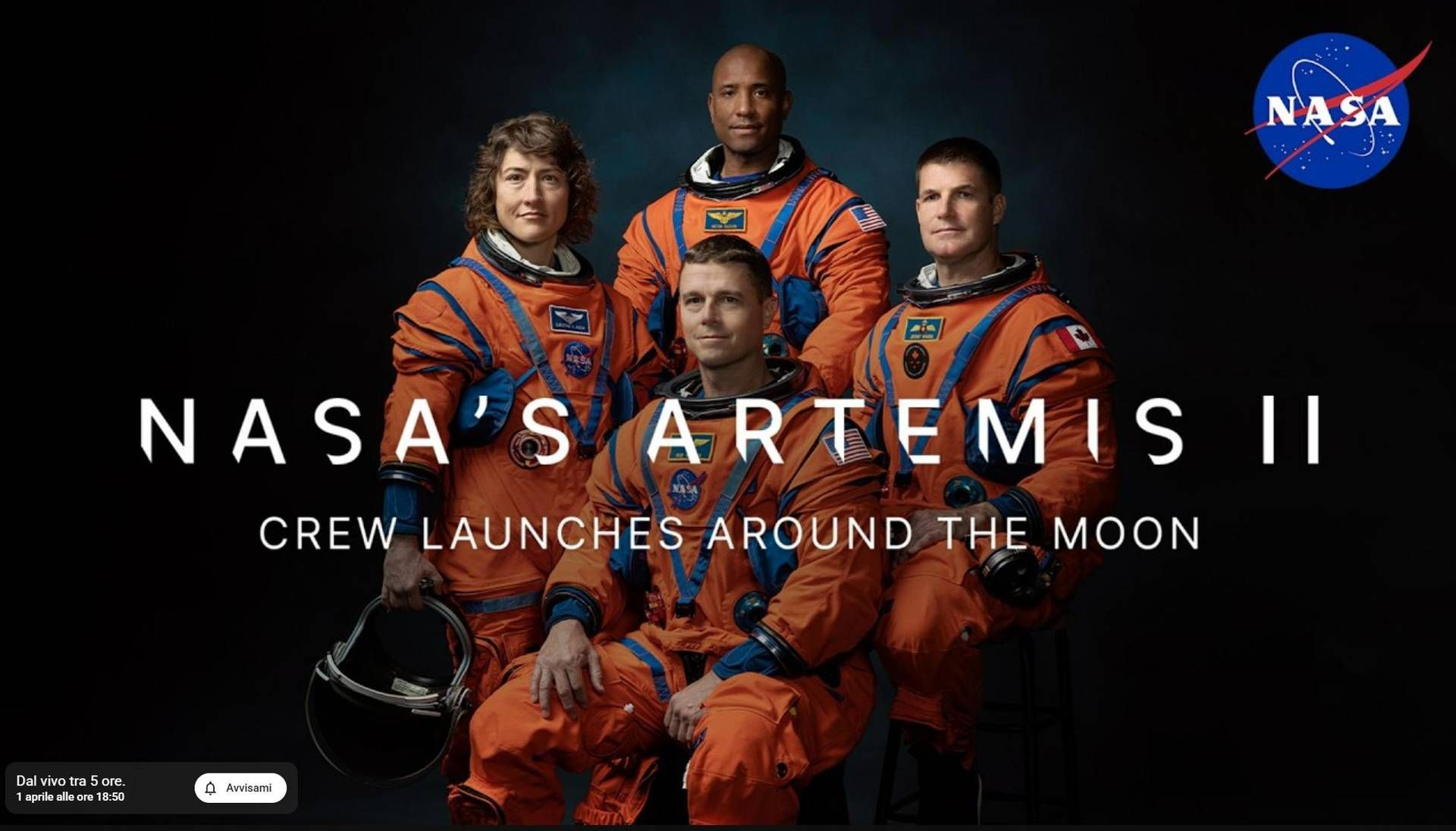
The SLS launch system and the Orion capsule are preparing to take off from the Kennedy Space Center for a ten-day mission that marks the passing of low Earth orbit after more than fifty years, with the opening of the launch window for the Artemis II mission, scheduled for 00:24 Italian time on April 2, 2026. After a series of technical reviews and tests on the ground systems, the colossal Space Launch System (SLS), a launcher almost one hundred meters high, is ready to push the Orion capsule beyond the confines of Earth’s orbit. This mission does not involve a moon landing, but is configured as a complex reconnaissance of ten thousand kilometers beyond the far side of the Moon, covering a total distance of 1.1 million kilometers. THE’primary objective is the validation of life support systems and manual maneuvering capabilities in a deep space environmentcritical elements for future stages of the human exploration program.
NASA provides two different YouTube channels to follow the launch and pre-launch phases. On this first connection it is possible to monitor the conditions of the carrier from the Kennedy Space Center
While from this channel it is possible to follow the phases of the Artemis II launch live
The crew, made up of professionals Reid Wiseman, Victor Glover, Christina Koch and Jeremy Hansen, will supervise delicate phases such as the translunar injection, scheduled approximately twenty-four hours after takeoff. One of the most relevant technical innovations of this mission concerns the test of the Optical Communications (O2O) laser communication system, designed to transmit high-resolution data and images with unprecedented speed compared to traditional radio systems.
During the flyby of the far side of the Moon, Orion will reach the furthest point from Earth ever touched by a vehicle designed for human transport, facing temporary radio silence due to interference from the lunar mass. This “free reentry” trajectory will exploit the gravitational balance between the two celestial bodies to direct the capsule towards the Earth’s atmosphere without the need for further major propulsion thrust.
The final phase of the mission, scheduled for April 10th with a landing in the Pacific Ocean, will represent the definitive test for the cutting-edge heat shield, which will have to dissipate temperatures of around 2,800 degrees Celsius generated by atmospheric friction at a speed of almost 40,000 km/h. Curiously, this mission sees for the first time the participation of a non-US astronaut, the Canadian Jeremy Hansen, demonstrating the international nature of the Artemis coalition. Enthusiasts and industry experts will be able to monitor each operational phase through the official NASA channels on YouTubewith live coverage beginning several hours before the engines fire to document boarding procedures and pre-flight checks.
https://a-plan.agency/SEO-Expert.html
https://a-plan.agency/How-to-create-an-ad-on-Google-AdWords.html
https://a-plan.agency/Profit-from-Google-ads.html
https://a-plan.agency/Strategies-for-Successful-Google-Advertising-Campaigns.html
https://a-plan.agency/our-services-en.html
https://a-plan.agency/SEO-conditions.html
https://a-plan.agency/Local-Service-Ads-Domination-en.html
https://a-plan.agency/Content-writing-price.html
https://a-plan.agency/Google-Trends.html
http://a-plan.agency/social-media-best-practices.html
https://a-plan.agency/social-media-best-practices.html
https://a-plan.agency/hosting-services.html
https://a-plan.agency/Sign-up-for-Google-News.html
https://a-plan.agency/Search-engine-results.html
https://a-plan.agency/On-Page-SEO.html
https://a-plan.agency/claude/learn/
https://a-plan.agency/claude/sectors/
https://www.webpronews.com/telehealth-changing/
https://spoutible.com/VarunChawla
https://www.labelradar.com/artists/RanjanHalder/profile
https://talk.plesk.com/members/varunchopra.497915/#about
https://tooter.in/SunilKurup/posts/116323807636070304
https://uiverse.io/profile/artur_5035
https://wallhaven.cc/user/KarthikIyer
https://www.adpost.com/u/piyushpatelse/