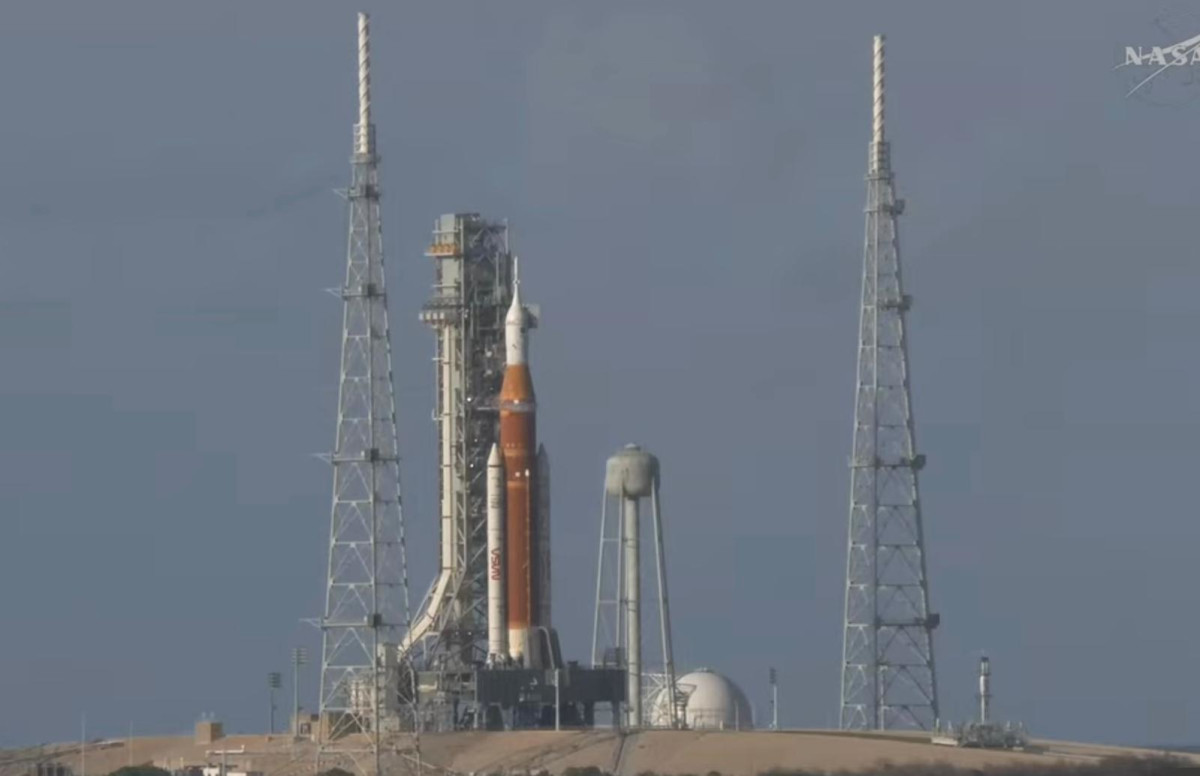
The night between Wednesday and Thursday will be remembered in the history books as the moment when the human race once again broke the limits of low Earth orbit. About four hours after most families in Israel had finished the Seder night meal, the massive engines of the giant satellite launcher at the Kennedy Space Center in Florida were fired up.
The launcher known as the Space Launch System, considered to be the most powerful rocket ever built by NASA, created a huge thrust that shook the ground for many miles and lifted the Orion spacecraft up. Reports from the control center indicate that the first stage of the launch went perfectly, and that the spacecraft is now on an accurate course for the transition to lunar orbit. The crew on board reported that they felt great and that the systems inside the command cabin were working like a dispatcher, which is exciting. A petition among the thousands of scientists and engineers who have worked on this project for over a decade.
Christina Cook is the first woman to reach the lunar environment, and Victor Glover is the first African-American astronaut to embark on such a mission, facts that emphasize NASA’s message that space belongs to everyone. They are not only pilots, but also scientists who are expected to perform a long series of experiments during the next ten days, with the goal of gathering as much information as possible about the effect of radiation and the prolonged stay outside the Earth’s magnetic protection on the human body.
The current journey is expected to last about ten days, during which the spacecraft will travel a distance of 384,000 kilometers until it reaches the lunar environment. The planned orbit is a free return orbit, where the spacecraft will use the moon’s gravity to turn around and return home without turning on the main engines for significant braking.
It is a complex engineering maneuver that requires millimeter precision at every stage of the flight. Although the astronauts won’t land on the surface this time, they will get about 10,000 kilometers beyond the far side of the moon. This position will allow them to examine long-range communications systems and see areas of the moon never before seen by the human eye so closely, relying on high-resolution cameras and advanced sensors to map the surface for future landings.
The Orion spacecraft itself is a technological marvel designed to survive the most extreme conditions in the solar system. 90% of the systems installed there are completely new or those that have undergone a massive upgrade in recent years. The life support system is able to recycle water and air with maximum efficiency, which is critical for missions that will continue for many months in the future. The thermal shield located at the bottom of the spacecraft is the largest and strongest ever made, and is designed to protect the crew during re-entry into the atmosphere at a speed of 40,000 kilometers per hour. Without these systems, humanity could not dream of returning to the moon and certainly not of a journey to Mars, since the radiation in deep space is much stronger than that present in the International Space Station, which is relatively close to Earth.
Why does humanity invest so many resources in flying to the moon precisely in the current era?
The answer to this is related to natural resources that exist on our satellite, and especially to the water ice that is found in the perpetually shadowed craters at the South Pole. This water is not only for drinking, but is the raw material for producing oxygen for breathing and fuel for rockets. If we succeed in producing fuel on the moon, we can turn it into a space gas station that will allow us to launch heavy spacecraft to Mars at a much lower cost. The moon is actually the first and necessary step on the way to our becoming a multi-planetary species, and every dollar invested in the Artemis mission is an investment in humanity’s future infrastructure outside of Earth.
The financial investment in this mission is huge and often provokes heated public debates. Each single launch within the program costs the American taxpayer around 4 billion dollars, and the total cost of the project has already crossed the 90 billion dollar mark. But NASA explains that this money is not invested in space but stays on Earth, creating thousands of jobs in technology companies, factories and universities. The technologies developed for Artemis return to our daily lives through improvements in water purification systems, the development of stronger and lighter materials and the fast communication methods we use in our cell phones. This mission is a technological growth engine that pushes the entire global industry forward and inspires an entire generation of Students who want to be the scientists and engineers of tomorrow.
The astronauts are expected to land in the Pacific Ocean in about ten days after passing the most terrifying phase of the mission. The entry into the atmosphere will generate heat of thousands of degrees around the command cabin, and the astronauts will experience heavy physical loads as the spacecraft decelerates at an enormous speed. Three giant parachutes will open in the final phase to ensure a soft impact on the water, where US Navy ships will be waiting for them. All the data that will be collected in the coming days will be carefully analyzed to make sure that there are no unexpected malfunctions before the exact date for the Artemis 3 mission is decided, in which astronauts are expected to set foot on the lunar soil and build the first manned base there.
The crew’s stay in the Orion spacecraft will be crowded and challenging, but they are equipped with everything necessary to maintain their physical and mental health. They will eat special food developed for long missions and perform fitness exercises daily to prevent muscle and bone weakening in weightless conditions. The experiments they are currently conducting will provide answers to many questions about our ability to live in places where there is no protection of an atmosphere or a strong magnetic field. This knowledge is critical because the journey to Mars will last many months, and we must know how to protect the astronauts from cosmic radiation over time. The moon is actually a large living laboratory that allows us to try everything close to home before we venture into the depths of the solar system.
https://www.udrpsearch.com/user/saladplough05
https://mapleprimes.com/users/spadetea38
http://jobs.emiogp.com/author/brokerflower85/
https://schoolido.lu/user/peadeal10/
https://cattletrailers.com.au/author/appleplain11/
https://www.instructables.com/member/farmpacket86/
https://skitterphoto.com/photographers/2547111/bojsen-cardenas
https://www.demilked.com/author/wheelpink92/
https://platform.joinus4health.eu/forums/users/appletea47/
https://oiaedu.com/forums/users/saladfemale33/
https://www.tumblr.com/wendihinojoa/812398452612988928/naturlige-kosttilskud-til-daglig-sundhed-og?source=share
https://alenasamples.livejournal.com/6493.html
https://rumble.com/v77rpy2-holistisk-naturlig-sundhed-med-danish-nutra-kosttilskud.html
https://storymaps.arcgis.com/stories/12dcaf5946b34a4f86aeb8f3e0b15363
https://webhitlist.com/video/premium-naturlige-kosttilskud-til-energi-og-velv-re
https://sparktv.net/post/936788_danish-nutra-tilbyder-premium-kosttilskud-designet-til-at-fremme-daglig-sundhed.html
https://www.dailymotion.com/video/xa3kgps
https://gettr.com/post/p3ynjrg0a7a
https://mastodon.social/@ParkerMaribe10/116310895529387680
https://www.pinterest.com/pin/1148910555080011568
https://gratisafhalen.be/author/framemallet51/
https://p.mobile9.com/farmanimal11/
https://moeamine.com/author/garlicpaint63/
https://www.ludikarus.com/author/bereteye06/
https://nhadat24.org/author/pumairon33