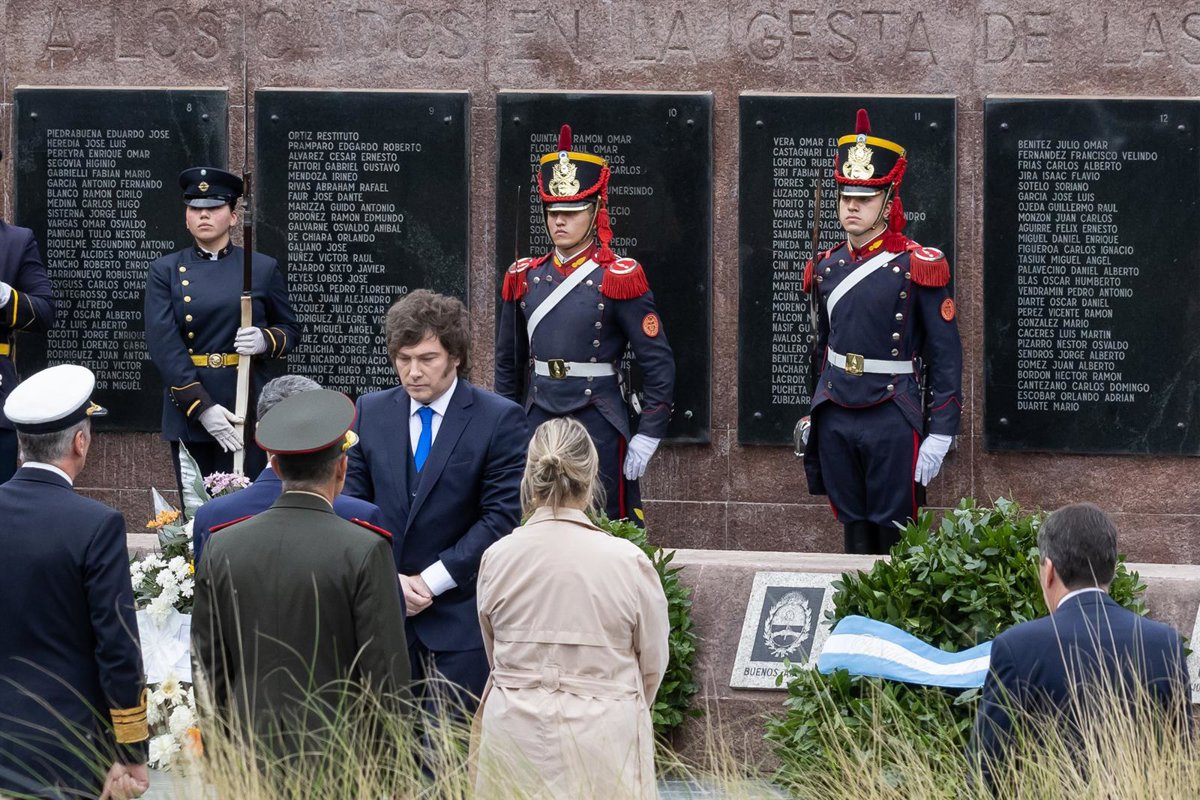
Argentina commemorated this week the 44th anniversary of the assault on the Malvinas Islands, administered by the United Kingdom and claimed by the South American country, a war that ended with the surrender of Buenos Aires and an arms embargo imposed by London, which President Javier Milei now seeks to lift with his next trip to the British capital, scheduled between April and May.
It will be the first visit by an Argentine head of state to the United Kingdom since 1998, with Carlos Menem in the Casa Rosada, and eleven years after both countries resumed diplomatic relations after a 74-day undeclared war.
Milei himself confirmed contacts with the British authorities in order for them to suspend a measure that would allow the Latin American country to acquire high military technology and modernize its Armed Forces, in an interview given to the newspaper ‘The Telegraph’ at the end of last year.
The president then defended that “there are no world powers without military power” and that “no country has relevance in the international context if it cannot defend its borders” and, although ‘Downing Street’ came forward denying the existence of “specific” conversations in this regard, government sources point out that London and Buenos Aires will continue to address defense issues throughout 2026.
In any case, it remains to be seen what tricks the Argentine Government uses to achieve the withdrawal of the arms embargo, if to do so an ultranationalist leader like Milei has to park his claim of sovereignty over the Malvinas.
This same week, the president defended his “full right” to sovereignty over the archipelago as an “unwavering” claim during the commemoration ceremony for the 1982 war, while insisting on his “will to reach a peaceful and lasting solution” to the dispute, through the resumption of negotiations with the United Kingdom.
Despite this claim, Milei’s solution requires the consent of those who reside in the Malvinas, which has been perceived in some sectors of the country as a surrender or transfer in favor of London. “The most important vote of all is the one made by the feet and we hope that the people of Malvinas decide one day to vote for us with their feet. That is why we seek to be a power, to the point that they prefer to be Argentine, that it is not necessary to use dissuasion or conviction to achieve it,” he stated in his speech last year.
So far no details have been revealed about the far-right’s visit to the United Kingdom, but at the Casa Rosada it is expected that the agenda will include a meeting with the country’s prime minister, Keir Starmer. The Labor Party has repeatedly defended that the Falklands “are British” and that they will continue to be so, citing the referendum held in March 2013, in which 92% of the little more than 1,500 voters opted to retain the political status of the archipelago as an overseas territory of the United Kingdom.
THE ARMS EMBARGO, A ISSUE OF NATURAL RESOURCES
The arms embargo, originally imposed during the first of Margaret Thatcher’s three consecutive terms (1979-1990), has been tightened or softened depending on relations between London and Buenos Aires. These sanctions have prevented the sale of equipment “that is considered to improve Argentine military capacity” since 2018, when David Cameron’s conservative government eliminated a series of additional restrictions that had been imposed five years earlier.
Tensions between the two countries over this archipelago reached their peak in 2012, when, coinciding with the 30th anniversary of the landing, London accused Cristina Fernández de Kirchner’s Argentina of “harming the economic interests” of the inhabitants of the Malvinas Islands.
The British Government responded in this way to the diplomatic and criminal actions that the Peronist leader stated that she would take against five British oil companies, including Rockhopper Exploration, for carrying out deposit explorations without permission from the Argentine Government, and instead from the authorities of the archipelago.
The dispute is reminiscent of the controversy that arose earlier this year when two companies, Rockhopper Exploration and the Israeli Navitas, announced the ‘Sea Lion’ project, a crude oil exploitation platform 220 kilometers north of the Falklands that plans to extract 170 million barrels of oil.
This initiative would allow them to raise more than 10 billion dollars in its first phase alone, a figure estimated based on the price per barrel in January, months before the surprise offensive by Israel and the United States against Iran, the blockade of the Strait of Hormuz by Tehran and, with it, the sharp increases in hydrocarbon prices.
The project does not foresee the first oil production until early 2028, but it has already provoked a protest in Buenos Aires that considers these activities “illegal” and “illegitimate”, according to a statement from the Minister of Foreign Affairs, Pablo Quirno.
THE US MONROE DOCTRINE IN THE FALKLANDS EQUATION
In this context, the United States has shown interest in extending its area of influence over what it calls the Western Hemisphere, and the location of the archipelago – about 500 kilometers east of Argentine Patagonia – makes the islands a powerful attraction in this sense.
In this equation, Milei, an ally of US President Donald Trump, can win even if Washington prioritizes the issue of the sovereignty of the Falklands over the lifting of the arms embargo desired by Buenos Aires.
To its strategic location we must add important oil, fishing and mineral reserves – especially zinc, lithium and copper – and its easy access to Antarctica, which has the largest reserve of fresh water on the planet, in a world where water resources have become a commodity as precious or more so than oil.
The ongoing war in the Middle East, one of the driest regions on the planet, has highlighted this reality. The attacks on desalination plants – both in Iran and in its neighbors in the Persian Gulf – are putting at risk the lives of millions of people who depend on these facilities not only for their own consumption but for industry, urban development or agricultural activity.
The conflict, which has now entered its second month, has also exposed the fragility of the link between Washington and London, due to Starmer’s initial refusal to support Trump’s adventure, who was “very disappointed” with the Labor party, referring to his traditional ally as “weak” and “unreliable.” However, the United Kingdom has authorized the North American country to use its military bases in the region for defensive operations in the Strait of Hormuz.
The question now is to see what steps the US Administration takes to pressure the British Government in favor of Argentina in the Malvinas issue and in exchange for what, although the explicit intentions of the Trump era in terms of foreign policy mean that the possibility of a military base in the extreme south of the continent is not a crazy idea.
http://storywatch.pbworks.com/w/page/163698522/Instagram%20Stories%3A%20The%20Fun%20Way%20to%20Share%20Your%20Day
https://penzu.com/public/31bcfddb616dcf96
https://pbase.com/barakseryie50/image/176209204
https://www.behance.net/gallery/246872317/watchigstoryanonymously
https://justpaste.it/e27df