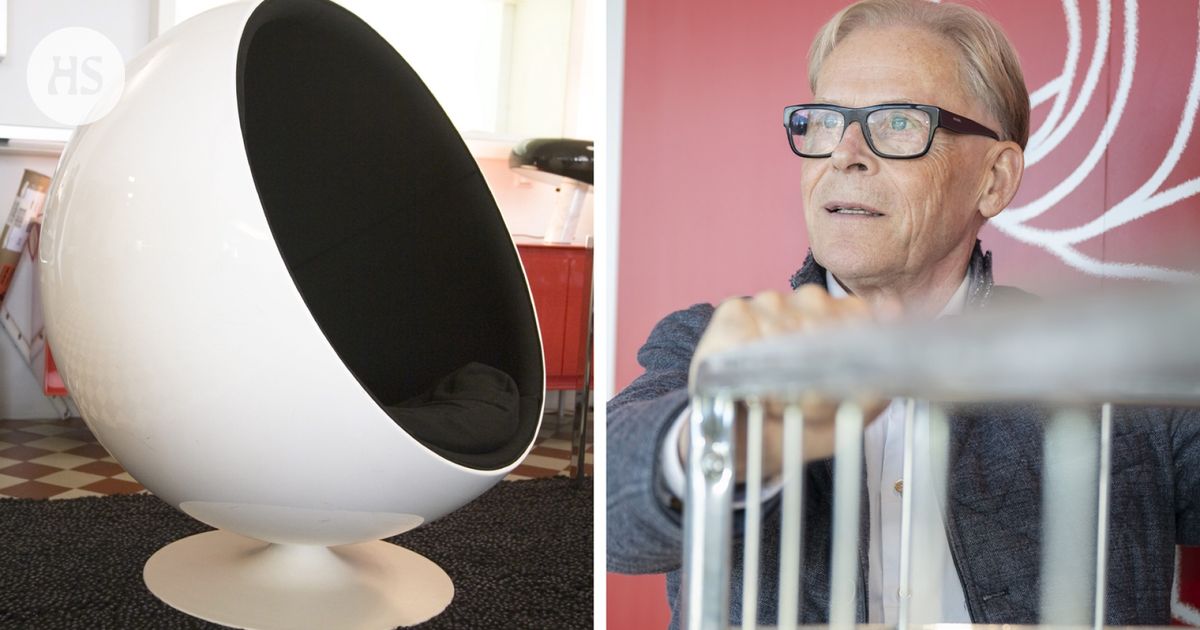
Ball chair|Eero Aarnio Originals, which manages the rights of the Ball Chair, had not heard about Toivo Sukar’s intentions to bring the Ball Chair back to Asko. Sukari told about it in an interview with HS.
Businessman Toivo Sukari said in an interview with Helsingin Sanomat that he wants to bring the Ball Chair back to Asko’s stores.
The company Eero Aarnio Originals, which manages the rights to the ball chair, had not heard about Sukari’s plans in advance and announced that the production of the ball chair would remain under their brand.
Sukari bought the Asko brand in March and wants to raise it to the premium category by bringing back classic furniture.
“Menu a little bit of coffee down the wrong throat.”
This is how Eero Aarnio Originals, the chairman of the board, describes it Stefan Mahlberg his moods as he read From an interview with HS Vision businessman Toivo Sukarin from the idea of bringing back “Ball chair, Cognac chair and other classics” to Asko’s stores.
In March, Sukari bought Asko and Sotka’s intellectual property rights, i.e. the brand. Sukari said in a recent interview that his vision is to bring Asko into the premium category, closer to Vepsäläi.
One part of Sukar’s premium plan is to bring classic furniture known from its history back to Asko. Probably the most famous of them Eero Aarnion designed Ball Chair, which Asko included in its collection and launched at the Cologne furniture fair in 1966.
Aarnio acquired the rights to the Ball chair back in the 1990s, and today they are managed by Eero Aarnio Originals, which exclusively manufactures Aarnio’s best-known classics.
Asko included the Ball chair designed by Eero Aarnio in its collection and launched it at the Cologne furniture fair in 1966.
Sugar the idea is to be in contact with both classic furniture designers and the entities that manage their rights. Sukari told HS that he was already looking for a factory that could make the classics again.
Mahlberg first heard about Sukari’s idea when Aarnio’s daughter Marjukka Törmi sent him the HS story to read. He hadn’t heard about Sukari’s intentions either before the story.
“The idea evoked a pretty strong reaction in Eero’s family. They were very puzzled by the idea, because they have no need or desire to go back in time. That’s why we wanted to clarify the matter,” says Mahlberg.
Eero Aarnio Originals sent a press release on Saturday, wishing Sukari success in renewing Asko’s brand and in the goal of continuing Asko’s operations.
“However, the production and marketing of the ball chair will remain under the Eero Aarnio Originals brand. In Asko’s time, there will be no return in this regard, and the production will not be licensed to new operators”, the press release ends.
Mahlberg points out that the domestic market for valuable designer furniture like the Ball chair is quite small, and the international market is more important.
At the moment, the fiberglass work of Pallotuolie is done in Estonia. Eero Aarnio Originals is responsible for upholstery, finishing and assembly in its own space. According to Mahlberg, a couple of hundred ball chairs are sold annually. Their selling price is currently 8,500 euros.
The company currently has distribution agreements in Finland with, for example, Vepsäläinen and Finnish Design Shop.
Could the company enter into a resale agreement with Asko so that Asko would sell the ball chairs they make?
“If we talk about retail cooperation, everything can always be discussed. We regularly get contacts from retailers,” says Mahlberg.
According to him, the current cooperation with Vepsäläinen is working well, and Eero Aarnio Originals would rather take care of good cooperation agreements with individual partners than acquire as many dealers as possible.
“Finland is a small country, and the current cooperation with Vepsäläinen covers the Finnish market quite well.”
Sugar tells HS that he is surprised if Eero Aarnio Originals does not want to cooperate with Asko.
“If the money isn’t enough for them, of course they won’t do it,” says Sukari.
Sukari says that he fully understands that the rights to the Ball Chair belong to Aarnio, and there is no way in his plan to make a copy of it for mass production. The hope is to get the original Ball Chair for sale in Asko.
“It would seem odd if they turn down the idea. It would be unique in my 50 years of business history. I haven’t been in touch with them yet, but I will be, and if they turn me down, then I’ll accept it.”
Sukari does not believe that ball chairs would be sold in large numbers at Asko. We can talk about “even a hundred copies” that he would like to sell.
Eero Aarnio’s furniture exhibition at Helsinki Art Hall in 2003.
With sugar there is also no absolute need to manufacture ball chairs himself, but it is also good for him if he can resell ball chairs made by Eero Aarnio Originals.
The last time this happened was in 2018, when, in honor of Asko’s 100th anniversary, Asko sold a special version of the Asko 100 Years Ball Chair made by Eero Aarnio Originals. Stefan Mahlberg also remembers this project well, and he does not consider it impossible that something similar could at least be discussed again.
”[Askon omistanut] Indoor Group contacted us then and it was a great tribute. I don’t want to give the impression that we have a negative attitude towards Asko or Sukari’s project to maintain its business. This idea just came out of the blue for us,” says Mahlberg.
Sukari is confident that his original idea will be realized in some form.
“At this point, I’m still trying to reach an agreement on a classic. If it’s not a Ball chair, a classic known from Asko will be sold,” says Sukari.
https://www.fullonsport.com/member/783926/public
https://kktix.com/user/8620710
https://dynamitesports.com/groups/xxxbp/
https://pumpyoursound.com/u/user/1597168
https://www.speedrun.com/users/xxxbp
https://www.fundable.com/xxxbp-xxxbp-1
https://www.thetriumphforum.com/members/xxxbp.60124/
https://admin.phacility.com/p/xxxbp/
https://idol.st/user/152385/xxxbp/
https://forum.melanoma.org/user/xxxbp/profile/
https://leetcode.com/u/CLWcQrNWtm/
https://www.sammyboy.com/members/xxxbp.211524/#about
https://www.roton.com/forums/users/gevapat604/
https://defence.pk/members/xxxbp.236223/#about
https://amazingradio.com/profile/xxxbp
https://hotnessrater.com/community/members/xxxbp.28201/#about
https://www.muzzleloadingforum.com/members/xxxbp.69915/#about
http://www.rohitab.com/discuss/user/3533504-xxxbp/
https://austincomingtogether.org/members/yosejo4658/
https://www.walleyecentral.com/forums/member.php?u=360793
https://www.networkisa.org/profile/xxxbp-xxxbp
https://gitea.com/xxxbp/-/projects/10636
https://www.urbanterror.info/forums/user/197974-xxbptv/
http://forums.desmume.org/profile.php?id=420776
https://pebforum.com/members/xxxbptv.235128/about