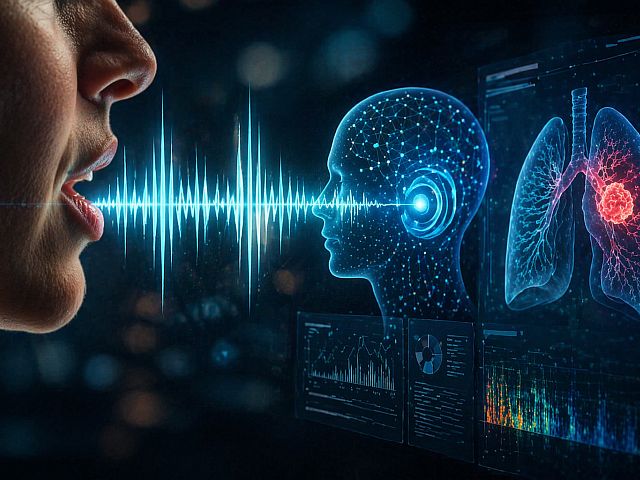
Early diagnosis of laryngeal cancer significantly affects the effectiveness of treatment. Today, it is usually performed using nasal video endoscopy and tissue biopsy, invasive procedures that can be difficult to access and take time. Delay in contacting a doctor delays diagnosis and initiation of therapy.
A new study published in the journal Frontiers in Digital Health suggests an alternative method. Scientists have found that small changes in a person’s voice can serve as indicators of vocal cord abnormalities. These “lesions” may be benign, such as nodules or polyps, but can also signal early stage laryngeal cancer. The study results suggest that artificial intelligence can be used for early cancer detection through voice analysis.
The research team participated in the Bridge2AI-Voice project, which is part of the national Bridge to Artificial Intelligence (Bridge2AI) initiative at the US National Institutes of Health. The goal of the project is to apply AI to solve complex biomedical problems. The study analyzed speech tone, pitch, loudness, and clarity using the first public version of the Bridge2AI-Voice dataset, which included 12,523 recordings from 306 participants in North America.
Only a portion of these recordings were from people diagnosed with laryngeal cancer, benign vocal cord growths, or other voice disorders such as spasmodic dysphonia or unilateral vocal cord paralysis. The researchers analyzed several measurable characteristics of speech: average fundamental frequency (pitch), jitter, which represents small variations in pitch, shimmer, which shows changes in amplitude, and harmonic-to-noise ratio, which compares structured sound to background noise.
Differences in pitch and harmonic-to-noise ratio were found among men without voice disorders, with benign lesions, and with laryngeal cancer. The same patterns were not observed among women, although scientists believe that more data may reveal significant trends. The study results suggest that changes in harmonic-to-noise ratio can be used to monitor vocal cord health and early detection of laryngeal cancer, especially in men.
https://forum.issabel.org/u/silkbeet93
https://farangmart.co.th/author/sleetrain72/
https://www.giveawayoftheday.com/forums/profile/1763982
http://jobs.emiogp.com/author/tailpigeon10/
https://irte.duiko.guru/forums/users/visesnake29/
http://jobboard.piasd.org/author/turkeyicon82/
https://gratisafhalen.be/author/fatherisland50/
https://www.demilked.com/author/tailcereal34/
https://www.ludikarus.com/author/lumberpeak59/
https://buyandsellhair.com/author/teamsense92/
https://onlinevetjobs.com/author/theorypigeon59/
https://oiaedu.com/forums/users/lumbernote59/
https://servodriven.com/forums/users/fatherpeak33/
https://platform.joinus4health.eu/forums/users/rayonfield46/
https://moeamine.com/author/tailisland05/
http://warblog.hys.cz/user/lumbereditor51/
https://sundaynews.info/user/sleetviola98/
https://itkvariat.com/user/mirrorkey99/
https://tvoyaskala.com/user/silkcereal38/
https://socialisted.org/market/index.php?page=user&action=pub_profile&id=474907
https://travelersqa.com/user/legbeet21
https://test.najaed.com/user/rayonborder96
http://gojourney.xsrv.jp/index.php?rayonpeak24
https://askmotopros.com/user/farmpigeon45
https://www.tvbattle.com/index.php?page=user&action=pub_profile&id=288858