American AP news agency reporters witnessed the destruction of homes and learned the thoughts of Iranian people on the road from the Turkish border to the capital Tehran.
A black banner hung on the border between Türkiye and Iran on April 4 expressed determination to take revenge on the US and Israel, next to a portrait of the late Supreme Leader of Iran Ali Khamenei. He was assassinated in a February 28 US-Israel raid.
Reporters from the US news agency AP entered Iran from Türkiye. During the 12-hour drive south to the capital Tehran, they watched as daily life continued in a country at the center of a regional war that has rocked the world economy.
People walk towards the border with Türkiye at the Razi border gate in Razi, Iran, April 4. Image: AP
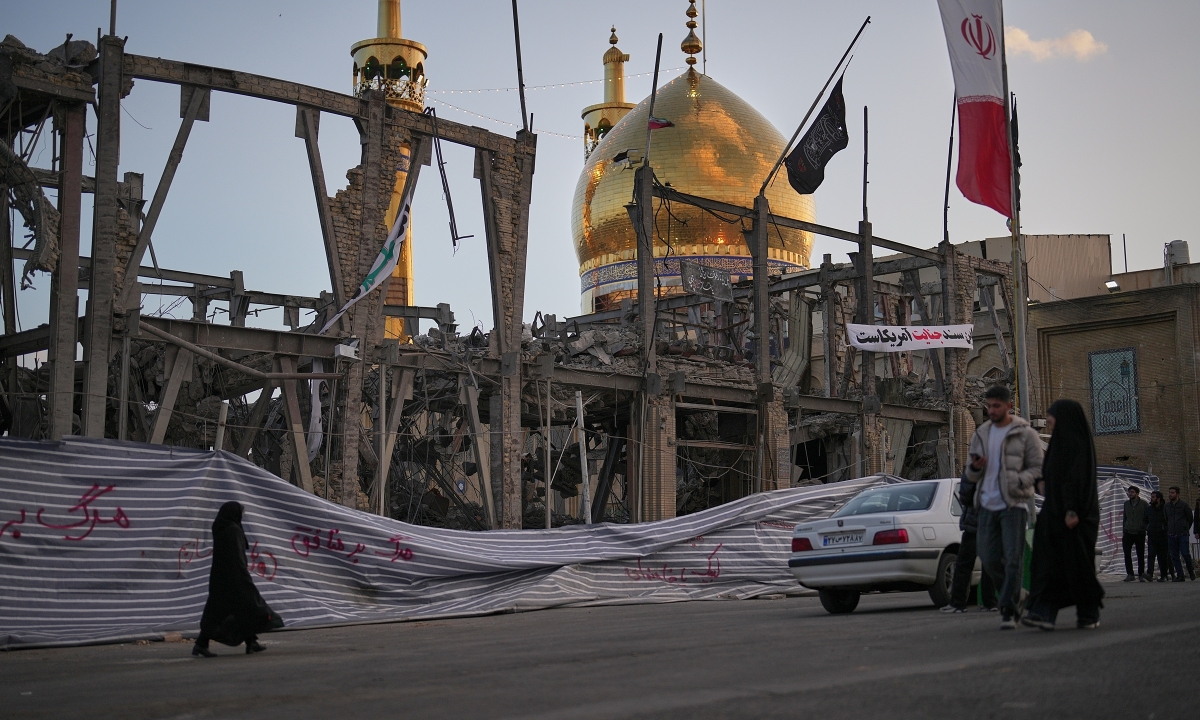
The first major signs of the war’s destruction appeared in the northwestern city of Zanjan, about a six-hour drive from the border. Iranian officials said an airstrike hit a religious community center known as a husseiniyah, killing two people and destroying a clinic and a library. Other structures in the complex, including centuries-old structures such as the gilded dome, were damaged.
When asked about the attack on Zanjan, the Israeli military said it hit “a military headquarters” and confirmed it avoided harming civilian facilities, without further explanation.
“This loss makes me very sad,” said Somayeh Shojaei, a local resident who regularly attends religious and cultural events at the center.
The attack killed the library custodian and an Iranian Red Crescent volunteer, according to Jaafar Mohammadi, the province’s director of Islamic culture and guidance.
The poor used to receive free treatment at the association’s clinic, and students frequented the library, which kept more than 35,000 books, including many ancient manuscripts. Mr. Mohammadi did not know why the complex was targeted.
“Iran wanted to negotiate peace with US President Donald Trump, but Trump responded with war,” Mohammadi said. “He started the war, but we will definitely win.”
A destroyed building inside the Grand Hosseiniyeh complex in Zanjan, Iran, April 4. In the background is the Muslim temple that was attacked in late March. Photo: AP
The American reporter described that on April 4, traffic was normal in cities on the route to Tehran. Markets and shops are still open, people walking on the streets. A restaurant serving Iranian specialties such as grilled lamb and rice, barley soup and saffron drinks while songs sing Losing my religion (Losing Faith) by the American music group REM rang out on the loudspeakers.
Many women go out without wearing a scarf to cover their heads. The group of reporters passed through two checkpoints on the way into Tehran and were not stopped. The Iranian capital was eerily quiet after midnight. The night before, the city had suffered a fierce raid on the mountains on the edge of the capital.
The US and Israel have carried out thousands of air strikes on Iran. The capital Tehran is the place that suffered the main damage. Iranian authorities said more than 1,900 people were killed. It is unclear how many of them are soldiers and civilians.
A truck loaded with wood and other vehicles moves along the road towards Tehran, near the Turkish border on the outskirts of Razi, northwestern Iran, April 4. Image: AP
Many government buildings and police stations were destroyed. The group of reporters passed through several checkpoints. They must stop once, open the car door and show their press card before being allowed to continue.
Fuel is highly subsidized, a liter of gasoline is only about 0.0375 USD. But people are only allowed to buy about 20 liters at a time. No one waited in line to get gas.
On April 4, US President gave Iran 48 hours to reach an agreement to reopen the Strait of Hormuz if it did not want civilian infrastructure, including bridges and power plants, to be destroyed. Mr. Trump then postponed the deadline until 8:00 p.m. on April 7 (7:00 a.m. on April 8, Hanoi time). With 12 hours left until the deadline, he warned that “Iranian civilization “will perish” if Tehran does not meet the demands, but also left open the possibility of a last-minute deal.
Meanwhile, Iran warned that if Washington crossed the “red line”, it would launch retaliation beyond the Middle East, and cause the US and its allies to lose the region’s oil and gas resources.
Lili, who works in the arts sector in the capital, said she and her family do not plan to leave Tehran. “There is no truly safe place to take refuge: When infrastructure is targeted, almost every corner can be hit,” she said.
https://www.openrec.tv/user/OliverMorales13/about
https://triberr.com/EthanMurphy25
https://pennylane.ai/profile/MasonWhite23
https://theexplorers.com/user?id=2f4bcf20-60b5-4753-aa4b-a433a9266f46
https://www.fundable.com/jjkmwbskli-jjkmwbskli
https://log.concept2.com/profile/2893979
https://www.elephantjournal.com/profile/qwqsbtfaxi/
https://telegra.ph/httpswwwfarmpallycomabout-us-03-12
https://hedgedoc.envs.net/s/Bd0ImTjt-
https://pinshape.com/users/8925407-alexandermartinez22?tab=designs
https://bsky.app/profile/qryvmgjpkj.bsky.social
https://www.fundable.com/esmkywykhi-esmkywykhi
https://telegra.ph/httpsplayawheelscom-03-31
https://hedgedoc.envs.net/s/JsEgU74Ls
https://www.brownbook.net/business/54963401/playawheels
https://www.40billion.com/profile/506771055
https://promosimple.com/ps/474a3/https-playawheels-com
https://promosimple.com/ps/474a4/https-smartappliancecare-co-za
https://telegra.ph/httpssmartappliancecarecoza-03-31
https://hedgedoc.envs.net/s/VM3Vi-98M
https://skitterphoto.com/photographers/2562321/kjyhahebvw
https://kumu.io/kjyhahebvw/kjyhahebvw#untitled-map
https://pinup-casino-resmi.com/
https://pin-up-az.ru/
https://pinup-casino.cc/