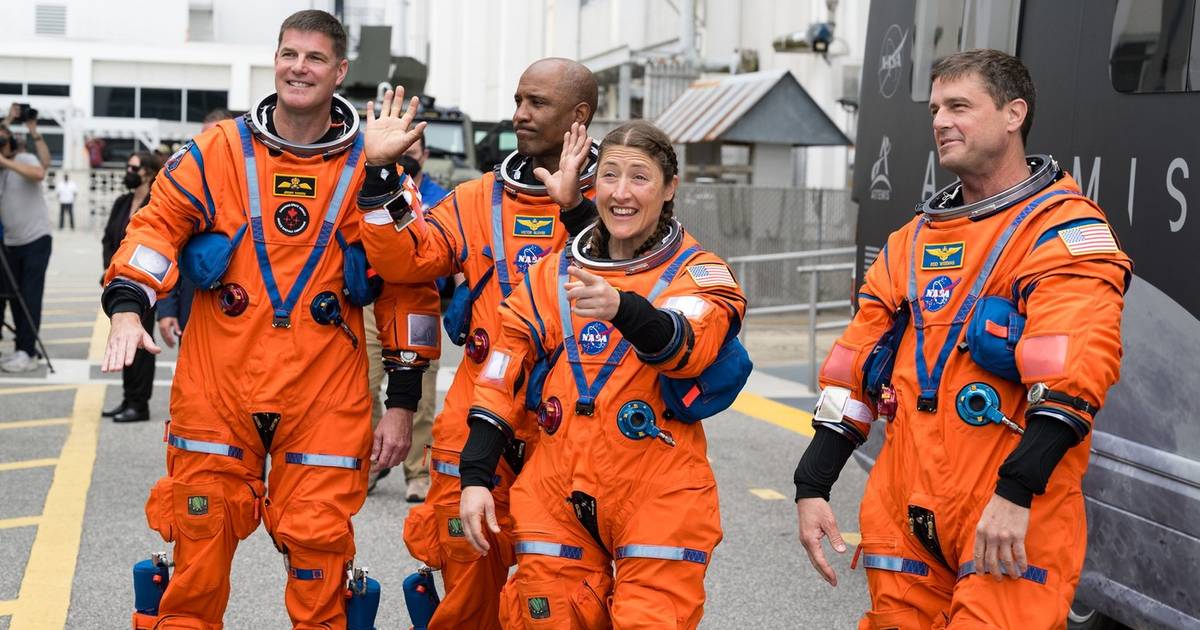
After a historic ten-day journey around the moon, the four-member crew of the Artemis II mission enters the final and most secretive phase of its flight, the return to Earth. Millions of people watched their launch, and now all eyes are on the Pacific Ocean, where the Orion capsule will land after more than 50 years since the last human flight to our natural satellite.
Four astronauts – NASA Commander Reid Wiseman, Pilot Victor Glover and Mission Specialist Christina Koch and Jeremy Hansen from the Canadian Space Agency (CSA) – are on their way home after breaking the record for the farthest human flight from Earth. Their landing, known as a “splashdown,” is scheduled for Friday, April 10, at approximately 5:07 p.m. local time (PDT), which corresponds to 2:07 a.m. Saturday CET.
The landing location was pinpointed: the Pacific Ocean, on the open sea, approximately 50 to 80 miles off the coast of San Diego, California. The weather forecast for the area is favorable, with light winds and waves within the safety limits set by NASA, despiteč approach of the Pacific storm system.
Fire trail in the sky over California
While photos of rocket launches have become commonplace, scenes of space capsule returns are much rarer. Many are wondering if Californians will be able to see the landing of Artemis II. The answer depends on a number of factors, but experience from previous missions shows that it is possible. Unlike launch, the spacecraft’s return through the atmosphere looks like a bright, fiery trail in the sky, similar to a meteor.
During the return of SpaceX missions from the International Space Station, such scenes were visible hundreds of kilometers away. For example, the return of the Crew-6 mission near Jacksonville, Florida left a bright trail visible even above the Kennedy Space Center on the other side of the state. Similarly, the trail of the Crew-7 capsule that landed near Pensacola was seen as far as Mississippi.
The Orion capsule will enter the atmosphere at a speed of almost 40,000 kilometers per hour, and the friction will create temperatures of up to 1650 degrees Celsius. Although the landing will be during the day, there is a possibility that residents of the coastal area of San Diego will see a flash in the sky, and maybe even a sonic boom as the capsule breaks the sound barrier. Visibility will, of course, depend on weather conditions and the exact route.
Extraction operation practiced for years
After Orion touches the surface of the ocean, a huge and precisely coordinated retrieval operation begins, led by the US Navy in cooperation with NASA. The main role is played by the amphibious transport ship USS John P. Murtha, which is moreć sailed from San Diego and is in position. There are about 150 experts from NASA and several hundred sailors on board.
Captain Neil Krueger, who is on board, emphasized the complexity of the preparations.
- We are working on this with NASA for moreć for about 12 years, preparing for this day. The capsule enters the atmosphere very quickly, and the parachutes slow it down so that when it hits the water, it has a speed of only thirty kilometers per hour – said Krueger.
The crew extraction process is significantly different from that during the Apollo missions. As the director of NASA’s recovery team Lili Villarreal explains, this time everything is done with one, but more versatile ship.
After landing, teams in small boats and Navy divers will be the first to approach the capsule to secure it. Then a doctor entered Orion to assess the astronaut’s condition.
The crew will not be extracted together with the capsule. Instead, the astronauts will exit the spacecraft to a special floating platform, from where they will be picked up by helicopters and transferred to the USS John P. Murtha within two hours of landing. Only after the crew is safe will the process of soaking the capsule itself into the inside of the ship begin.
- I’ve been in the Navy a long time; this is the most exciting thing I’ve ever been a part of,” Krueger said.
https://monopoly-casino.biz/en/
https://monopoly-casino.biz/ro/
https://monopoly-casino.biz/de/
https://monopoly-casino.biz/pl/
https://monopoly-casino.biz/fr/
https://monopoly-casino.biz/it/
https://monopoly-casino.biz/el/
https://monopoly-casino.biz/nl/
https://monopoly-casino.biz/se/
https://monopoly-casino.biz/pt/
https://monopoly-casino.biz/bg/
https://monopoly-casino.biz/sk/
https://monopoly-casino.biz/hu/
https://monopoly-casino.biz/lt/
https://monopoly-casino.biz/gb/
https://monopoly-casino.biz/nz/
https://monopoly-casino.biz/lv/
https://monsterwin-gr.org/
https://monsterwin.eu.com/
https://monsterwin7.gr/
https://monsterwingr.com/
https://moonprincess100.com.gr/
https://moonprincess100demo.com.gr/
https://mostbet-pt.eu/
https://mostbet.co.pt/