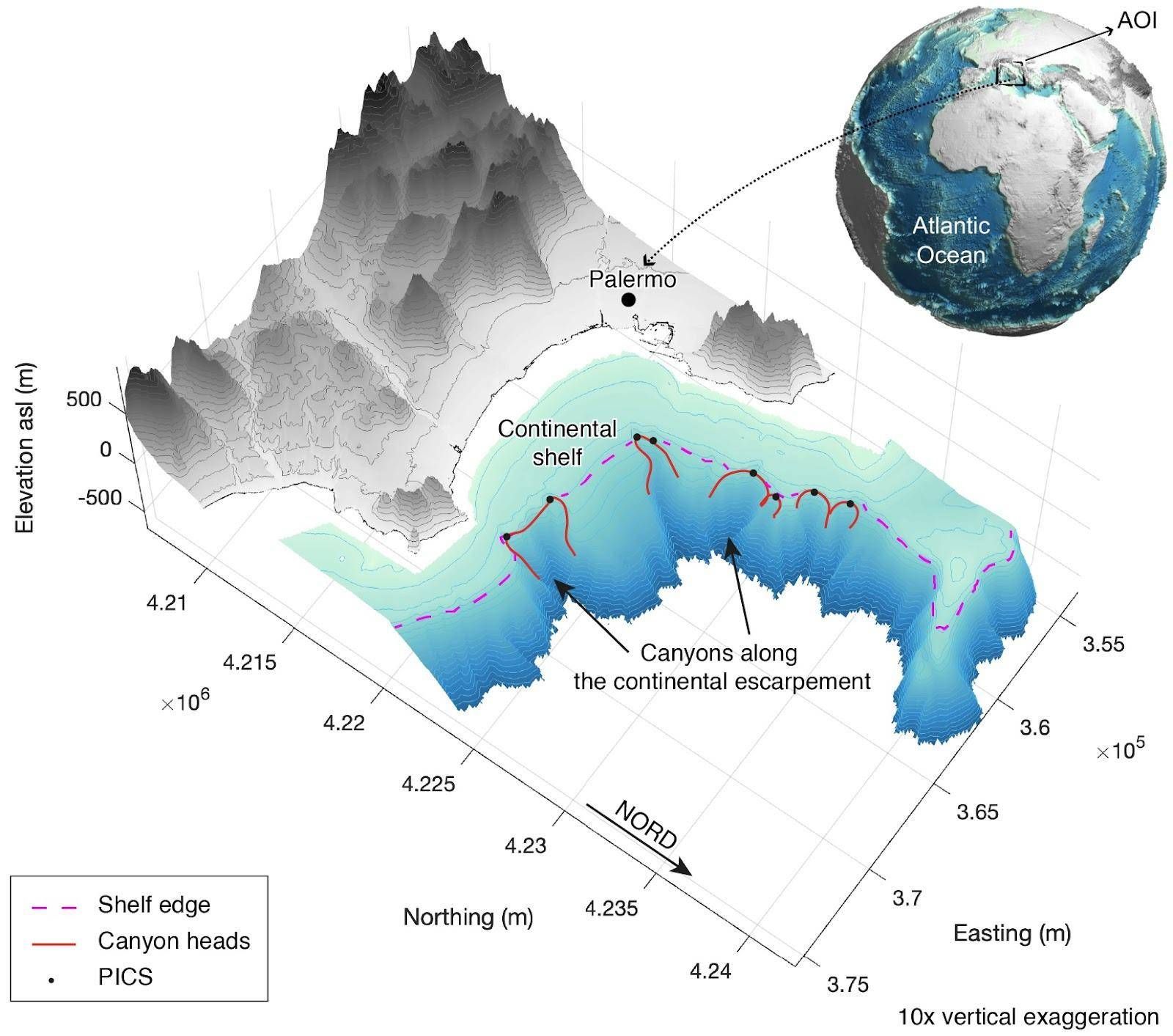
The stability of the Italian continental margins is closely linked to the evolution of submarine canyons, deep incisions in the seabed that act as preferential channels for the transport of sediments towards the abyssal plains. Research published in the journal Communications Earth & Environment ha examined the dynamics of over 2,700 canyon heads (the most superficial areas close to the coast), highlighting how their migration towards the coast is influenced by a combination of instrumental seismicity and fluvial sedimentary contributions. The integration of bathymetric data and satellite geodesy measurements has made it possible to map the areas most subject to retreat, providing new parameters for the assessment of underwater geological risks.
The use of machine learning models has allowed the processing of complex datasets relating to crustal deformations and regional seismicity. According to the researchers, tectonic activity acts as a primary driver in shaping the seascape, favoring conditions of gravitational instability along the slopes. “This work was carried out thanks to the availability of multiple public European and national datasets, many of which were produced by INGV, ranging from satellite data to bathymetric data“, explains Salvatore Stramondo, Director of the INGV Earthquake Department. “Italy is one of the few nations in the world to freely provide such a quantity of geophysical and geomorphological data whose integration allows us to improve the evaluation of the phenomena that shape coastal margins and to strengthen natural risk analysis tools“. The accessibility of these geophysical data allows us to strengthen the tools for analyzing natural risk in a complex basin such as the Mediterranean one.
Seismotectonic and morphological context of the Italian continental margins
The proximity to the mouths of the rivers represents the second determining factor: the load of sediment transported by the waterways contributes to fueling the dynamics of the canyons, accelerating the processes of erosion and retreat of the heads. “Submarine canyons represent real preferential routes for sediment transport towards the deep sea“, underlines Nicolò Parrino, Researcher at INGV. “In this work we used modern analysis techniques that use artificial intelligence to understand the factors that drive their evolution and this helps to reconstruct the interaction between tectonic processes, coastal dynamics and changes in the seascape“. Knowledge of these transport routes it is essential for the protection of submerged infrastructures, such as cables and pipelines, and for the planning of interventions along the over 8,000 km of Italian coastsareas often exposed to earthquake-induced processes which can directly affect the safety of the territory.
Cover image: 3D topo-bathymetric view of the Gulf of Palermo showing the heads of the submarine canyons along the continental slope. The black dots represent the starting points of the canyon carvings
https://www.fuelly.com/driver/marstevens
https://egl.circlly.com/users/marstevens
https://www.kongregate.com/en/accounts/suychquang
https://www.canadavisa.com/canada-immigration-discussion-board/members/suychquang.1348072/#about
https://www.alora.io/forums/user/844017-suychquang/
https://tekkenmods.com/user/137187/suychquang
https://edabit.com/user/ZSHgjuYJ7Qf4xhHjA
https://notionpress.com/author/1492866
https://gettr.com/user/236693651301531648
https://www.betmma.tips/mma_handicapper.php?ID=180734
https://scioly.org/forums/memberlist.php?mode=viewprofile&u=166430
https://www.provenexpert.com/tochkalubvi24/
http://www.place123.net/place/%D1%82%D0%BE%D1%87%D0%BA%D0%B0-%D0%BB%D1%8E%D0%B1%D0%B2%D0%B8-%D0%BC%D0%B8%D0%BD%D1%81%D0%BA-%D0%B1%D0%B5%D0%BB%D0%B0%D1%80%D1%83%D1%81%D1%8C
https://www.callupcontact.com/b/businessprofile/_/10042831
https://www.brownbook.net/business/54997938/%D1%82%D0%BE%D1%87%D0%BA%D0%B0-%D0%BB%D1%8E%D0%B1%D0%B2%D0%B8
https://www.cleansway.com/%D0%BC%D0%B8%D0%BD%D1%81%D0%BA-%D0%B1%D0%B5%D0%BB%D0%B0%D1%80%D1%83%D1%81%D1%8C/business/%D1%82%D0%BE%D1%87%D0%BA%D0%B0-%D0%BB%D1%8E%D0%B1%D0%B2%D0%B8
https://www.techdirectory.io/%D0%BC%D0%B8%D0%BD%D1%81%D0%BA-%D0%B1%D0%B5%D0%BB%D0%B0%D1%80%D1%83%D1%81%D1%8C/health-beauty/%D1%82%D0%BE%D1%87%D0%BA%D0%B0-%D0%BB%D1%8E%D0%B1%D0%B2%D0%B8