Global oil supply will be further tightened when Iranian oil cannot enter the market, affecting many importing countries in Asia.
Central Command (CENTCOM), the agency in charge of US military operations in the Middle East, said it began blocking all maritime traffic to and from ports in Iran from the morning of April 13. This follows the Strait of Hormuz blockade order previously announced by President Donald Trump.
“The blockade will be applied equally to ships of all countries entering and leaving the coastal areas in Iran, including all of the country’s ports in the Persian Gulf and the Gulf of Oman,” the notice read.
This move could further tighten the global oil supply. The Strait of Hormuz has been paralyzed since the Middle East conflict broke out, causing energy prices to skyrocket since the end of February. This is a maritime route that transported about 20% of global crude oil and liquefied gas before the war, mainly serving the Asian market.
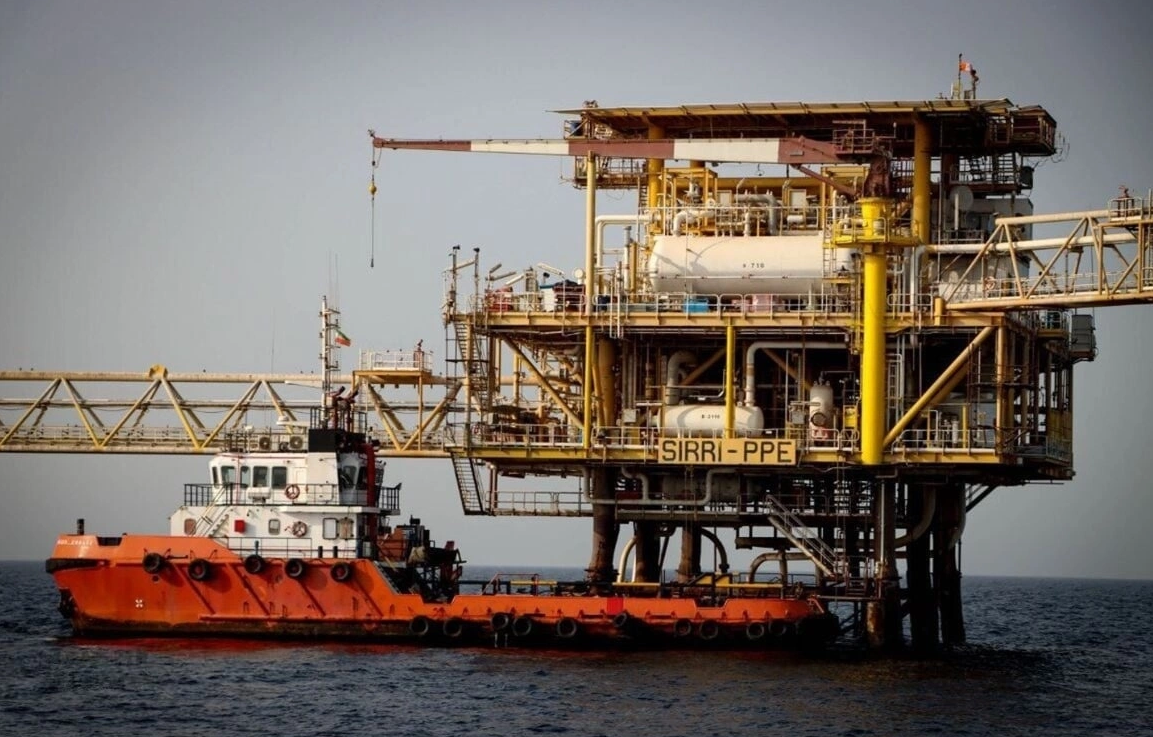
A ship anchored next to an oil rig off the Iranian city of Ilam in the Persian Gulf, September 2025. Image: Iranintl
However, about 2 million barrels of Iranian oil are still entering the market every day via Hormuz. According to data firm Kpler, Iran exported 1.84 million barrels a day in March and is expected to export 1.71 million barrels in April. These figures are up from the 2025 full-year average of 1.68 million barrels.
Iran’s sharp increase in output before the conflict broke out on February 28 has caused the country’s amount of oil loaded onto ships to reach a near record level. More than 180 million barrels of Iranian oil are in ships as of early April, according to Kpler.
However, even when the US and Iran announced a two-week ceasefire last week, ship traffic through Hormuz did not improve much. According to data firm LSEG, three super tankers passed through this strait on April 11. Each ship can carry up to 2 million barrels of oil. But this number is still much lower than the pre-war period, when more than 100 ships passed through here every day.
After Mr. Trump announced the blockade of the Strait of Hormuz, some oil tankers avoided the strait. Agios Fanourios I – a super tanker flying the flag of Malta was originally planning to pass through this strait on April 12 to receive Iraqi crude oil transported to Vietnam, but then turned around and is currently anchored near the Gulf of Oman. According to Kpler, as of April 7, about 187 ships transporting a total of 172 million barrels of crude oil and refined products are in the Persian Gulf.
The tightening of oil supply from Iran caused world oil prices to skyrocket on April 13. Currently, each barrel of Brent is priced at 102 USD, while WTI is up to 104 USD.
This could also affect many Asian countries that depend on oil supplies from the Middle East. Before the conflict broke out, most of Iran’s oil exports were shipped to China – the world’s largest crude oil importer. Last month, the US also announced a sanctions exemption mechanism, allowing countries to temporarily import Iranian oil.
According to ship tracking data released by LSEG and Kpler on April 8, India is expected to receive the first batch of crude oil from Iran in 7 years this week. Reuters Last month, it was also reported that many Asian oil refineries planned to buy Iranian oil after the US eased sanctions.
The conflict in the Middle East has reversed supply and demand forecasts in the crude oil market this year. Analysts predict oil demand will exceed supply by an average of 750,000 barrels a day this year. A similar survey last September showed the opposite result, with a supply surplus of 1.63 million barrels a day, mainly due to OPEC+ gradually increasing production.
The International Energy Agency (IEA) estimates that by the end of March, the conflict had reduced oil supply by about 11 million barrels a day. In its report on April 9, ANZ bank said that this number was 9 million barrels. In January, the IEA said total global oil supply stood at about 106.6 million barrels a day.
https://doc.micr0.dev/s/6_2WCzWUR
https://hedgedoc.obco.pro/s/bSGpgSbmr
https://md.renjikai.com/s/c6cluOhPM
https://hedgedoc.inqbus.de/s/n0MuOas-o
https://doc.wangdongdong.wang/s/GPkRfo4IO
https://dados.ufscar.br/user/maria26
https://pad.keks.cloud/s/feuaXPC0H7
https://hedgedoc.catgirl.cloud/s/CGKWl3TUUE
https://3dwarehouse.sketchup.com/by/thepointjetski
https://pad.keks.cloud/s/fN4ZuQk2Vx
https://pad.stadtfabrikanten.org/s/vmSu5G7bom
https://doc.dcrich.net/s/S-1jbQ3thg
https://doc.projectsegfau.lt/s/xVZrLFEzDr
https://mapacultural.petrolina.pe.gov.br/agente/50284/#info
https://notes.rabjerg.de/s/H1wuxg12-l
https://hedge.novalug.org/s/zdTy7pEZmV
https://md.emile.space/s/abKmKjElBs
https://pad.nik.mx/s/dv0lkFXQCq
https://pad.n39.eu/s/7AidZgTH_o
https://write.frame.gargantext.org/s/ryfOxhcjWe
https://siili.rahtiapp.fi/s/pCEN90rpY
https://pad.mytga.de/s/OnyaCahq5
https://doc.asknet.community/s/VqvPu7O-V
https://pad.nik.mx/s/qtNiR8Zs5B
https://datos15-21.slp.gob.mx/user/lasendadeloso