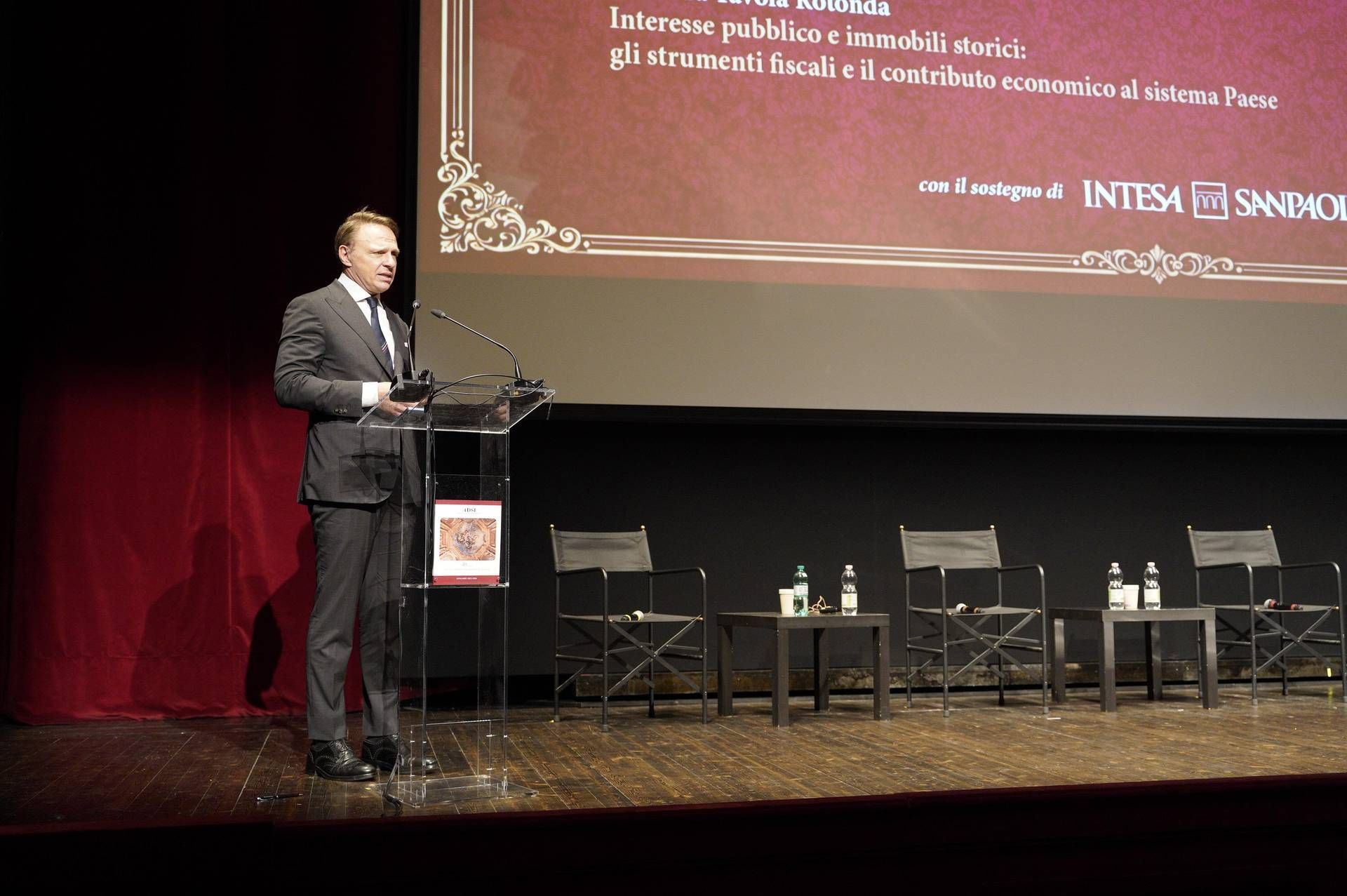
The Italian cultural heritage represents a potential economic driver, but for this to happen, collaboration between the public and private sectors must be supported by effective tools, first and foremost by an adequate regulatory framework. It is one of the messages that summarizes what emerged on the occasion of the 49th Assembly of the Italian Historic Houses Association (ADSI), entitled “Private heritage, public value: the role of historic homes for the country system”, held today at the Teatro Argentina in Rome.
The meeting, chaired by the President of ADSI, Maria Pace Odescalchi, was attended by Francesco Lollobrigida, Minister of Agriculture, Carlo Nordio, Minister of Justice, Maurizio Leo, Deputy Minister of Economy and Finance, Giorgio Mulè, Vice President of the Chamber of Deputies, Maurizio Lupi, member of the II Justice Commission of the Chamber of Deputies, Massimo Garavaglia, President of the VI Finance Commission of the Senate, Irene Manzi, member of the VII Culture Commission of the Chamber of Deputies, Antonio Calabrò, President of Museimpresa, Don Alessio Geretti, former manager of Jubilee 2025 art events for the Holy See and curator of the Illegio exhibitions, Massimiliano Giansanti, President of Confagricoltura, Renata Cristina Mazzantini, Director of GNAMC Rome, Francesco Spano, Director of Federculture, Giorgio Spaziani Testa, President of Confedilizia and Flavio Valeri, Vice President FAI national team.
The data from the VI Report of the Observatory on Private Cultural Heritage confirm the economic and social role of historic homes in Italy: approximately 46,000 private cultural assets distributed throughout the national territory, almost 30% in municipalities under 5,000 inhabitants, where they are cultural and identity landmarks; 60% generate direct value through activities in the tourism, culture and agriculture sectors, also contributing to youth employment; in 2024 over 35 million visitors, thanks also to the more than 20,000 entities promoting events and openings to the public; on the maintenance front, 85% of interventions are self-financed, with an average expense of more than 50,000 euros per year per asset; investments in restorations reached 1.2 billion euros for extraordinary interventions in 2024 and over 1.9 billion overall, equal to more than 10% of the GDP growth recorded in 2023; over 10,000 homes are ready to expand their activities in the presence of a more favorable regulatory environment.
During the debate, the need to strengthen collaboration between public and private institutions, which pursue the same objective of safeguarding the Italian cultural heritage, was underlined, so that it can realize its potential as an economic driver in the face of investments supported by stable and continuous instruments. Among these, the extension of the Art Bonus to private cultural assets, managed by foundations or third sector entities, would make investments in maintenance, restoration and valorization more sustainable, with positive effects on the connected supply chains and on employment in the territories.
The proposal put forward by Federculture to rationalize and harmonize VAT for restorations and activities in the cultural sector was also discussed, making the taxation more fair and favorable compared to other European countries. In the case of historic homes, this would recognize the public function of assets cared for by private individuals who are an active part of local communities, through openings to the public, tourist activities, cultural events and initiatives of collective interest. The debate, moderated by Andrea Ducci, was divided along two main lines: on the one hand, the management and development models of historic homes, which are increasingly central in combining protection and valorisation; on the other, the topic of taxation and economic impact, with the aim of identifying tools capable of supporting investments and strengthening the contribution of private cultural heritage to the country system.
“Historic homes are today an integral part of our country system, not only for their inestimable cultural value, but also for the concrete contribution they offer to the territories every day”. declared Maria Pace Odescalchi, president of the Italian Historic Houses Association. “They create employment, support entire production chains – from restoration and maintenance, to agriculture and quality food and wine – and promote responsible tourism that rediscovers the internal areas and smaller towns, guardians of our identity and memory”.
The event was also an opportunity for the announcement of the winners of the seventh edition of the Adsi Graduation Thesis Award, promoted by the Association to support young scholars who choose to dedicate themselves to the study and valorization of private cultural assets: the first prize went to the architects Elena Rizzico and Alessandro Piacentini, of the Polytechnic of Milan, for the thesis “Palazzo Franco in Vicenza. Methodological perspectives for recovery and valorization”. The second was awarded to the architect Nicola Gigli, for the thesis “Rural architecture of the Reggio Emilia Apennines: identity, knowledge, mission”, while the third prize was awarded to Dr. Concetta Sidoti Abate, of the University of Palermo, for the thesis “Museum houses and genius loci, promotion and cultural valorisation of a territory – a case study: Villa Piccolo di Calanovella in Capo d’Orlando”.
https://www.purcycling.com/group/sabaneros-mtb/discussion/c23ea944-6c39-42ec-90a2-9d741256f9cf
https://www.apruebaxtreme.com/group/grupo-aprueba-xtreme/discussion/a4cc80d3-2676-455a-869d-eadff60a56b8
https://ekologistakmartxan.org/eu/forums/topic/donde-encontrar-una-agencia-inmobiliaria/
https://guiacereza.com/foro/foro-general/que-tal-las-propiedades-en-malaga/25330
https://passionford.com/forum/groups/gamesbest-d2255-how-to-buy-property-in-spain.html
https://www.vam.ac.uk/blog/museum-life/stylish-spacious-apartment-sale-va#comment-925550
https://www.lasag.org.uk/group/asbestos-support-group/discussion/63d7ccb5-83d5-4263-99b8-e2e271072c8a
https://www.socialwellnessclub.co.uk/group/www-socialwellnesscl-group/discussion/93333cde-45f8-41b8-ba3b-64142b7d56b8
https://www.thecollegeofpracticalhomeopathy.co.uk/group/the-college-of-pract-group/discussion/6ae97793-b177-4011-b458-62123efd3134
https://www.occupationaltherapyni.co.uk/group-page/developmental-disability/discussion/c6069643-3669-41f2-9c96-58ec4d66e33a
https://www.futurepathway.co.uk/group/mysite-200-group/discussion/e56d0a20-27cf-4fa1-b752-ff3032b222a3
https://www.tantrafestivals.co.uk/group-page/tantrafestivals-co-u-group/discussion/b0677aeb-f0e6-41ae-8828-bff7287fd16a
https://www.merthyrtownfc.co.uk/group/international-martyrs/discussion/440530c3-f965-4586-82d4-8f1aa96bd0bf
https://www.orkanadventures.com/forum/tell-me-about-property-in-malaga
https://www.toyota-4runner.org/groups/atlanta-4runners-d2685-pricescope-talks-%C2%97-comparing-everyday-costs-across-countries.html
https://www.rctech.net/forum/groups/chatting-d7022-tracking-everyday-prices-around-world.html
https://www.adrex.com/en/forum/via-ferrata/comparing-everyday-prices-worldwide-83598/
https://megagrass.com/community/question-and-answer/forums/4133-general-questions/topics/3289378-coca-cola-cost-around-the-world
https://www.hdforums.com/forum/groups/arizona-riders-group-d3547-like-i-grabbed-a-bottle-of-coca-cola.html
https://forums.maxperformanceinc.com/forums/member.php?u=235251&vmid=21504
https://groups.diigo.com/group/TechNews/content/i-got-into-comparing-everyday-prices-20822931
https://urstyle.fashion/topic/2442811/started-paying-attention-to-global-price-differences
https://www.isarms.com/forums/media/snackprice-wanderers.8082/
https://offcourse.co/users/activity/836002/
https://forums.operationsports.com/forums/forum/other/non-sports-gaming/26896239-state-of-gaming-2026