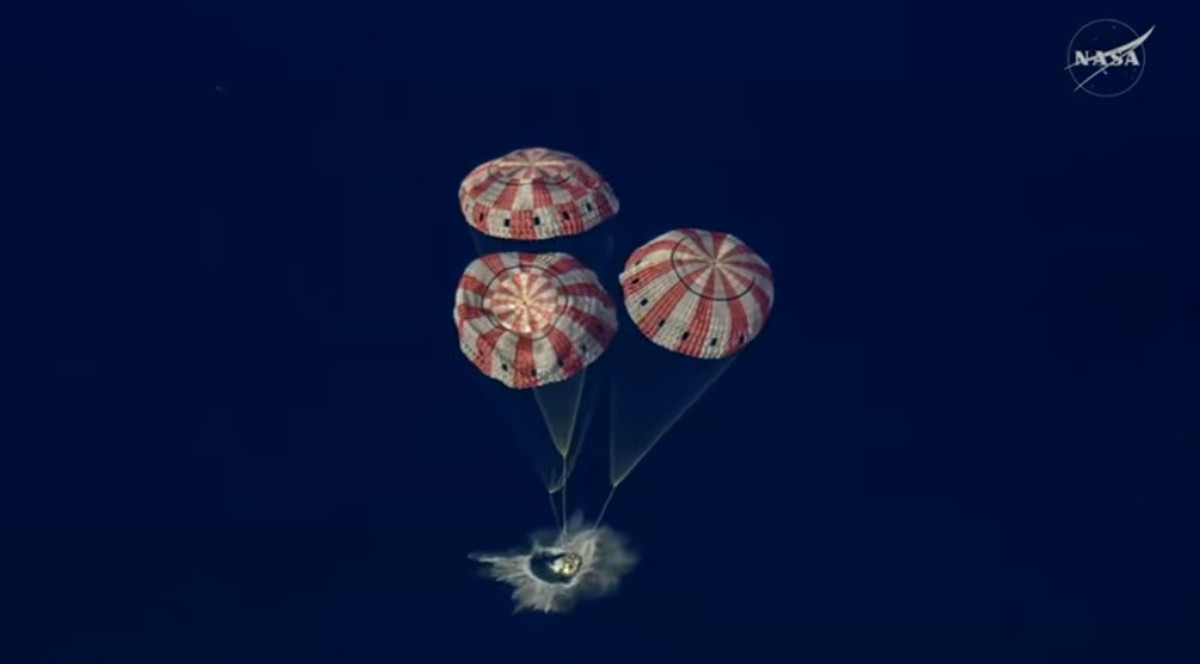
The return process was a masterpiece of engineering and precision. It began in the last hour when the Orion’s habitation compartment separated from the European Service Vehicle and turned its heat shield towards the atmosphere. The spacecraft met the upper layers of the air at a tremendous speed of about 40,000 km/h – 32 times the speed of sound.
In the critical phase of the landing, the spacecraft performed the complex Skip Re-entry maneuver. It entered the atmosphere, “bounced” from it back into space for a few seconds to lose speed and heat, and then dived back in for good. Tense minutes at the space center in Houston when the spaceship entered a 6-minute “blackout” in which it penetrated the atmosphere and plasma is formed around it causing the disconnection.
At the peak of penetration, the heat shield reached a temperature of approximately 2,760 degrees Celsius, which created a plasma envelope around the spacecraft and caused a tense blackout in front of the control center in Houston. When contact was resumed, the astronauts announced that the systems were working and they were in the final gliding phase. At a height of about 7 kilometers, the stabilization parachutes were deployed, followed immediately by the three main giant parachutes that graced the sky and brought the capsule to a soft and precise landing in the middle of the sea.
At this very moment, the rescue ship of the US Navy is approaching the capsule shaking on the waves. For the team, the medical challenge is just beginning. After ten days of weightlessness, the re-encounter with gravity (1G) is a severe physiological shock. The astronauts are expected to suffer from intense dizziness, nausea and a feeling of extreme heaviness in the limbs.
The medical team will perform initial tests already on board the ship, with an emphasis on blood pressure and heart function, to make sure that the “fluid loading” protocol they performed in space did indeed prevent fainting. In the coming hours they will be transferred to the Johnson Space Center in Houston, where they will be under close medical supervision for the next few days. The goal is to monitor the re-adaptation of the vestibular system (equilibrium) and the restoration of the bone and muscle density damaged by being in the void.
historical achievements
The Artemis 2 mission will be remembered as one of the most successful in NASA history. During the ten-day journey, the team achieved several groundbreaking goals:
The next flight in the series, the Artemis 3 mission, is expected to take place in 2028. This time, the mission will not be content with a distant orbit; It will include an actual manned landing on the surface of the moon, in the south polar region, including the first woman and the first black man to walk on its soil.
https://www.pcguia.pt/2026/04/como-fazer-entrada-no-ginja-casino-online-passo-a-passo/
https://pastelink.net/2hlvamw2
https://sites.google.com/view/ginja-casino-pt-online
https://coolors.co/u/GinjaCasino
https://pubhtml5.com/homepage/ehtel/
https://fliphtml5.com/homepage/wrfkv/ginja-casino/
https://www.twitch.tv/joguenoginja
https://telegra.ph/Cassino-Online-no-Seu-Bolso-Descubra-a-Experi%C3%AAncia-Mobile-do-Ginja-Casino-02-23
https://www.camaro6.com/forums/member.php?u=216808
https://www.pexels.com/ru-ru/@ginja-casino-2159871023/
https://rentry.co/hxmbddr7
https://geocaching.hu/users.geo?id=167295
https://writexo.com/share/45404acbb52b
https://slides.com/aritonovam/technologies-in-the-world-of-gambling-how-innovations-are-changing-the-industry/scroll
https://www.project1999.com/forums/member.php?u=323760
https://pinshape.com/users/8917854-bonusdoginja?tab=designs
https://te.legra.ph/Ginja-Casino-para-celular-divers%C3%A3o-na-palma-da-sua-m%C3%A3o-03-03
https://medium.com/@DmitrievaNika/ginja-casino-divers%C3%A3o-tecnologia-e-grandes-emo%C3%A7%C3%B5es-66c04bf0cbf5
https://md.openbikesensor.org/s/mcsRxsoOnj
http://linoit.com/users/ginjacasino/canvases/Plataforma%20Completa%20de%20Jogos%20Onl
http://webanketa.com/forms/6mv3ae9j6rqp8e9qcmwk8c1j/
https://collectednotes.com/ginja-casino-pt-online/ginja-casino-plataforma-moderna-de-jogos-online-em-portugal
https://ivebo.co.uk/ginjacasino
https://hpad.dataone.org/s/U0Q8uMWRy
https://www.pearltrees.com/ginjacasino/item787900000