American presidents and popes have publicly made conflicting statements, when the two sides had different views on important issues.
Recent tensions between US President Donald Trump and Pope Leo XIV are revealing deep differences between the White House and the Vatican over the war in Iran. From the Pope’s calls for an end to the conflict to Mr. Trump’s harsh reaction, this disagreement is attracting global attention.
“Enough of this war,” Pope Leo XIV said during a prayer for peace on April 11. He denounced the “illusion of unlimited power” that was fueling the escalation of conflict. The message, which does not mention any side by name, is understood as a call to return to the path of dialogue and multilateral solutions.
President Trump responded on April 12 with a post on the social network Truth Social, saying that Pope Leo XIV was “weak in fighting crime and very bad in foreign policy”. “I don’t want a Pope who thinks Iran can have nuclear weapons. I don’t want a Pope who thinks it’s bad that the US attacked Venezuela, a country that has shipped large amounts of drugs into the US,” Mr. Trump wrote.
Pope Leo XIV on April 13 declared that he is “not afraid of the Trump administration” and will continue to speak out for peace, the rare time the head of the Vatican mentioned an American presidential administration by name. The Pope emphasized that he was “not attacking anyone” and “blessed are the peacemakers”.
This is not the first time Mr. Trump has argued with a pope, nor is it the first time an American president has disagreed with the leader of the world Catholic community.
US President Donald Trump (left) and Pope Leo XIV. Image: AP
President Trump and Pope Francis
When running for his first term in 2016, Mr. Trump was involved in a controversy with Pope Francis, Pope Leo XIV’s predecessor, regarding his commitment to build a wall along the US-Mexico border.
“A person who only thinks about building walls anywhere without building bridges is not a Christian,” Pope Francis told reporters in February 2016, on a flight back to the Vatican after visiting Mexico.
Mr. Trump called Pope Francis’ comments “unbelievable” and “shameful.”
“No leader, especially a religious leader, has the right to question the religion or faith of others. I am proud to be a Christian and as president, I will not allow Christianity to be continuously attacked and weakened,” Mr. Trump wrote on social networks at that time.
The public disagreement between Pope Francis and President Trump on immigration continued throughout his first term and extended into his second term.
In February 2025, the Vatican published a letter from Pope Francis sent to American Catholic bishops, which strongly criticized President Trump’s mass deportation policy.
“The act of expelling people who in many cases have left their homeland because of extreme poverty, insecurity, exploitation, repression or serious environmental degradation, damages the dignity of many men and women, as well as of families, and places them in a particularly vulnerable and unprotected situation,” Pope Francis wrote in the letter.
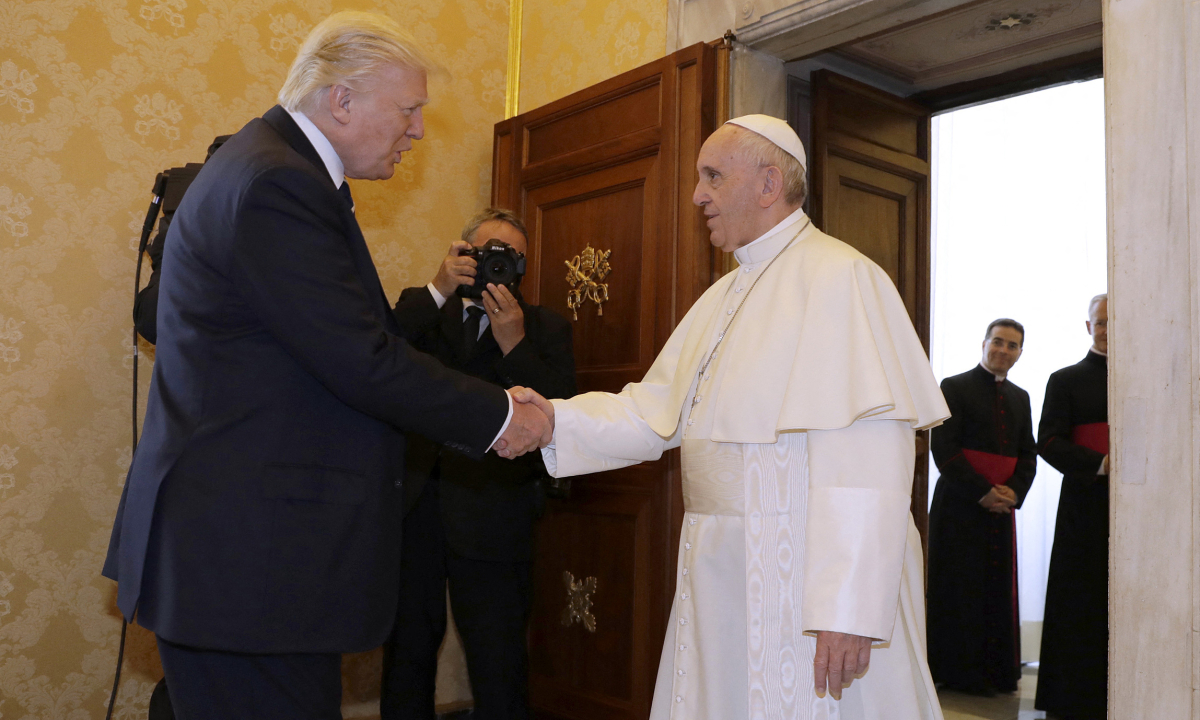
President Donald Trump (left) shakes hands with Pope Francis during his visit to the Vatican in May 2017. Image: AFP
President George W. Bush and Pope John Paul II
In July 2001, in his first meeting with President George W. Bush, Pope John Paul II called on the US to “reject” stem cell research from human embryos. The meeting took place at the Pope’s summer residence Castel Gandolfo near Rome, on the occasion of Mr. Bush’s visit to Italy to attend the G8 summit.
“A free and moral society, which America strives for, must reject actions that degrade and violate human life at any stage, from conception to natural death,” Pope John Paul II told President Bush.
US President George W. Bush (left) talks with Pope John Paul II at the Pope’s summer residence Castel Gandolfo, town of Castelgandolfo in July 2001. Image: AFP
A month after meeting with Pope John Paul II, President Bush announced in a televised address that he approved federal funding for stem cell research, using stem cell lines that already existed.
The White House boss noted that “this issue is still being debated within the church, with people of different faiths.” He said the US government approved the funding because research from the private sector has shown “great promise” in improving the lives of people with diseases such as type 1 diabetes, Alzheimer’s, Parkinson’s and spinal cord injuries.
“At its core, this issue forces us to confront fundamental questions about the beginnings of life and the limits of science,” Mr. Bush said. “It puts us at a difficult ethical intersection. On one side is the need to protect life at every stage, on the other is the opportunity to serve and improve the quality of life at all times.”
President Bill Clinton and Pope John Paul II
US President Bill Clinton had a disagreement with Pope John Paul II on the issue of abortion. During the 1992 election campaign, Mr. Clinton said his position on abortion was to make it “safe, rare and legal.”
At the first face-to-face meeting between the two in Denver, Colorado in August 1993, Pope John Paul II emphasized the “right to life” viewpoint.
“If you want equal justice for all, true freedom and lasting peace, then, America, protect life. All the great goals you are pursuing today only have meaning when you guarantee the right to life and protect people,” Pope John Paul II said in Denver, with Mr. Clinton standing next to him.
US President Bill Clinton and Pope John Paul II in Denver in August 1993. Image: AFP
During a meeting at the Vatican in June 1994, Mr. Clinton admitted that there were “real disagreements” with Pope John Paul II on contraception and population policy. The two continued to express their differing views on this issue at the United Nations population conference held in Egypt in September of the same year.
Despite the tensions, Mr. Clinton still praised the moral leadership of Pope John Paul II. The two sides also found common ground in efforts to support the poor, end conflicts and promote America’s global responsibility.
David Campbell, a political science professor at the University of Notre Dame, said policy disagreements between US presidents and the pope are normal, but he and his colleagues have never seen a “fight” like what is happening between Mr. Trump and Pope Leo XIV.
“This is an unprecedented level of criticism from an American president towards the pope,” Professor Campbell said.
https://belmontrecords.us/divorce-records
https://belmontrecords.us/inmate-search
https://belmontrecords.us/property-records
https://belmontrecords.us/warrant-search
https://beltramirecords.us/
https://beltramirecords.us/arrest-records
https://beltramirecords.us/court-records
https://beltramirecords.us/criminal-records
https://beltramirecords.us/divorce-records
https://beltramirecords.us/inmate-search
https://beltramirecords.us/property-records
https://beltramirecords.us/warrant-search
https://benningtonrecords.us/
https://benningtonrecords.us/arrest-records
https://benningtonrecords.us/court-records
https://benningtonrecords.us/criminal-records
https://benningtonrecords.us/divorce-records
https://benningtonrecords.us/inmate-search
https://benningtonrecords.us/property-records
https://benningtonrecords.us/warrant-search
https://bentonrecords.us/
https://bentonrecords.us/arrest-records
https://bentonrecords.us/court-records
https://bentonrecords.us/criminal-records
https://bentonrecords.us/divorce-records