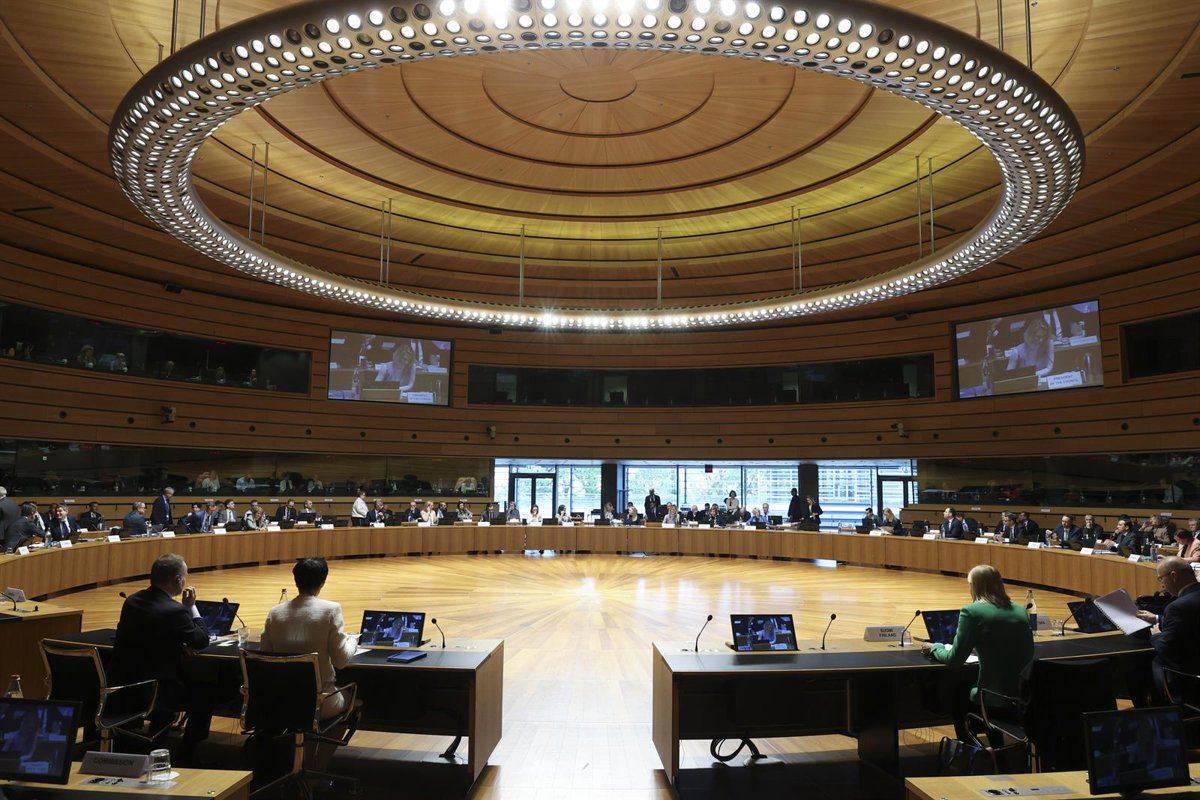
Several countries of the European Union have opened up this Tuesday to increase the pressure on Israel with the imposition of sanctions, as a first group of three countries, including Spain, ask the Twenty-Seven, although for now they do not contemplate the total suspension of the Association Agreement, a measure that Germany has described as “inadequate”, but are limited to trade measures.
Specifically, France and Sweden will present at the meeting of the Foreign Affairs Council (CAE) held this Tuesday in Luxembourg a document with proposals for the EU to limit trade with Israeli settlements in the West Bank, although they have not valued the demand of Spain, Ireland and Slovenia to suspend the treaty that grants Israel a preferential partner status for the EU.
This was announced by the Swedish Foreign Minister, Maria Malmer Stenergard, in statements to the media before attending the Foreign Affairs meeting, in which she assured that her joint proposal with France has more opportunities to succeed than that of Spain, which does not have “enough support for today”, and that it would only be enough for Hungary, with an incipient new government, to withdraw its veto on sanctions against the settlers.
His colleague from the Netherlands, Minister Tom Berendsen, has defended that it is “important” to increase pressure on Israel at this time, with the objective not merely of “suspending the commercial component, but of achieving a change of behavior” on the part of the country led by Benjamin Netanyahu.
The head of Dutch diplomacy has also expressed the opinion that the suspension of the Association Agreement with Israel would be a “severe” measure and that for now there is “no indication” that there is a sufficient majority for its approval, but in any case he has shown himself willing to probe what the Twenty-Seven think and whether recent Israeli actions have changed any position.
Belgium has been the country that has gone furthest of these four, stating that “it is evident” that the EU needs to “raise the tone on sanctions.” He has also defended “at least” the “partial” suspension of the Association Agreement, which would involve trade measures and could be approved with only the support of a qualified majority of countries.
“We are aware that a total suspension is probably out of reach, given the positions of the different European countries, but we must be able to act and focus the debate,” Belgian Foreign Minister Maxime Prévot said in statements to the media.
GERMANY SEES IT “INAPROPRIATE”
In contrast, Germany’s Foreign Minister, Johann Wadephul, has openly opposed the total or partial suspension of the European Union Association Agreement with Israel, describing such a measure as “inappropriate.”
Of course, he has shown himself willing to address “critical issues” with Netanyahu’s government, such as the introduction of the death penalty for Palestinians or settler violence in Israeli settlements in the West Bank, among other issues.
“I hope that the Israeli Government acts more clearly, firmly and with all the means of the rule of law against this violence,” he indicated, also being critical of any possibility of “annexation of the West Bank”, since in his opinion it would undermine the possibility of making the two-state solution possible.
Regarding Lebanon, the German minister referred to the recent ceasefire with Israel, and called for taking advantage of “the willingness to dialogue” to hold talks between both parties, “something that has not happened for 50 years.” “It is a sign of cautious hope,” he added.
SPAIN, IRELAND AND SLOVENIA REQUEST SUSPENSION
Spain, together with Ireland and Slovenia, brought to the meeting the debate on the review of relations with Israel due to the violation of Human Rights in Gaza, but also in Lebanon and the West Bank, with the focus on the Union’s breakdown of the Association Agreement.
The Minister of Foreign Affairs, European Union and Cooperation, José Manuel Albares, has demanded this Tuesday from his European partners firmness towards Israel and warned that the European bloc “risks its credibility” if it does not oppose with “the same voice, the same principles and objectives” the violence in the Middle East as it does in the face of other crises such as the Russian invasion of Ukraine.
The Government defends the complete breaking of the agreement – which would require the unanimity of the 27 – but Albares has said that they are willing to consider other measures that other Member States put on the table and, in this regard, he has recalled that to take the step of partially suspending the agreement, that is, affecting only the commercial pillar, “a qualified majority” of the partners is enough.
However, Albares has defended that since the 27 examined this possibility – six months ago, also at the request of Spain and other countries -, the situation in the Middle East has worsened to the point that what is happening in Lebanon or the West Bank is “unbearable.”
https://pincocasinokg.com.kg/
https://pinco-kazino-kg.com.kg/
https://pincokg.kg/
https://pincokg.com.kg/
https://pincobetkg.com.kg/
https://pinkocasino.com.kg/
https://pinko-casino.com.kg/
https://pinco-kg.org/
https://pincocasinokg.net/
https://pinco-kazino-kg.net/
https://pincokg.net/
https://pincobetkg.net/
https://pinco.com.kg/pinco-kyrgyzstan/
https://pinko.kg/pinko/
https://pinko.com.kg/rasmiy-web-sait/
https://pinco-kg.net/pinco-kg/
https://pincocasino.kg/kire-berish/
https://pincocasino.com.kg/online-web-site/
https://pinco-casino.kg/tokmok/
https://pinco-casino.com.kg/pingo-kg/
https://pinco-bet.com.kg/pilinko-kg/
https://pincoapp.com.kg/juktep-aluu/
https://pincocasinokg.com.kg/bishkek/
https://pinco-kazino-kg.com.kg/pingo/
https://pincokg.kg/karakol/