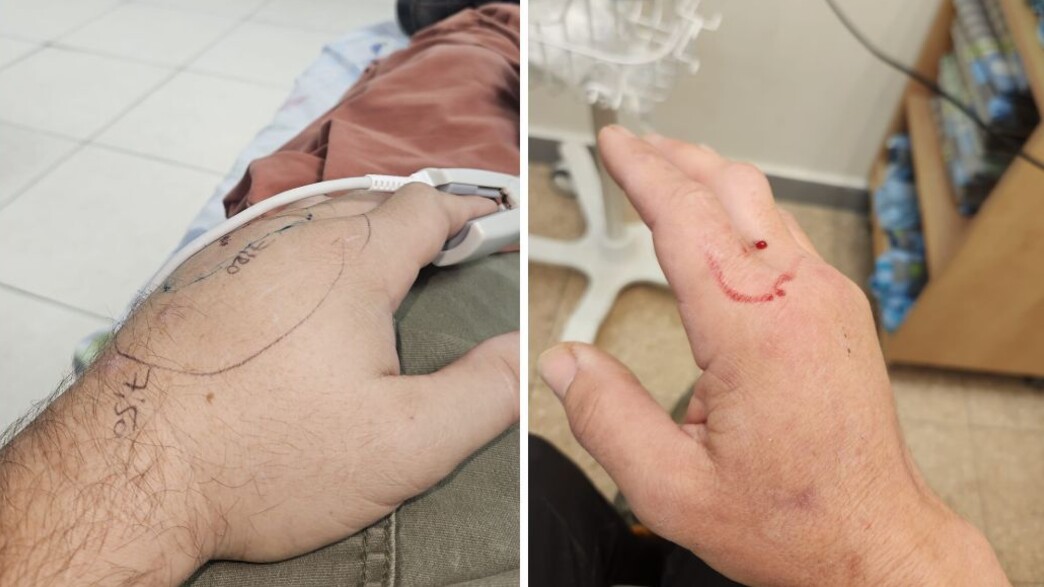
Screams of pain were heard last Friday in the streets of Beit Shemesh, after a 10-year-old boy was bitten by a snake near his home. “He was playing ball with his friends in the parking lot of the building, and when he ran to get the ball – a snake bit him in the hand,” say the neighbors. “He screamed in pain. His hand became red and swollen. We immediately put ice on his hand and within minutes rescue team vehicles arrived and started treating him.”
In recent weeks, additional cases of bites have been recorded across the country, from the north to the south, as the weather warms up, more Israelis are going for walks, spending time in gardens, yards and open spaces – and the snakes are also returning to activity.
“Snakes don’t chase people”
Zohar Lahat, a snake catcher, explains that in most cases the bite does not begin at all from an initiated attack by the snake – but rather from an attempt by the bitten to deal with it alone. “A lot of the bites happen when someone sees a snake and tries to kill it or trap it themselves, instead of calling a snake catcher,” she says. They push him into a corner – then he defends himself and attacks. You have to understand that a snake has no interest in biting a human being. As long as he can escape – he will. Snakes don’t chase people.”
According to her, many more cases of being bitten are due to carelessness – when people step on bushes, are in gardens and hiding places, or walk barefoot in the yard at night and thus accidentally step on a snake.
Lahat adds that the peak season is right now. “May and October have the most activity. Now is the height of spring, the breeding and courtship season, so you see a lot more snakes.” She says that in recent weeks there has been a clear increase in sightings and captures. Israel has about 40 species of snakes, but most of them are not poisonous. “The most common snake that exists in residential environments is the common viper, from the Beer Sheva area to the Hermon. But from the Gilboa to the desert areas in the south, the diverse Apea is more common.”
At the end of summer there is another increase in encounters with snakes. “In September and October, you see a lot of small snakes that have hatched from the eggs and are active, and then again there are many calls for snake catchers. In the winter, the activity decreases significantly because it is cold, but even then on sunny days you can still come across a snake.”
“You must not suck the venom or cut the bite site”
Dr. Itamar Mehul, a senior physician at Dr. Bilinson of the Klalit Group, explains that in Israel there are an average of 250 cases of snakebite each year, but in practice the number may be even higher. “There used to be a law that required reporting of every bite to the Ministry of Health, but it was repealed, so both the number of reports and the ability to estimate the extent of the phenomenon were affected,” he says. “This number also includes dry bites – cases where the snake bit but did not inject venom.”
According to him, the severity of the bite is determined by several key factors: the amount of venom, the weight of the bite, the location of the bite and the body’s personal reaction to the venom. “Children are at a higher risk compared to adults due to their low body weight. A bite in a sensitive area like the neck is also more dangerous than a bite in the hand or leg, where most bites occur.”
He adds that about 90 percent of the poisonous bites in Israel are caused by the Israeli land viper, which is also the most common and dangerous poisonous snake in Israel. “Snakes are attracted to places where they have food, so in agricultural areas – such as chicken coops – you see quite a few cases.”
He also mentions the black snake – a large, black snake is not poisonous. “He actually keeps vipers away from the area where he lives, so when you meet him it’s better to just stay away and respect his presence – and not try to kill him.”
In any case of a beating, he emphasizes, you should get to the hospital quickly and not try to treat the victim. “You should not try to suck out the venom or place a tourniquet. Likewise, you should not cut the bite site. You should keep calm, prevent unnecessary movement of the bitten organ and call the EMS.” According to him, the hospital also checks the status of the tetanus vaccine, and if the vaccine is not valid, the patient receives a corresponding vaccine.
“It is also important to try to identify the snake – it is advisable to do this by photographing it from a distance, without taking risks or trying to catch it, as this could lead to another bite. A description of the snake and the geographical location can also help us adjust the right treatment, but a picture definitely helps.”
https://swallowingdisorderfoundation.com/forum/users/keeling-v/
https://www.themoviedb.org/u/alexwolles
https://fyers.in/community/member/wsatvr1xIp
https://hanson.net/users/zaynee
https://scrapbox.io/taftie/%E0%A6%97%E0%A7%87%E0%A6%AE%E0%A7%87%E0%A6%B0_%E0%A6%9C%E0%A6%97%E0%A6%A4%E0%A7%87_%E0%A6%AA%E0%A6%A5_%E0%A6%B9%E0%A6%BE%E0%A6%B0%E0%A6%BE%E0%A6%A8%E0%A7%8B_%E0%A6%B8%E0%A6%B9%E0%A6%9C
https://blogs.bangboxonline.com/posts/gem-beche-newar-age-ken-tthz-jana-jruri
https://writexo.com/share/218aa3602bac
https://notepad.pw/markdown/j1rblxnob
https://500px.com/p/jetx_aviator
https://www.themoviedb.org/u/JetXgamee
https://www.dibiz.com/nemnogoznaal228
https://3dwarehouse.sketchup.com/user/d3ce9083-c504-4cf2-ae76-3e39fea809dd
https://fueler.io/jetxgame
https://edabit.com/user/KfFNPApyj3diMATbb
https://www.muvizu.com/Profile/JetX/Latest
https://www.behance.net/zayncoldee
https://smath.com/bts/Issues/IssueDetail.aspx?id=5333
https://huggingface.co/piterson1/rds33/blob/main/README.md
https://portfolium.com/entry/jetx-the-crash-game
https://sites.google.com/view/jetxgame-com/
https://www.kingmods.net/ru/profil/rocket-money
https://www.are.na/pin-up-eqlmanypxq8/jetx
https://www.spigotmc.org/members/alexandra23.2507716/
https://ecency.com/games/@thomwayne/jetx
https://recordsetter.com/submit/review?pend=711b3515-b839-4abb-8721-70ae62e19704