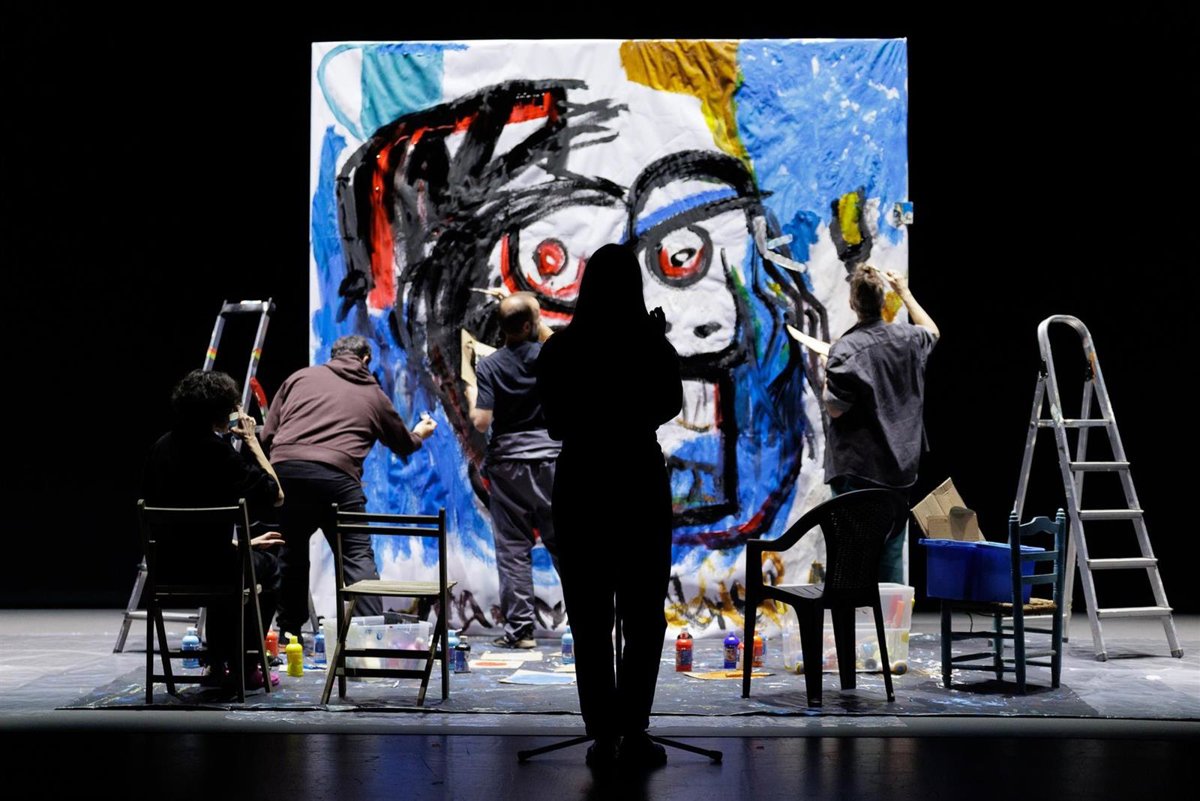
Four people painting a Basquiat painting; the inauguration of a member of the RAE; the trip of two Spanish tourists to the Kassel Documenta or an experimental film that gets into the viewer’s head are some of the seven scenes or living paintings that make up ‘lexicaln’, the new creation of the company El Conde de Torrefiel, which premieres in the National Dramatic Center, between April 24 and May 24.
The company aims to show the creative and, at the same time, finite force of the word. Tanya Beyeler and Pablo Gisbert, founders and members of the company, fill the María Guerrero Theater with their words, after 13 years in which the performers of their creations have not spoken on stage.
“Premiering this show here, in a space with the circumstances and characteristics of this theater, was a good opportunity to return to the word spoken live.“, explained Pablo Gisbert.
‘Lexicon’ is presented as a collection of stories in the style of Boccaccio’s Decameron or ‘One Thousand and One Nights’. “The viewer will find a play that is a parade, a sequence of independent scenes, but that are linked in some way.. Not for a narrative thread, but for a conceptual thematic thread, which is the use of words to build worlds,” added Tanya Beyeler.
According to El Conde de Torrefiel, the piece “is not about language, but rather tries to capture the duality of the word, which is at the same time air and poison, which allows you to express yourself while never being able to truly communicate.” Tanya Beyeler, Carmen Collado, Amalia Fernández, Ion Iraizoz and Mauro Molina are the interpreters and performers who bring the ‘Lexicon’ stories to life on stage.
The Count of Torrefiel summons multiple artistic languages on stage that are equal in importance to the spoken word. “There is painting, with all the materiality that that implies. There are very powerful choreographic and plastic scenographic moments.and others in which sound also creates scenography and dramaturgy,” revealed Tanya Beyeler.
In each scene there will be a protagonist element, which alternates between light, sound, a scenographic component or a technique. All of this with the aim of providing the viewer with a sensory experience that seeks to expand their perception. “It is another type of communication. We cancel the logos (the reason). We try not to speak the same language as the audience to expand the idea of communication. That is why we use music, especially sound space and the creation of sound fields, to try to break through the fourth, fifth and sixth walls,” Gisbert added.
https://morriscountycourt.us/divorce-records
https://morriscountycourt.us/inmate-search
https://morriscountycourt.us/probate-records
https://multnomahcountycourt.us
https://multnomahcountycourt.us/arrest-records
https://multnomahcountycourt.us/divorce-records
https://multnomahcountycourt.us/inmate-search
https://multnomahcountycourt.us/probate-records
https://muscogeecountycourt.us
https://muscogeecountycourt.us/arrest-records
https://muscogeecountycourt.us/divorce-records
https://muscogeecountycourt.us/inmate-search
https://muscogeecountycourt.us/probate-records
https://newcastlecountycourt.us
https://newcastlecountycourt.us/arrest-records
https://newcastlecountycourt.us/divorce-records
https://newcastlecountycourt.us/inmate-search
https://newcastlecountycourt.us/probate-records
https://newhanovercountycourt.us
https://newhanovercountycourt.us/arrest-records
https://newhanovercountycourt.us/divorce-records
https://newhanovercountycourt.us/inmate-search
https://newhanovercountycourt.us/probate-records
https://newyorkcountycourt.us
https://newyorkcountycourt.us/arrest-records