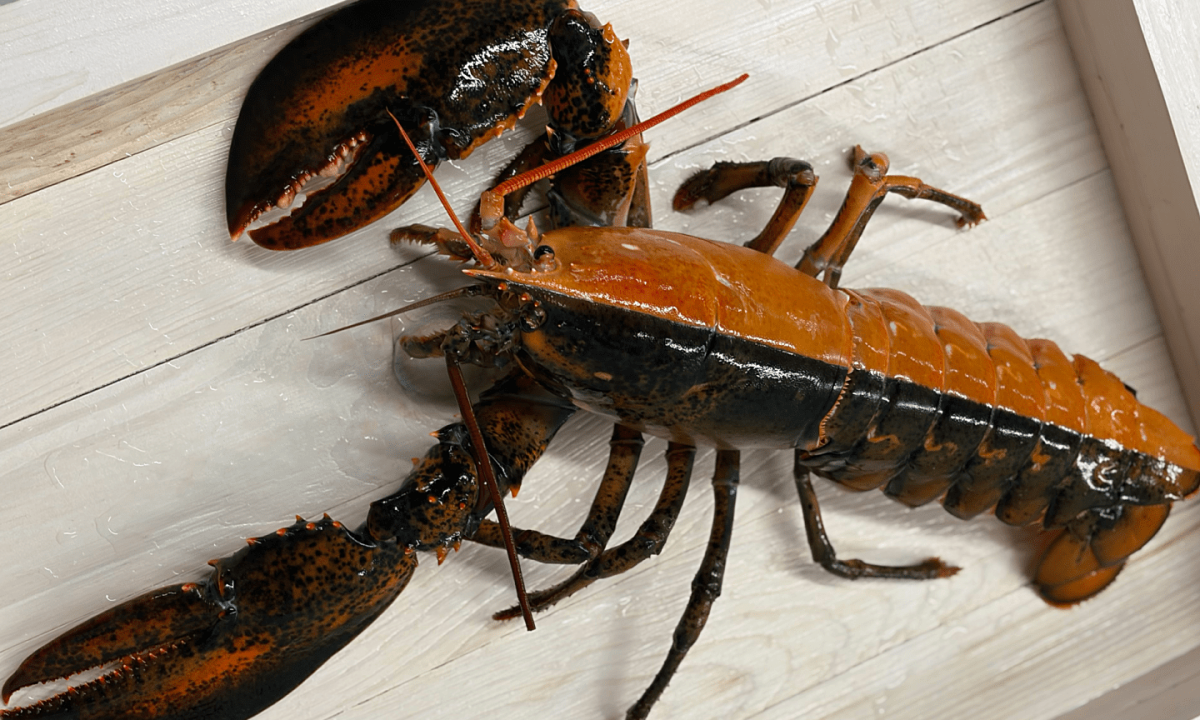
Wellfleet Shellfish, a Massachusetts seafood company, donated a rare bicolored lobster to the Woods Hole Scientific Aquarium, saving it from becoming food.
The particular lobster is typically brown on one side and bright orange on the other, the two-color boundary extending from head to tail. Wellfleet Shellfish considers this an “exciting and remarkable discovery”. The company has also received many inquiries about the animal in the past few days.
“While the Woods Hole Science Aquarium is under construction, the lobster is being cared for with other creatures in the tank at the Marine Biology Laboratory. When the aquarium reopens, the animal will be on display to give visitors a rare opportunity to observe one of the ocean’s most impressive anomalies,” Wellfleet Shellfish announced on April 27.
Previously, fishermen caught two-colored lobsters off the coast of Cape Cod on April 16. “Moments like these are why we do what we do: supporting fishing communities, protecting and sharing the wonders of the ocean with everyone,” said Wellfleet Shellfish.
Theo APoddly colored lobsters often appear in New England harbors during the spring and summer, but this bicolored specimen is rarer than most. American lobsters are usually mottled brown, but can have color abnormalities due to genetic mutations that affect proteins associated with pigmentation. Some are blue, some are orange, some are variegated, and others are so brightly colored that they are called “cotton candy” lobsters.
Two-color lobsters, half brown and half orange, are rare. Image: Conflict with the Shellfish Wellfleet
Marine science professor Markus Frederich from the University of New England said that two-colored lobsters may appear because two eggs fuse and develop into one individual. There are estimates of the rarity of lobster colors, but Frederich warns they are only relative.
According to the Seacoast Science Center, the probability of having a lobster with two colors on each side is only about 1 in 50 million. Wildlife experts told local news outlets WCB that this dichotomous color could also be due to genetic mosaicism, pigmentation abnormalities during development or hermaphroditism – a rare condition where lobsters have both male and female characteristics.
https://betmode.co.com/nl/download/
https://betmode.co.com/nl/free-spins/
https://betmode.co.com/nl/login/
https://betmode.co.com/nl/promo-code/
https://betmode.co.com/nl/registration/
https://betmode.co.com/nl/review/
https://betmode.co.com/no/app/
https://betmode.co.com/no/bonuses/
https://betmode.co.com/no/deposit/
https://betmode.co.com/no/download/
https://betmode.co.com/no/free-spins/
https://betmode.co.com/no/login/
https://betmode.co.com/no/no-deposit-bonus/
https://betmode.co.com/no/promo-code/
https://betmode.co.com/no/registration/
https://betmode.co.com/no/review/
https://betmode.co.com/no/welcome-bonus/
https://betmode.co.com/pl/app/
https://betmode.co.com/pl/bonuses/
https://betmode.co.com/pl/deposit/
https://betmode.co.com/pl/download/
https://betmode.co.com/pl/free-spins/
https://betmode.co.com/pl/login/
https://betmode.co.com/pl/no-deposit-bonus/
https://betmode.co.com/pl/promo-code/