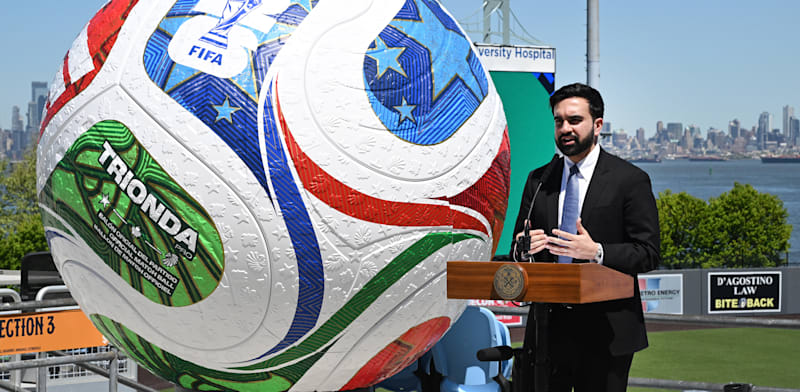
The 2026 World Cup tournament, which will open on June 11 in America, is expected to be one of the highlights in world football. However, in the United States, even before the tournament got underway, a less sporting question arose – how do you actually get to the games, and who should bear these demanding costs? In recent weeks, fans who have already managed to purchase tickets, began to understand that the real expense does not amount to the price of the FIFA ticket.
Take the state of New Jersey for example: there they are currently discussing a significant increase in train prices to MetLife Stadium, which will also host the final game. A round trip from Penn Station in Manhattan, which usually costs less than $13, can reach almost $100 on game day. The local press in New York is already calling it the “World Cup tax”, and the feelings of anger have already reached American politics.
Mickey Sherrill, the governor of the state of New Jersey, has in recent weeks attacked the agreement signed with FIFA even before she held office. According to her, the state received a “poor inheritance” – the soccer organization does not cooperate at all in financing public transportation, even though according to the governor it is expected to earn billions from the tournament. “I do not intend to pass on such costs to the residents in the coming years,” she said.
It should be noted that, although public transportation prices are usually fixed, cities and transportation authorities in the US have the option of raising prices temporarily during periods of unusual and crowded events, such as the 2026 World Cup. In such cases, the transportation authorities can approve “special event rates” for a limited period of weeks or months, alongside additional levies during rush hours and on game days.
Cost of 48 million dollars
It should be clarified that the operation of the special transportation system alone is estimated at approximately 48 million dollars. On the other hand, FIFA is supposed to put in its pocket, according to the predictions of the experts quoted in the American press, a huge sum of about 11 billion dollars from the World Cup.
In Washington, too, the atmosphere is noticeably heating up. Chuck Schumer, the leader of the Democrats in the Senate, stated that FIFA “rolls the bill to the public.” According to him, it is not true that the people of New York will pay for a profit of billions that will flow into FIFA’s pocket.
But the problem does not stop only at train prices. Those who plan to come to the MetLife complex with a private car are faced with parking prices that are now about $225 for one parking space, and the number of parking spaces is smaller than usual due to the expansion of the security areas and complexes around the stadium.
Private helicopter flights
Therefore, quite a few will choose to pay almost any price just to avoid traffic jams, and for this a completely new market has been created: private helicopter flights. Cities like New York and Boston already offer luxury packages that often cost tens of thousands of dollars, mainly for small groups. In Boston, for example, a helicopter flight of a few minutes can cost nearly $30,000 for eight people. And those who do not want to finance these flights, will probably have to deal with huge traffic jams in all the gaming areas.
In Boston, too, the prices for transportation to Gillette Stadium jumped to about $95 per passenger, and several other cities are trying to increase their bus, train, and shuttle transportation systems. However, the claim that “these systems weren’t really designed for this kind of tournament” is heard again and again, in official and less official circles.
Behind all this there is also a deeper question. The World Cup should be the flagship event for the United States in the coming years, a rare opportunity to show the world that the biggest sports tournament is taking place here, on American soil. FIFA claims that the games will lead to a total contribution of more than 30 billion dollars to the American economy, and the host cities expect millions of tourists to light up the streets. But as the tournament approaches, the picture includes quite a few headaches.
If you look at things in a broader context, the public transportation systems in the United States are having difficulty recovering from the effects of the corona epidemic. The traffic congestion in the big cities is breaking new records, and the debate over who will actually fund the congestion on the systems during the World Cup has become an acute issue in recent weeks.
The federal government intervenes
Even the federal government had to intervene – last March special funding of more than 100 million dollars was announced to improve the transportation systems in the host cities. The funds are intended to enable the operation of additional trains, security and special services for the days of the games. However, it seems that in most of the cities that will host the games, it does not seem that this will be enough.
Of the 104 games that will be held, 26 will take place outside the United States: 13 in Canada and 13 in Mexico. The United States will host 78 matches, including the playoffs and finals.
Dr. Amnon Schreiber, a researcher in the Department of Economics at Bar Ilan University, says that “the debate about the economic contribution of huge events is not new, and it is far from settled. The classic study by economists Robert Budd and Victor Matheson from 2004, which examined the 1994 World Cup in the USA, showed that in many cases the promised economic growth is a myth, and that the host cities sometimes experienced lower than average growth, due to suppression of normal economic activity.
“The economists point out that what appears to be an economic ‘boom’ is often simply a diversion of public budgets into private pockets, which puts the viability of hosting the World Cup in constant question.”
According to Dr. Schreiber, “from a purely economic point of view, the dynamics we are currently seeing in transportation and parking in the US is a case study of a collision between a rigid supply curve and a sharply rising demand curve.”
“Despite the criticism, it is important to understand that a price increase during a temporary increase in demand is not an ’employer’ in the economic sense, but an effective mechanism for determining priorities. In conditions of shortage,” explains Dr. Schreiber. “The price is used as a tool that enables the product or service to be obtained precisely for those who need it the most, or prioritizes it to the highest degree, thus preventing a situation of absolute shortage or huge queues.”
For your attention: The Globes system strives for a diverse, relevant and respectful discourse in accordance with the code of ethics that appears in the trust report according to which we operate. Expressions of violence, racism, incitement or any other inappropriate discourse are filtered out automatically and will not be published on the website.
https://ludios.co.com/fi/deposit/
https://ludios.co.com/fi/download/
https://ludios.co.com/fi/free-spins/
https://ludios.co.com/fi/login/
https://ludios.co.com/fi/no-deposit-bonus/
https://ludios.co.com/fi/promo-code/
https://ludios.co.com/fi/registration/
https://ludios.co.com/fi/review/
https://ludios.co.com/fi/welcome-bonus/
https://ludios.co.com/fr/
https://ludios.co.com/fr/app/
https://ludios.co.com/fr/bonuses/
https://ludios.co.com/fr/deposit/
https://ludios.co.com/fr/download/
https://ludios.co.com/fr/free-spins/
https://ludios.co.com/fr/login/
https://ludios.co.com/fr/no-deposit-bonus/
https://ludios.co.com/fr/promo-code/
https://ludios.co.com/fr/registration/
https://ludios.co.com/fr/review/
https://ludios.co.com/free-spins/
https://ludios.co.com/login/
https://ludios.co.com/lv/
https://ludios.co.com/lv/app/
https://ludios.co.com/lv/bonuses/