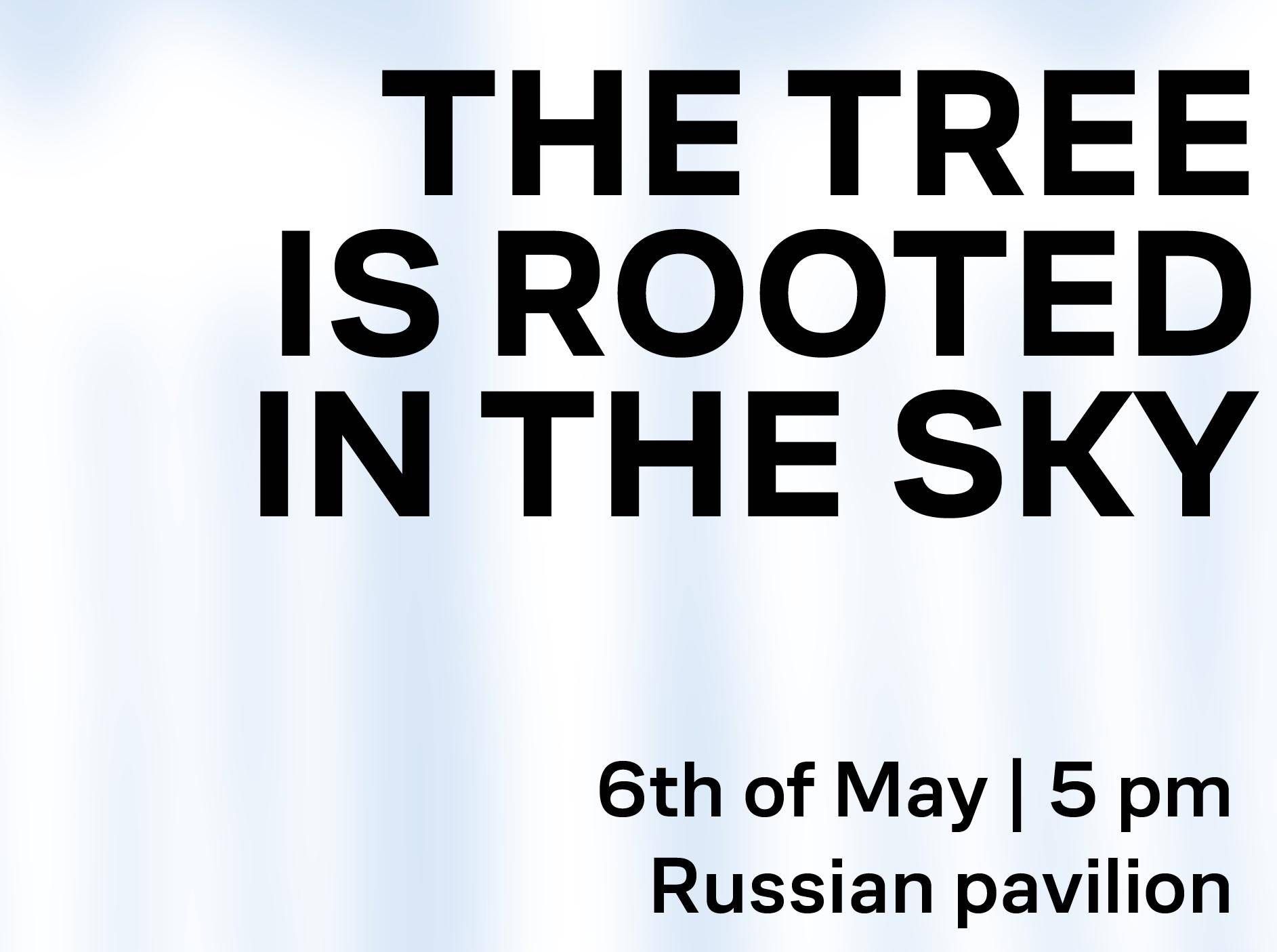
Wednesday 6 May promises to be one of the most controversial and politically charged days of the entire 61st International Art Exhibition of the Venice Biennale. In the Gardens, at the southern end of the city, in fact, in the same space of a few hours two events destined to remain symbolic will intertwine: on the one hand the opening (by invitation only) of the Pavilion of the Russian Federation at 5 pm, on the other a large artistic and political protest action scheduled for late morning, from 10 am to 1 pm, which will cross the public space between the entrance to the Gardens and the lagoon. A double appointment that crystallizes, once again, a deep fracture generated by the war in Ukraine and the geopolitical tensions between Russia and the European Union.
According to the invitation sent to Adnkronos by the commissioner of the Russian pavilion Anastasia Karneeva, the afternoon event on May 6th at 5pm is defined as “convivial” and “dedicated exclusively to the artists’ performances”. The context, however, is anything but ordinary. The Pavilion of the Russian Federation, present in the Gardens since 1914 and owned by the Moscow government, presents itself as a unique case in the entire 2026 edition: it will be the only national pavilion not accessible to the public for the entire duration of the event (9 May – 22 November).
The performance will have the title “The Tree is Rooted in the Sky”, a famous quote from the French philosopher Simone Weil, which indicates how vital energy, grace and the profound meaning of things come from above (sky/spirit), then leaving their mark on the earth. For this reason, a tree, according to what Adnkronos reports, has already arrived in the Russian pavilion to create the symbolic installation. During the performance – including music, art and readings – around fifty artists will perform, including Russians (all with visas) and others from Argentina, Brazil, Mali and Mexico.
A few hours after the official opening of the Russian pavilion, on the morning of May 6, a public action entitled “From the margins of the Empire to the open lagoon. Names. Faces. Voices” will take shape. The initiative is promoted by Arts Against Aggression, Memorial Italia and League of Free Nations, with the participation of artists and activists linked “to the indigenous and colonized peoples” of the Russian Federation. The participants will be defined as “living pavilions”, explain the organizers: “individuals who embody marginalized cultures, languages and identities, transforming their bodies into exhibition devices”. In the organizers’ statement, the performance fits into the context of the war in Ukraine and denounces the continuity between external military aggression and internal repression in the Russian Federation. According to their reading, the presence of the Russian pavilion at the Biennale would represent a form of indirect legitimation of political power, while indigenous communities would continue to be marginalized or assimilated.
Among the most radical voices of Russian artistic dissent is the Pussy Riot collective, which will be in Venice for a protest action. The collective will propose the exhibition “Resistance Imprisoned”, already presented in Strasbourg, which collects works created by political prisoners, former prisoners and artists who died in prison. According to founder Nadya Tolokonnikova, “the Russian penitentiary system today represents a contemporary form of cultural and political repression, in which art becomes an instrument of resistance”.
On the Italian front, the Minister of Culture, Alessandro Giuli, defined the situation as “already closed on a technical level”, after the inspection at the Biennale headquarters, postponing the final assessments to Palazzo Chigi. In the minister’s opinion, the president of the Biennale, Pietrangelo Buttafuoco, was “the victim of a peacemaking fantasy, he wanted the UN of art, he ended up deluding himself that he could carry out foreign policy. But this is up to the government and Parliament”. According to Giuli, “the Biennale caused the image damage to itself. As the prime minister said, Pietrangelo is very capable, yes, very capable of anything”.
The summary document of the ministerial inspection tomorrow, Monday 4 May, will be sent to Palazzo Chigi and will end up on the table of Prime Minister Giorgia Meloni and Undersecretary Giovanbattista Fazzolari. These, in summary, are the key points of the report drawn up by officials of the Ministry of Culture: no “formal invitation” to the Russian Federation, a timely verification of compliance with the European sanctions regime, the management of the cut in European Union co-financing of 2 million euros over three years for projects related to cinema and the choice of resignation of the international jury, informed of the “personal risk of exposure to compensation for damages” not only due to the warning from the artist representing Israel, Belu-Simion Fainaru, but also for the Foundation itself.
The document, consisting of seven pages, was drawn up by MiC technicians and countersigned by the Biennale on Thursday 30 April at 3.30 pm at the end of the inspection. A confrontation defined as “prosecution and defense”, with at the table, on one side, the head of cabinet of the minister Alessandro Giuli, Valerio Sarcone, flanked by Luca Maggi, Arianna Proietti and Orsola Bonifati, and on the other the general director of the Andrea Del Mercato Foundation with Debora Rossi, Francesca Oddi and Martina Ballarin for legal and institutional affairs.
On the Russian front, the Biennale clearly clarifies in the minutes that the Russian Federation was not formally invited and did not sign any participation document, as expected for other subjects involved. The Russian pavilion, a historic building dating back to the time of Tsar Nicholas II and restored in 2019, would have been the subject of communications to the competent local authorities, but without a uniform procedure permanently involving the Foundation. The Biennale also highlights the absence of a consolidated protocol for maintenance work on the national pavilions.
Ample space is also dedicated to verifying compliance with European sanctions against Moscow. The Foundation reports that it has carried out checks “at all possible times” on compliance with the regulatory framework, within the limits of available information and without the possibility of direct intervention on the projects presented. The declared objective was to verify the compliance of the initiatives with the restrictions in force, despite a complex operational context.
A further clarification concerns the nature of the inaugural event, the vernissage scheduled between 5 and 8 May, defined as a private appointment, by invitation and not open to the public. For this reason, the presentation of the Scia for public events would not be envisaged. The Biennale also adds that, based on the sanctions currently in force, the Russian Federation would not be able to obtain the necessary authorizations to open the pavilion to the public during the exhibition period. However, the Biennale informs that, by decision of the Foundation, “in the current edition of the catalog published by the Biennale the section relating to the participation of the Russian Federation will not be present as Russia’s participation is being examined in depth in light of the current regulatory framework”.
On a more general level, the Foundation reiterates its legal nature, distinguishing the Biennale model from that of the Expo: it is not an event that directly selects the participating States, but a platform in which the Countries independently choose to join.
Finally, a central chapter of the report concerns European co-financing of around 2 million euros over three years, linked to film projects. Faced with the risk of revocation by the European Commission, the Biennale has adopted a prudential line: in the 2025 budget, the amount relating to the advance already received for the two-year period 2026-2027 was entered into the risk fund, while the resources foreseen for the following years were maintained in the 2026 budget, already approved by the competent bodies. However, the Foundation Council reserved any decisions pending further developments with Brussels.
The second part of the minutes addresses the issue of the resignation of the international jury, resulting from the desire to refrain from evaluating for the purposes of the awards the countries whose leaders are accused by the International Criminal Court of crimes against humanity. A principle applied both to Vladimir Putin’s Russia and to Israel led by Benjamin Netanyahu. The Ministry of Culture asked the Foundation what measures it intends to adopt to protect its image and prevent possible compensation actions, after Fainaru’s lawyers had feared a request for damages for alleged discrimination. The Biennale reports that it has informed the jury of the risk of legal exposure, both for the appellant artist and for the Foundation itself, initiating discussions to clarify the position taken. The objective is to evaluate the consequences of the declaration and prepare possible responses to the lawyers and the supervisory authority. A few hours after the inspection closed, at 4.30 pm on April 30, the international jury formalized its resignation, closing a story that intertwines law, cultural diplomacy and institutional responsibilities in the delicate context of the 61st International Art Exhibition. (by Paolo Martini)
https://penzu.com/p/b6c023b5cb2c8715
https://all4webs.com/medicinweb/home.htm
https://medicinbook.substack.com/p/understanding-the-demand-for-tramadol
https://hackmd.io/@MedicinPro/home
https://cullencrawford.notion.site/Understanding-Codeine-Phosphate-30-mg-A-Closer-Look-332cda2cf8a680389616e575803c8f87?pvs=73
https://writeablog.net/gavinschaefer/understanding-the-demand-for-dihydrocodeine-30mg-tablets
https://johncornershop.hatenablog.com/entry/Understanding_the_Demand_for_Xanax_1_mg_Tablets
https://craigslistdir.org/buy-co-codamol-dosage-online_413724.html
https://classifieds.ocala-news.com/author/radishsecure1
https://buyandsellhair.com/author/virgogemini4/
https://nhadat24.org/author/felonystudy3
https://365d24h60m.com/forums/users/startresult4/
http://jobs.emiogp.com/author/oniontiger5/
http://dudoser.com/user/brokerlink4/
https://sub.elfejewelry.com:443/index.php?rodriguezlacroix594255
http://csmouse.com/user/tunebottom8/
http://kriminal-ohlyad.com.ua/user/peruperu4/
https://www.rvparking.com/user/506315
https://www.indiesound.com/track/138807
https://uconnect.ae/post/962898_secure-online-ordering-for-uk-sleep-treatments-we-offer-secure-online-ordering-f.html
https://to-portal.com/post/472150_reliable-online-pharmacy-for-uk-sleep-needs-we-offer-a-reliable-online-pharmacy.html
https://sparktv.net/post/939413_trusted-sleep-medication-supplier-online-uk-we-provide-a-trusted-online-supplier.html
https://www.mediafire.com/file/o4fsugcfp6pfjpp/Buy_Sleeping_Pills_and_Medications_Online_Safely.pptx/file
https://pixeldrain.com/u/vd6jApDZ
https://techywellnesswork.amebaownd.com/posts/58642184
https://all4webs.com/julionewton/pregabalin300mg.htm
https://skylarhumphrey.notion.site/Understanding-the-Rise-of-Buying-Tramadol-Capsules-Online-330af36b7a1680c6844acc6f995e1a9f
https://blogfreely.net/medicinworld/understanding-the-increasing-demand-to-buy-dihydrocodeine-phosphate-tablets
https://postheaven.net/medicindesign/understanding-the-growing-demand-for-co-codamol-tablets
https://rant.li/404lsjekbz
https://writeablog.net/medicintech/understanding-the-growing-demand-to-buy-zopiclone-7-5-mg-online-in-the-uk
https://topmedicin.blog5.net/91542393/the-rising-demand-to-buy-zopiclone-tablets-what-consumers-need-to-know