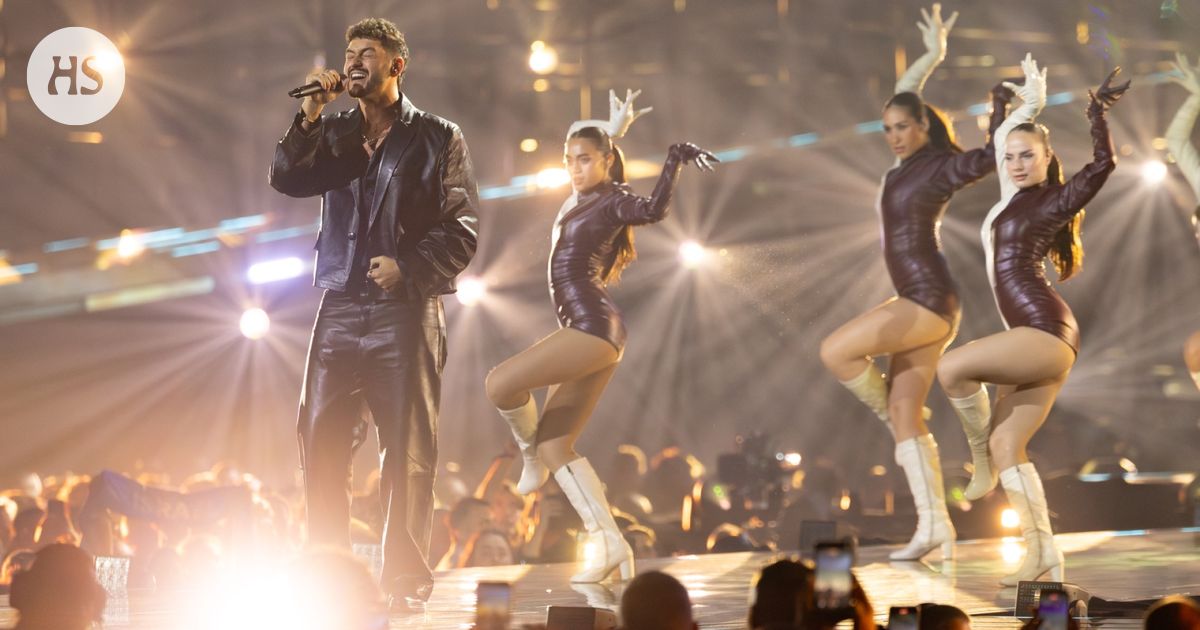
EurovisionThe EBU of the European Broadcasting Union is forced to make changes in order for Eurovision to have a future, expert Anna Muurinen believes.
Eurovision expert Anna Muurinen believes that the European Broadcasting Union Ebu is forced to make changes in order for Eurovision to have a future.
Israel’s success in public votes and the boycott of five countries this year create uncertainty around the competition.
According to Muurinen, the coming weeks will show whether we will be satisfied with the current event.
Eurovision are currently in a completely exceptional situation, says the journalist and Eurovisa expert Anna Muurinen.
Not only did Bulgaria’s victory manage to surprise even connoisseurs like Muurinen, Israel’s participation and success also creates uncertainty about the future of the singing competition.
Israel’s war in Gaza has caused widespread protests. This year, five countries boycotted the Games because Israel was not excluded. This is how it was done with Russia after it started the war against Ukraine in 2022.
“This Israel pattern is really interesting. They came second and have received really good rankings in recent years. And on the other hand, the head of the Eurovision Song Contest Martin Green on flashedthat Russia could also return to the competition. In that case, it would be really interesting to see who else would like to participate in the Games in the future and who wouldn’t,” Muurinen reflects.
Last in Israel received an avalanche of votes in the public vote. Later, Ebu’s investigative body concluded that Israel’s vote fishing had been government-driven.
After that, the rules of the song contest were changed so that the maximum possible number of votes given by an individual voter was halved to ten. Marketing campaigns funded by third parties, such as national governments, were also banned.
“Ebu has indeed made changes, but are the changes big enough? The coming weeks will show whether we will settle for this kind of Eurovision event. Are we happy in the current situation? This is really a very exceptional situation, and I have tried to read the international press to see if there could be a red thread to this. But everyone is now completely confused,” says Anna Muurinen.
To the public Bulgaria’s victory also contributes to the confusion.
“I’ve been watching Eurovision for 45 or 46 years, and I don’t remember ever having such a surprising winner,” says Muurinen.
“I’m not saying that Finland should have won, but on the other hand, Finland had a song that traditionally could have won. Do we now have a new Eurovision audience that votes in a new way, one that we haven’t thought of, or has Bulgaria received counter-votes that made them want to vote against Israel?”
In any case Muurinen sees that Ebu is forced to make changes in order for the event to have a future.
According to him, the participation of professional juries no longer works as before, when they tried to balance the voting of neighboring countries, which is typical of public votes.
At that time, the role of the professional juries was to focus on the musical merits of the performances, but in Muurinen’s view, that too has been neglected.
He does not consider neighbor voting in public voting to be a particular problem, but instead the possibility of an individual person casting several votes is problematic. It gives you the opportunity to speculate with audience votes.
For example ESC Insight -fan site conducted an experiment during the semi-finals, in which one person managed to cast a total of 90 votes using different e-mail addresses and payment cards in 16 minutes.
“Something must be done so that this is not just allowed to continue year after year as such an unreliable lump,” says Muurinen.
For example The New York Timesin an investigative article published at the beginning of the five-week period described how in the 2025 Spanish public vote, Israel received by far the most, i.e. 33.3 percent of the votes, even though the general atmosphere in the country is otherwise very critical of Israel.
According to the voting result, Spain gave Israel 12 public votes.
This year, Spain is one of the countries that boycotted Eurovision.
https://fortuneox.br.com
https://fortuneox.br.com/bonuses
https://fortuneox.br.com/demo
https://fortuneox.br.com/download
https://fortuneox.br.com/how-to-play
https://fortuneox.br.com/mobile
https://fortuneox.br.com/play
https://fortuneox.br.com/real-money
https://fortuneox.br.com/reviews
https://fortuneox.br.com/strategy