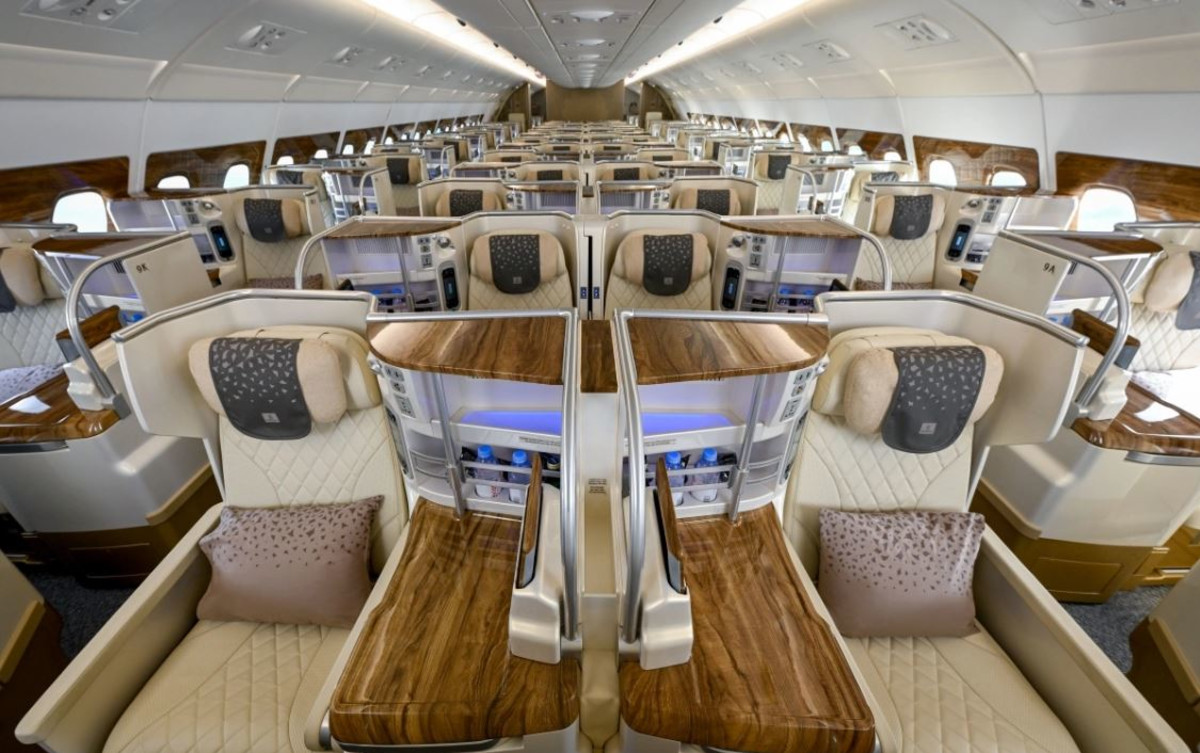
According to the report published by the company, the refurbished aircraft, marked A6-EUX, has already taken off for commercial operations on the EK 39/40 route between Dubai and Birmingham. Instead of the previous configuration, which included only business class and tourist class, the plane now includes 76 business class seats, 56 premium economy seats and 437 tourist class seats. This is the first of 15 two-class A380 aircraft in the Emirates fleet that are expected to undergo a similar conversion by the end of 2026.
Although it is an old plane undergoing an upgrade, and not a new plane delivered by the manufacturer, in terms of the passenger experience it is a significant change. Emirates is removing some of the tourist seats, adding premium seats, expanding the business class and trying to adapt its giant planes to the change in the aviation market: many passengers are not necessarily willing to pay for business class, but are willing to pay more for space, quiet, upgraded service and a better flight experience than the normal tourist class.
At the same time, Emirates upgraded the interior of the entire plane. The company reports replacing carpets, ceilings, coverings, seats and interior finishes. The design includes more recent colors, wood finishes, and motifs inspired by the Gaf tree, which is considered a local symbol in the United Arab Emirates. From the perspective of the company, the goal is to reduce the gap between older aircraft in the fleet and newer aircraft, and to create a passenger experience as uniform as possible on its international routes.
Complex engineering work is behind the upgrade. Emirates carried out the conversion at its engineering center in Dubai, without outsourcing the entire project. During the work, the interior of the plane was almost completely dismantled, and on the upper floor 120 tourist seats were removed to make room for 56 premium economy seats and 18 more seats in the business class. According to the company, about 50 engineers and technicians invested about 35 thousand working hours, using more than 2,500 types of parts.
The first conversion lasted about two months, including planning, disassembly, installation and testing. Emirates estimates that later, after learning lessons from the first plane, the duration of work on each similar plane will decrease to about 30 days. So far, the company has completed the upgrade of 95 aircraft: 42 Airbus A380 aircraft and 53 Boeing 777 aircraft. Emirates’ extensive upgrade program includes 219 aircraft, including 110 A380 aircraft and 109 777 aircraft, with an investment of approximately 5 billion dollars.
Aerial bar and luxury lounge
One of the elements that continues to attract attention on the Emirates A380 aircraft is the air bar on the upper floor. This is a lounge area located in the rear of the upper deck, intended for business class and first class passengers, depending on the configuration of the plane. It includes a bar counter, a standing and sitting area, drinks and snacks, and is designed to allow passengers to refresh, chat or get away from the seat for a short time during long flights.
The bar is not intended for all plane passengers. Even after adding premium economy to the upper floor, lounge access remains part of the Emirates luxury class experience, primarily business and first. The refurbished planes of this type do not have first class, so the lounge serves business class passengers. From a marketing point of view, this is still one of the strongest symbols of Emirates compared to other airlines, especially at a time when many companies are actually crowding planes and reducing services.
Emirates’ move reflects a broader trend in the aviation industry: the return of demand for more expensive products from tourist class, but not necessarily for full business class. In recent years, Premium Economy has become one of the most sought-after classes among independent business travelers, well-established families and travelers on long flights who are looking for more comfort without paying the full price of business class. For the airlines, this is a particularly profitable class, because it takes up more space than normal tourists, but is sold at a significant price difference.
Therefore, behind the words of luxury and design hides a clear business decision: Emirates prefers to lower some of the tourist seats on its giant planes, and increase the number of seats sold at a higher price. This is a change that signals confidence in demand for long-haul flights, especially from Dubai to destinations in Europe, Asia, Australia and North America.
https://trueblueairfilters.com
https://professionalchoiceboots.com
https://iconoclast-boots.com
https://rampageboots.com
https://bunker-hill-security.com
https://gijoedoll.com
https://thecalfmanna.com
https://myhighwings.com
https://thekunnan.com
https://thegrottico.com
https://prextexchristmastree.com
https://theprotecta.com
https://firelinefishingline.com
https://thekulana.com
https://chefmatecookware.com
https://myironton.com
https://thehudsonsprayer.com
https://basque-cookware.com
https://tame-the-wild.com
https://thexurisen.com
https://thefelixking.com
https://myelantrip.com
https://thesarlai.com
https://thesleeprestoration.com
https://theboolegon.com