The US and Iran are still pursuing negotiations as the two sides have their own economic and political calculations, despite the clash that broke out in the Strait of Hormuz.
On May 26, the Iranian delegation still appeared at the negotiating table with the US side in Qatar, even though the night before, US Central Command (CENTCOM) destroyed two Tehran speedboats in the Strait of Hormuz and attacked an anti-aircraft missile site in Bandar Abbas in an action that Washington described as “self-defense”.
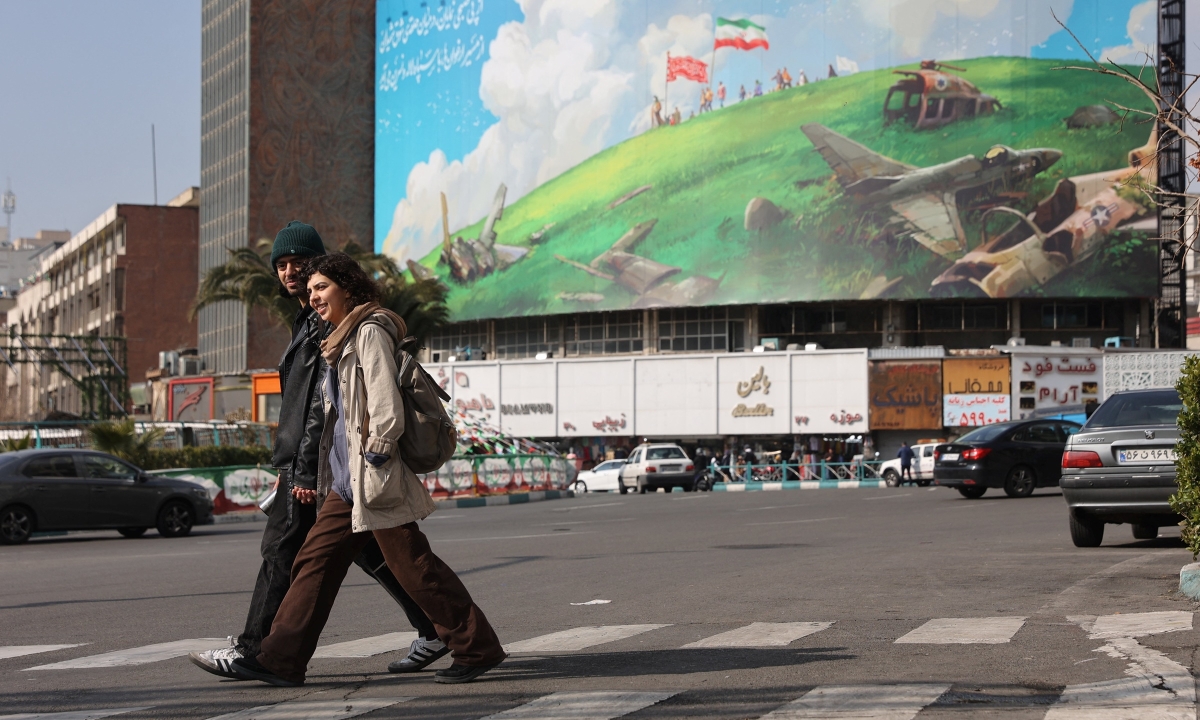
People walk past a sign with anti-American content on a street in Tehran on February 5. Image: Reuters
The raid occurred after mixed signals from President Donald Trump last weekend. On May 23, he announced that the agreement with Tehran had basically been negotiated, but almost immediately changed his stance afterward, seemingly because of criticism from some Republicans in the Senate about the terms of the preliminary agreement.
Despite America’s tough actions and statements, Iran stated that they will not derail the peaceful discussion process. Despite accusing the US of seriously violating the ceasefire, Iranian government spokesman Fatemeh Mohajerani implied on May 26 that diplomatic efforts are likely to continue.
Responding to a question about the attacks at a press conference, she emphasized that the combination of Iranian military forces on the ground and the negotiating role of National Assembly Speaker Mohammad-Bagher Ghalibaf “will benefit the Iranian people”.
Mr. Ghalibaf, Tehran’s top negotiator, came to Qatar to discuss with the US on May 24 and remained after the CENTCOM airstrike. Iranian officials said the country had delayed releasing information about some members of the Islamic Revolutionary Guard Corps (IRGC) killed in the airstrike, to keep the negotiation process on track.
According to Iranian officials and Arab mediators, Tehran is pursuing negotiations with Washington to achieve two intertwined goals. On the one hand, they seek to save the economy under heavy pressure from sanctions and blockades and this is the reason they did not leave the negotiating table after the US airstrike. On the other hand, they also did not make too many concessions to avoid creating an opportunity for President Trump to declare victory.
Officials familiar with the matter said Mr. Ghalibaf came to Qatar to discuss a number of deadlocks, including $100 billion in Iranian overseas funds blocked by the West and details about reopening the Strait of Hormuz.
Iranian President Masoud Pezeshkian had a phone call on May 26 with his Egyptian counterpart Abdel Fattah Al Sisi, one of the intermediary countries, to discuss efforts to reach a memorandum of agreement between Tehran and Washington. This is considered another sign that Iran wants to maintain dialogue with the US despite events on the ground.
Intermediaries, including Pakistan, Qatar and Egypt, are trying to help the two sides narrow their disagreements. Iranian officials and intermediary countries said a key point discussed was the release of $24 billion, or a quarter of Iran’s money frozen abroad.
They also said Iran is close to a compromise agreement to disburse 50% of that amount in advance.
The US raided the Iranian port city of Bandar Abbas on May 26. Video: X/AMK Mapping
Realistic members of the Iranian government want to push for this agreement to ease the economic burden, which has suffered heavy losses due to hostilities and the US seaport blockade, causing revenue from oil exports to almost paralyze.
According to estimates by the International Monetary Fund (IMF) in January, Iran’s real GDP will only increase by 0.3% in 2025, a sharp decrease compared to previous years (3.7% in 2024 and 5.3% in 2023). Inflation has increased so much that the Central Bank of Iran in mid-March issued a 10 million rial banknote, the highest denomination in circulation. A month earlier, this agency launched a 5 million rial note, also a record at that time.
Iranian officials fear the wave of nationalism that has shielded the government from criticism could turn into a fire of discontent if the economy continues to decline.
On the US side, some hard-line Republican lawmakers, such as senator Ted Cruz, objected to the preliminary terms of the agreement because they believed this was a mistake that could strengthen Tehran and was too similar to the nuclear agreement under former president Barack Obama, which was canceled by Mr. Trump in his first term.
Mr. Trump appears to have absorbed these criticisms and is seeking to change some of the terms of the agreement, rather than abandoning negotiations.
On the social network Truth Social, he tried to calm the critics, declaring that the deal was “the complete opposite” of what they complained about. He then said he wanted Saudi Arabia, Qatar, Pakistan, Türkiye, Egypt and Jordan to sign the Abraham Accords to establish or expand diplomatic relations with Israel. He also suggested that Iran could join the accord after Tehran signs a peace agreement.
US officials said Mr. Trump discussed with his team of assistants and outside advisers the idea of expanding the scope of the Abraham Accords hours before calling with regional countries. However, Middle Eastern leaders were not informed in advance in that direction, making them surprised when Mr. Trump made the proposal.
According to a senior White House official, the President himself came up with the idea.
White House spokeswoman Anna Kelly said the Abraham Accords have benefited all participating countries, so expanding it “will complement a peace agreement between the United States and Iran.”
By mentioning the Abraham Accords at the same time as the agreement to end hostilities in Iran, Mr. Trump changed not only the course of ongoing peace negotiations but also the relationship between the United States and Middle Eastern countries, where skepticism about normalizing relations with Israel is very high after years of conflict engulfing the region.
President Donald Trump spoke at an event at Arlington National Cemetery, Virginia, USA, on May 25. Image: AP
US officials say President Trump has long viewed the Abraham Accords as the top foreign policy achievement of his first term and has tried to expand it in his second term, with Saudi Arabia as the main target. His new initiative received praise from political allies but faced discreet objections from Qatar and Riyadh.
The intermediaries said they had also made progress on the future status of Iran’s stockpile of highly enriched uranium, which the United States fears could be used to make nuclear weapons.
Late on May 25, Mr. Trump somewhat gave in to his request that Iran hand over all more than 440 kg of enriched uranium to the US. On Truth Social, he said Iran could destroy that uranium on site or at another approved location, under the supervision of the International Atomic Energy Agency (IAEA).
This will bring America’s stance closer to Iran. Tehran has already agreed to dilute its uranium stockpiles to low levels and expressed willingness to transfer them to Russia.
However, intermediaries, including Pakistan, Qatar and Egypt, expressed concern that members of the hard-line faction in Iran wanted to hinder the peace agreement by targeting ships passing through the sea.
Satellite images analyzed by maritime AI company Windward show that three IRGC speedboats appeared in the southern area of the Strait of Hormuz on May 26. On the same day, the British Maritime Trade Executive said an oil tanker was hit by fire in the Gulf of Oman, right in the area where Iran frequently attacks commercial ships.
Members of the Iranian government’s hard-line faction also echoed criticism of the negotiation effort. Majid Moosavi, commander of the unit in charge of the IRGC’s missile and unmanned aerial vehicle (UAV) program, affirmed that “negotiations with the enemy are a complete failure”.
Intermediaries are also concerned about who really makes decisions in Iran, as Supreme Leader Mojtaba Khamenei has yet to appear or speak in public since his appointment in March. They are trying to determine whether Iran’s current proposal has been accepted by Mr. Khamenei and other hard-line members, or just reflects the views of National Assembly Chairman Ghalibaf, Foreign Minister Abbas Araghchi and moderate members of the administration.
However, an Iranian official said that all decisions do not depend on any single individual but are made on the basis of consensus in the Supreme National Security Council, which includes both moderates like Mr. Pezeshkian and hard-line military and security leaders.
https://portal.wnb-shop.com/casinos/krypto
https://portal.wnb-shop.com/neue-casinos
https://portal.wnb-shop.com/paysafecard-casinos
https://portal.wnb-shop.com/casinos/ohne-oasis
https://portal.wnb-shop.com/klarna-casinos
https://portal.wnb-shop.com/cashlib-casinos
https://portal.wnb-shop.com/sofortuberweisung-casinos
https://portal.wnb-shop.com/apple-pay-casino
https://portal.wnb-shop.com/astropay-casino
https://portal.wnb-shop.com/ueber-uns/petra-zeitz
https://portal.wnb-shop.com/impressum
https://portal.wnb-shop.com/datenschutzerklaerung
https://portal.wnb-shop.com/paysafecard-casinos/ohne-oasis
https://portal.wnb-shop.com/skrill-casino
https://portal.wnb-shop.com/revolut-casino
https://portal.wnb-shop.com/google-pay-casino
https://portal.wnb-shop.com/lastschrift-casino
https://portal.wnb-shop.com/paypal-casino
https://portal.wnb-shop.com/trustly-casino
https://portal.wnb-shop.com/mifinity-casino
https://portal.wnb-shop.com/jeton-casino
https://portal.wnb-shop.com/bonus
https://portal.wnb-shop.com/bonus/willkommensbonus
https://portal.wnb-shop.com/bonus/cashback-bonus
https://portal.wnb-shop.com/bonus/200-prozent
https://portal.wnb-shop.com/bonus/250-prozent
https://portal.wnb-shop.com/bonus/400-prozent
https://portal.wnb-shop.com/bonus/300-prozent