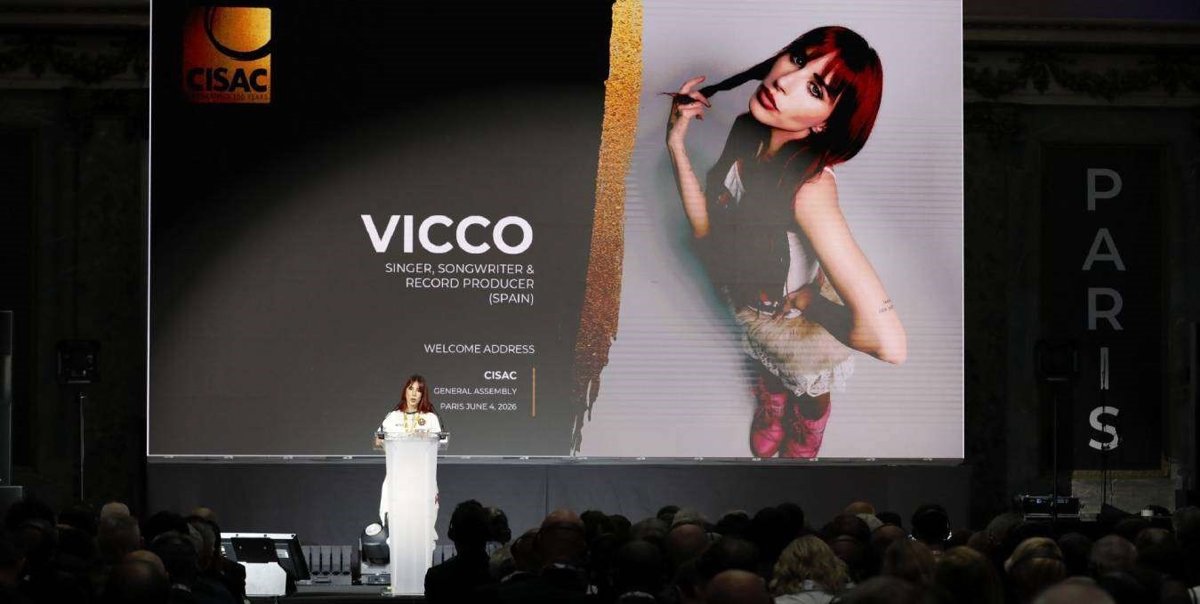
Spanish singer and songwriter vicco claimed this Thursday the value of human creativity and the need to protect copyright in the face of the advance of artificial intelligence (AI) during the inauguration of the General Assembly of the centenary of the International Confederation of Societies of Authors and Composers (CISAC), held in Paris.
“The emergence of generative artificial intelligence has considerably increased the feeling of insecurity and precariousness. If we allow the works of millions of creators to be used without authorization, without transparency and without remuneration to feed commercial AI systems, “We will be putting at risk the creative ecosystem that makes it possible for new songs, new movies, new books and new stories to exist,” said the artist, a member of the General Society of Authors and Editors (SGAE).
One of the central axes of his intervention has been the impact of generative artificial intelligence on the rights of creators. The composer has warned that allowing the use of protected works without authorization, transparency or remuneration to train commercial AI systems could put the sustainability of the creative ecosystem at risk.
“The most important question is not only how many rights we can lose. The question is how many songs will stop being written because future composers and authors decide to dedicate themselves to other things to make ends meet.“he stated.
Although it has shown its support for technological innovation, Vicco has defended the need to establish clear rules to guarantee respect for copyright. “We need transparency. We need consent. And we need technological progress to advance while respecting those who make culture possible.“he claimed.
The artist has also highlighted the role of collective management entities in protecting creators. In reference to his membership in SGAE, he pointed out that being part of the entity means having an organization that protects their rights and works so that authors receive fair remuneration for their works.
For his part, the president of CISAC, Björn Ulvaeus, focused his opening speech on the differential value of human creativity compared to artificial intelligence. As he has argued, although these tools can imitate certain forms of expression, human creativity is linked to lived experience, an element that technology cannot reproduce.
Ulvaeus has also vindicated the historical work of collective copyright management entities and recalled that, for a century, these organizations have been working to guarantee the recognition and remuneration of creators.
PROTECT THE SUSTAINABILITY OF THE CULTURAL ECOSYSTEM
The general director of SGAE, Cristina Perpiñá-Robertwho participates in one of the meeting’s debate panels, has called for comprehensive regulation that takes into account the structural impact of artificial intelligence on human creation.
Perpiñá-Robert has pointed out that Authors are the first interested in incorporating new technologies into their creative processesalthough it has warned of the risks derived from the generation of content based on works used without prior authorization.
Likewise, he recalled that a study presented by SGAE in 2025 estimated that artificial intelligence could reduce income from music copyrights by up to 28 percent by 2028, which would mean an approximate loss of 100 million euros in that year and of between 160 and 180 million euros in the period between 2025 and 2028.
The CISAC centenary General Assembly brings together representatives of authors’ societies from around the world this week in Paris to address some of the main challenges facing creation in the digital age, including the protection of copyright, the economic sustainability of creators and the development of artificial intelligence.
Besides, The participants will sign this Thursday the so-called ‘Paris Commitment’, an international declaration in defense of human creativity.
https://www.musicinafrica.net/users/el-enfoque-de-golisimo-espana
https://www.kingmods.net/en/profile/teresa-m-paschal
https://www.kingmods.net/en/profile/dolly-d-hill
https://app.cal.com/brettodom
https://myearthcam.com/davidkidd
https://www.musicinafrica.net/users/la-evolucion-del-entretenimiento-digital
https://www.kingmods.net/en/profile/freddie-j-flores
https://www.scener.com/@michaelwaller
https://pinterest.com/nerinef5/_profile/
https://www.kingmods.net/en/profile/ramon-e-allen
https://app.cal.com/dianachester
https://www.kingmods.net/en/profile/delisa-j-malik
https://www.newreleasetoday.com/lyricsdetail.php?lyrics_id=106109
https://www.scener.com/@jenniegross
https://myearthcam.com/laurenhatcher
https://openlibrary.org/people/donnaevans/lists
https://pinterest.com/nakyia3/_profile/
https://myearthcam.com/johnrathburn
https://www.newreleasetoday.com/lyricsdetail.php?lyrics_id=35974
https://pinterest.com/sven2482/_profile/
https://myearthcam.com/rafaelamcclain
https://www.newreleasetoday.com/lyricsdetail.php?lyrics_id=97200
https://www.scener.com/@phyllisbeaubien
https://myearthcam.com/williamblack
https://www.newreleasetoday.com/lyricsdetail.php?lyrics_id=65242