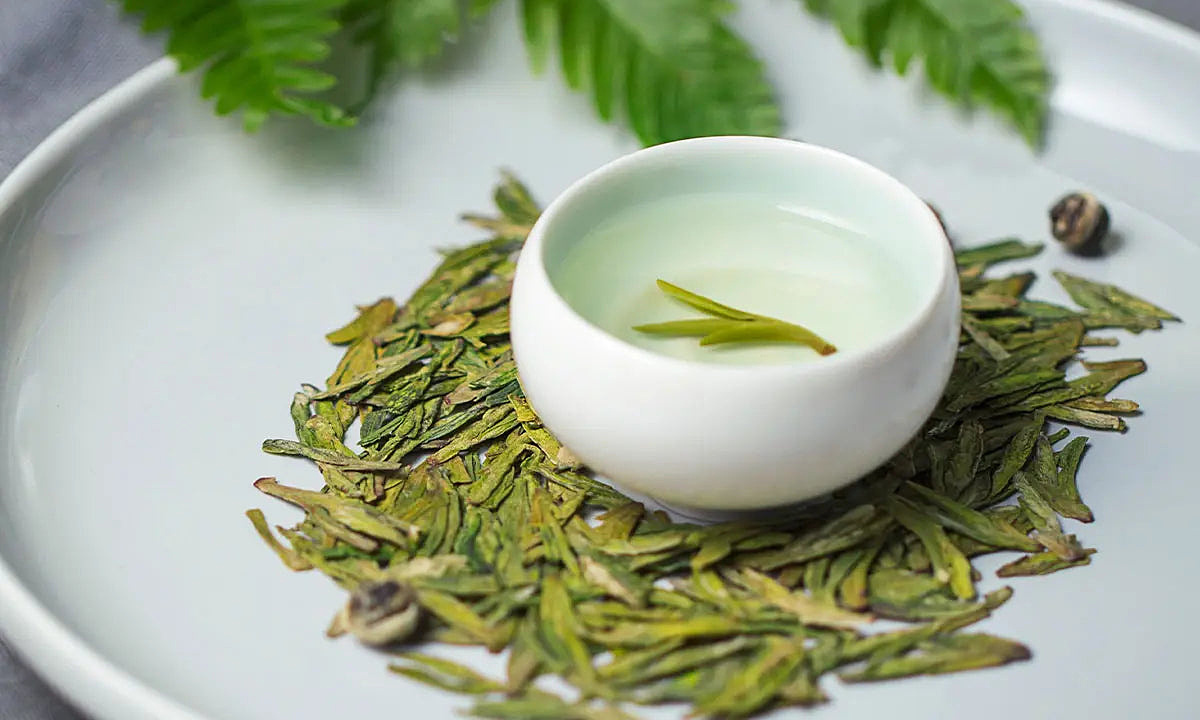
West Lake Longjing tea was once ordained by King Qianlong, and is currently the most expensive drink in the world due to the rigorous manual harvesting process and limited area.
In spring, the tea hills around West Lake area, Hangzhou city, Zhejiang province enter the busiest period of the year, harvesting Longjing tea. Considered “green gold” by Chinese media, batches of premium Tay Ho Long Tinh tea are currently sold for about 8,800 USD (more than 220 million VND) per kg.
In 2012, a batch of the highest quality tea buds reached a record price equivalent to 56,000 USD per kilogram, surpassing the value of gold at the same time. According to the China Tea Association, this price is not purely speculative, but reflects the serious scarcity of first-class tea buds picked in the heritage core area.
This drink has maintained its reputation throughout the centuries. Legend has it that in the 18th century, when King Qianlong visited Hangzhou, he was impressed by the light flavor of tea, so he conferred royal title on 18 ancient tea trees at Longjing Pagoda, keeping the entire output to present to the king.
Longjing tea hill in Hangzhou. Image: China Road
On a hillside on the outskirts of Hangzhou, Ge Xiaopeng, a fourth-generation tea grower, uses his thumb and index finger to gently pluck each smooth young tea bud and drop it into a basket. For farmers here, tea picking time determines the success or failure of the entire crop.
“Time is the most important factor,” Mr. Xiaopeng said.
Long Tinh tea is strictly priced and classified according to the 24 lunar seasons. The highest grade is “Ming Tien” – which means batches of tea harvested before Qingming (April 4 or 5). At this time, tea buds grow slowly due to cloudy weather and light drizzle, helping to accumulate high levels of amino acids, creating a characteristic chestnut flavor and sweet aftertaste without being acrid. At Xiaopeng’s farm, 500 grams of Mingxian tea costs more than 30,000 yuan (about 4,400 USD).
On the contrary, the “Vu tien” variety is harvested later, before the Coc Vu period (April 19 or 20), when the temperature and rainfall increase sharply. Fast growing plants cause tea leaves to contain more polyphenols, creating a bitter taste and reducing commercial value. However, the short two-week time frame for harvesting Minh Tien tea is increasingly difficult to predict due to the impact of global climate change.
After harvesting, fresh tea buds are immediately processed using the manual frying method. Mr. Zhenghua, Xiaopeng’s father, stood next to a large pan heated to 200°C. He used his bare hands to stir continuously to feel the temperature and humidity of the tea leaves without protective gloves. This process helps prevent oxidation, preserves the jade green color and shapes the tea leaves into a flat spear-like shape.
Although machines have now been widely applied to save time and produce uniform products, Mr. Zhenghua affirmed that hand-starred tea still has a completely different level.
“Hands can distinguish things that machines cannot. Machines are inanimate objects, but these hands are alive,” Mr. Zhenghua shared.
Ms. Chen Yifang, lecturer at Suye Tea Institute, likens the clean taste of Longjing to the gentle fragrance of spring bean flowers. She commented that, unlike strong drinks such as black tea or coffee, which reveal their flavor immediately, people who enjoy Long Tinh must sit back slowly to fully feel its qualities.
A cup of Longjing tea. Image: iTea World
To protect the brand, the Chinese government limits the original “West Lake Longjing” growing area strictly within 168 square kilometers. Tea grown in other regions of Zhejiang province is only called “Longjing tea”, and areas outside the planning are only allowed to be sold under the name of regular green tea. Each original tea package when leaving the factory is required to have a certification label with a QR code for traceability.
This control becomes even more urgent when the demand for authentic tea increases suddenly from the trend guochao (Youth return to promote traditional cultural heritage products).
The explosion in economic value is also changing the social structure in craft villages. Previously, Mr. Zhenghua was worried that traditional occupations would disappear as the younger generation continuously left the hometown to study at university and find jobs in big cities.
Now, the trend is reversing. Many young people, including his son, decided to return to take over the family farm. Sustainable income from “green gold” and a sense of cultural preservation are the driving forces to retain them.
“Young people growing up on these farms smell the scent of tea every spring. It is the scent of their homeland,” Mr. Zhenghua said.