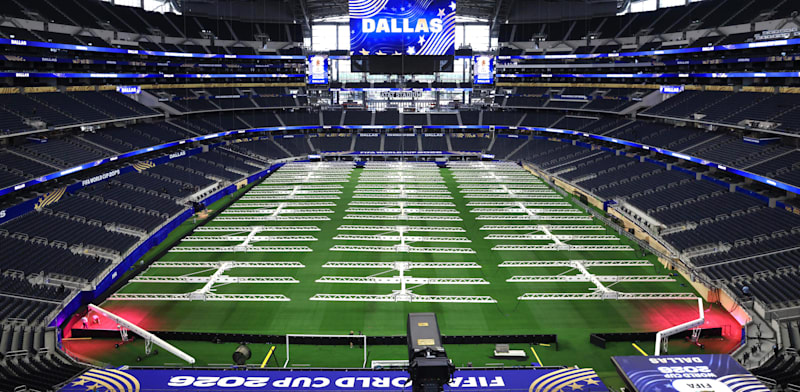
“This is the greatest event that humanity has ever seen” – this is how, without a hint of modesty, FIFA President Gianni Infantino described the 2026 World Cup last April. Whether he is right or not, for the international soccer federation it is undoubtedly the most profitable event in its history.
According to the organization’s estimates, the four-year revenue cycle, since the previous World Cup, is expected to break records and reach 13 billion dollars, with close to 9 billion dollars of which will come directly from the tournament itself, and the rest from the qualifying stages.
The big money comes mainly from the sale of tickets, luxury hospitality packages, broadcasting rights and sponsorships. To understand the dimensions of the precedent, the Paris Olympics held two years ago generated less than half of this amount, and compared to the previous World Cup held in Qatar, the current amount is about 70% higher.
The current World Cup is unusual not only in the numbers on the check, but also in its scope: for the first time, 48 national teams will take part (instead of 32), and the number of games will increase from 64 to 104 – which will be spread over three different countries: the USA, Mexico and Canada.
Ticket prices jumped 5 times
FIFA’s high profitability does not come in a vacuum. One of the main sources of income is the ticket prices that have reached imaginary amounts. For example, the prices of the tickets sold for the final to be held in New Jersey reached up to 11 thousand dollars per ticket. This is an amount 5 times higher than the previous final held in Qatar.
On top of that, FIFA has developed a platform for selling second-hand tickets – with a 15% commission from both the buyer and the seller. Simply put, if a ticket is sold for $1,000 between two different people, FIFA deducts $300. To this should be added the fact that the amount of games itself has increased significantly. The total revenue from tickets and related services is expected to reach about three billion dollars – three times more compared to Qatar.
The revenues from broadcast rights are expected to reach 4 billion dollars and sponsorships are expected to yield about 1.8 billion dollars. Among the sponsorships, the Saudi oil company Aramco stands out.
The big question: where does the money go?
FIFA is supposed to be a non-profit organization, and one of the main questions is where all these billions are going. The revenue from the World Cup is intended to finance FIFA’s current activities around the world for the next four years. Some of the money will be used to replenish the organization’s cash coffers, which have shrunk since the tournament in Qatar from $3.9 billion to $2.7 billion at the end of 2025.
Since FIFA is a non-profit organization, its budget is planned so that almost all of the revenues will be reinvested, with the goal of ending the current four-year round with a symbolic surplus of only 100 million dollars. However, the world is wondering where the large sums will go and who will cut a coupon along the way.
The betting network behind the games
Just two days before the opening of the World Cup games on June 11, the volume of bets in the prediction markets for the games crossed the 2 billion dollar mark.
The bet that generates the most demand is the question of who will win this year’s World Cup, in Polymarket Spain and France are at the top of the betting list, with a probability of about 16% for each of them to win the tournament, with the total bet amounting to 1.8 billion dollars.
According to analysts, this is a test point for the markets, in an area where the traditional sites have dominated for many years, and at a time when regulators around the world are debating whether prediction markets are legitimate trading.
The prediction markets have grown significantly as a sports betting arena since the launch of Polymarket in 2020. And the extraordinary trading volume of 1.8 billion dollars on the identity of the winner of the World Cup is one of the largest on the platform for a sporting event.
Preparations are also being made in Israel
In Israel, most World Cup bets are made through Toto’s Winner games. In contrast to betting in the prediction markets – where the amount of winnings is derived from the amount of bets, Batuto published an announcement that the first prize guaranteed to the participant who guesses the highest number of games is NIS 250,000.
In addition, Betoto expects revenues of NIS 623 million from betting on the World Cup, among other things because the tournament is expected to have 104 games, and will be spread over many days.
The amount intended for the production of the current World Cup is estimated to be close to 4 billion dollars. A similar amount is allocated to “development and education” worldwide. But the money is divided among the 211 members of the organization equally – which causes further criticism. How is it possible for a country with a billion inhabitants to have the same budget as a country with a million or two? The claim is that alongside the inequality, it is an attempt to gain political support within the organization. Because, FIFA’s election system is based on a principle of equality in influence regardless of the size of the country.
Lots of income and heavy costs
But this money does not seep into the cities that host the games. For them and for the governments, along with the income from tourism, there are also heavy expenses such as security and public transportation costs.
The host cities signed contracts in which they pledged to provide FIFA with a wide range of services, facilities and infrastructure. According to officials familiar with the hosting budgets who spoke to the New York Times, each of the cities is expected to spend over 100 million dollars to meet the tournament’s requirements.
Many cities are determined to balance these budgets, and to try to help them, FIFA created a program that allows cities to recruit local sponsors. The problem is that FIFA has not given cities many assets that can be sold for sponsorships, and in addition, it prohibits them from signing agreements with companies in industries where it already has its own official sponsors.
As a result, fast food companies, beverage manufacturers, sports brands, car manufacturers, airlines and many other industries are unavailable to the cities for local sponsorships.
Some cities benefit from access to federal or state public funding, but others struggle much more. The federal government in the United States allocated a total of 625 million dollars to the 11 host cities for the purpose of securing the games, but even these funds did not solve the budgetary pressures. In some cases, cities have reduced plans to establish fan complexes and public festivals, mainly because these are particularly expensive initiatives.
In New Jersey, for example, they found a unique solution. The city will host the World Cup finals at MetLife Stadium, and the local train company (NJ Transit) is offering special tickets to the stadium at an exorbitant price of $98. For comparison, a normal trip costs only about 13 dollars.
FIFA: The investment pays off
FIFA Masada claims that this is a worthwhile investment for the cities, because the tournament attracts tourists, brings in revenue and provides unprecedented global exposure.
All this is true for relatively small cities. In Kansas City, for example, Hospitality Committee Executive Director Pam Cramer told the Times that there is a “collective and united belief” that the World Cup may change the way people around the world perceive the city.
“There is a shared feeling that this event could be transformative in terms of the way people think about Kansas City,” Kramer said, “and also in terms of the confidence we have in ourselves.”
Big cities, on the other hand, do not need the FIFA spotlight. Many economists question the grandiose predictions that the 2026 World Cup will generate billions of dollars of ‘economic impact’.” According to them, despite the international exposure and the temporary increase in tourism, it is very difficult to prove that host cities actually generate significant and long-term economic profit from the event itself.
Dr. Amnon Schreiber, from the Department of Economics, at Bar-Ilan University, believes that “the business model of the tournament has become distinctly asymmetric: the international organization, FIFA, draws the Libyan revenues, from unprecedented broadcasting rights, through huge sponsorships to the sale of tickets and hospitality packages at very high prices. On the other hand, the local authorities are left with the burden of financing security systems, closing axes, Transportation, logistics and the adaptation of the stadium infrastructures”.
According to him, “From an economic point of view, this dynamic is reminiscent of the “winner’s curse”. When several cities compete for the right to host under conditions of uncertainty, the winner is sometimes the one who had the most optimistic and exaggerated forecasts regarding the revenues, or the one who underestimated the costs.
“The very victory in the tender paradoxically indicates an overcommitment, which ultimately leads to a loss in the overall balance sheet. It is no coincidence that there were also cities that chose to withdraw from the game – Chicago, for example, gave up the bid to host the 2026 Games after, according to the mayor’s office at the time, FIFA did not provide basic certainty regarding ‘missing central figures’ that could endanger the city and the taxpayers.”
For your attention: The Globes system strives for a diverse, relevant and respectful discourse in accordance with the code of ethics that appears in the trust report according to which we operate. Expressions of violence, racism, incitement or any other inappropriate discourse are filtered out automatically and will not be published on the site.
https://ProspectLandscaping.us/gardening/weeding
https://ProspectLandscaping.us/lawn-care
https://ProspectLandscaping.us/lawn-care/artificial-grass-installation
https://ProspectLandscaping.us/lawn-care/dethatching-lawn
https://ProspectLandscaping.us/lawn-care/fertilizing-lawn
https://ProspectLandscaping.us/lawn-care/hydroseeding
https://ProspectLandscaping.us/lawn-care/lawn-aeration
https://ProspectLandscaping.us/lawn-care/lawn-edging
https://ProspectLandscaping.us/lawn-care/lawn-grubs-control
https://ProspectLandscaping.us/lawn-care/lawn-installation
https://ProspectLandscaping.us/lawn-care/lawn-leveling
https://ProspectLandscaping.us/lawn-care/lawn-mowing
https://ProspectLandscaping.us/lawn-care/lawn-renovation
https://ProspectLandscaping.us/lawn-care/lawn-seeding
https://ProspectLandscaping.us/lawn-care/sod-installation
https://ProspectLandscaping.us/lawn-care/weed-control
https://ProspectLandscaping.us/yard-clean-up
https://ProspectLandscaping.us/yard-clean-up/green-waste-disposal
https://ProspectLandscaping.us/yard-clean-up/gutter-cleaning
https://ProspectLandscaping.us/yard-clean-up/junk-removal
https://ProspectLandscaping.us/yard-clean-up/leaf-removal
https://ProspectLandscaping.us/yard-clean-up/tree-removal
https://ReddingLandscaping.us
https://ReddingLandscaping.us/gardening
https://ReddingLandscaping.us/gardening/brush-removal