Although still mainly performed on stage, some humanoid robots have also appeared more in real life, preparing for the “real labor” stage.
On June 11, the 2026 FIFA World Cup kicks off in the US, Canada and Mexico. The tournament not only has the largest number of participating teams ever with 48 teams, but is also the largest practical testing ground for AI and robots in the history of human sports.
Before the 2026 World Cup took place, the tournament organizers said they would apply humanoid robot Atlas and four-legged robot Spot from Boston Dynamics for practical tasks at some stadiums, such as supporting event operations, interacting with fans, and security patrols. In fact, these robots are present at the Dallas International Broadcast Center, New York Stadium and New Jersey Stadium with the task of automatically patrolling and monitoring the venue in real time.
This is the latest example showing the trend of robots “transforming” into workers, instead of just dancing and fighting… Not only in China, many countries are starting to bring robots into life, such as handling goods at the loading and unloading area of Tokyo Haneda airport (Japan), tightening screws on the production line of the Texas Instruments semiconductor factory (USA), assembling cars at the BMW factory in Germany, or making coffee in supermarkets or working as restaurant staff in some places. other.
Experts assess that as AI becomes more perfect and physical intelligence technology such as humanoid robots begin to solve most of the problems of adaptation in different situations, more and more humanoid machines will appear as “workers” in the near future.
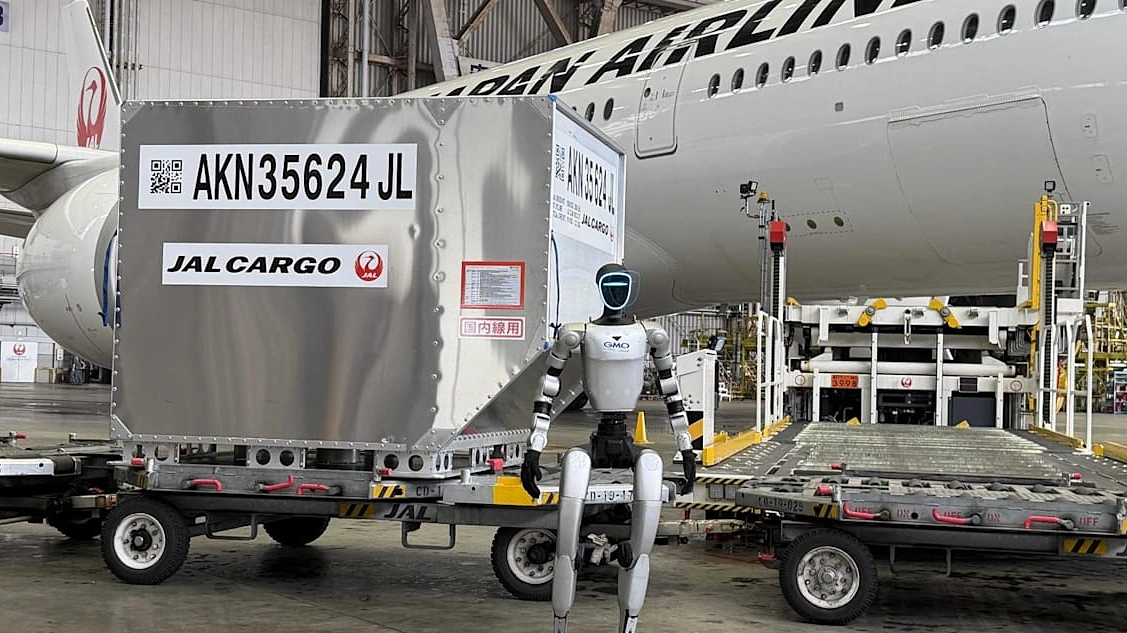
A humanoid robot served at the airport in Japan in May. Photo: Japan Airlines
China still dominates
Although the US has some representatives such as Tesla, Boston Dynamics or Figure AI, the majority of humanoid robots appearing in life come from China. According to investment bank Barclays, Chinese humanoid robots account for 85% of the global market share by 2025. Technology research company Omdia (UK) said that there were more than 13,000 humanoid robots shipped last year, of which Agibot and Unitree reached 5,000 robots each. American competitors like Figure AI and Tesla only produce a few hundred robots or less.
Data from customs also shows China’s superiority. In the first four months of the year, the country exported a total of 8.145 million robots of all kinds with a total value of 15.79 billion yuan (2.34 billion USD) to more than 150 countries and territories.
Meanwhile, China’s humanoid robot exports in the first quarter of the year increased 210% over the same period last year, with Europe, Southeast Asia, and the Middle East being the main markets. Morgan Stanley predicts that China’s humanoid robot sales will double compared to last year, reaching 28,000 machines.
Theo China Dailymost of the leading humanoid robot enterprises in China aim to double last year’s output, such as Unitree setting 10,000-20,000 robots shipped, while Zhipu Robotics, UBTech and Deep Robotics all expect to reach 10,000 robots.
These businesses are given maximum capital conditions. Citation of figures, p 36kr said there were more than 100 capital raising events across the entire Chinese humanoid robot industry chain in the first quarter of 2026. More than 20 companies have announced their IPO plans, most of which passed the approval process, such as Unitree, Leju Robotics, Fourier Intelligence or Deep Robotics.
From stage to factory
BlueRun Ventures analyst Cao Wei believes that the existential intelligence industry – that is, artificial intelligence embodied in physical products such as robots – is in the “late stages of a typical expansion cycle”. Humanoid robots still mainly perform on stage, but have been applied more in real life.
According to UBTech’s report at the beginning of the year, the company’s revenue in Hong Kong and markets outside China reached 475 million yuan (70 million USD), present in 50 countries and regions. Since the beginning of this year, the Walker C model began to take on the “worker role” when Texas Instruments deployed it on a factory line. RossMann, one of Europe’s largest drug store chains, also uses Walker C in retail stores and logistics centers, and Hitachi (Japan) uses it to manufacture and assemble elevators.
Similarly, in May, the G1 robot wore a vest at Tokyo Haneda Airport (Japan) as a “ground crew” employee to help handle luggage, transfer goods and coordinate conveyor belts.
Xinhua News Agency said that humanoid robots also began operating in the Jianggao logistics area of Guangzhou postal center, China. The machine undertakes many tasks, such as sorting and identifying parcels, with the ability to process up to 1,200 parcels per hour.
Theo GeekSpinexamples show that Chinese humanoid robots are “exploding” on a large scale, from airports to factories, from logistics to manufacturing, from services to manufacturing. “They are starting to assert themselves in every link of the global industrial chain as workers,” commented researcher Zhang Zhengtao at the Institute of Automation of the Chinese Academy of Sciences.
However, experts assess that humanoid robots still face many barriers when applied in practice, according to Guardian. Samm Sacks, senior expert at the New America research organization, said that the majority do not meet the requirements of working in a complex and unpredictable environment. Chibo Tang from Gobi Partners, a company specializing in investing in technology startups, commented similarly, that the application cases of humanoid robots are “still very limited”.
“The economic problem is very difficult because humanoid robots have high production costs, are easily damaged when operating, and need a tightly structured environment to operate,” Sacks explained.
She believes that humanoid robots have a long way to go to reach a level where “people really feel comfortable” using them to care for the elderly or children in the home. A more feasible path to commercialization is probably through the industrial and logistics sectors, but this path is not easy when many factories are equipped with robot arms to perform repetitive work, meaning there is no need for many humanoid robots.
Michael Tam, UBTech brand director, admitted that it is not easy to replace workers with humanoid robots. He said above Financial Times that the company’s newest humanoid robot, Walker S2, “achieves 30-50% of the productivity of humans”, and is “only good at certain tasks” such as stacking boxes or checking component quality.
https://spinoloco-polska.com/legal
https://spinoloco-polska.com/login
https://spinoloco-polska.com/mirror
https://spinoloco-polska.com/mobile
https://spinoloco-polska.com/payments
https://spinoloco-polska.com/problems
https://spinoloco-polska.com/promocode
https://spinoloco-polska.com/review
https://spinoloco-polska.com/slots
https://spinoloco-polska.com/support
https://spinoloco-polska.com/withdraw
https://spinoloco-espana.com
https://spinoloco-espana.com/apk
https://spinoloco-espana.com/app
https://spinoloco-espana.com/bonus
https://spinoloco-espana.com/casino
https://spinoloco-espana.com/deposit
https://spinoloco-espana.com/download
https://spinoloco-espana.com/faq
https://spinoloco-espana.com/legal
https://spinoloco-espana.com/login
https://spinoloco-espana.com/mirror
https://spinoloco-espana.com/mobile
https://spinoloco-espana.com/payments
https://spinoloco-espana.com/problems