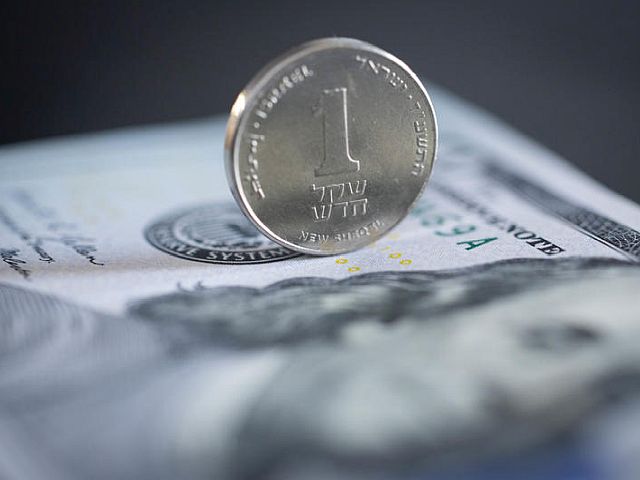
About the reversal of the shekel after a sharp strengthening. Why the Ministry of Finance does not want to save large high-tech at the expense of the budget. About state insurance against racketeering, which looks like the right step – but only for six months.
The publication was prepared by Newsru.co.il economic observer Mikhail Shafranov.
What is behind the weakening of the shekel?
The shekel has fallen 6% over the past month, prompting headlines calling the Israeli currency “one of the weakest in the world” over the period. The headlines tell the truth, but not the whole truth, since this 6% is a rollback after strengthening by 20% over the previous year, of which by 10% in the previous two months.
The main question discussed in the light of this reversal was whether the previous jump in the shekel was a short-term episode, after which we can expect further weakening to the usual levels, or whether we are talking only about a technical correction and no further weakening of the shekel should be expected.
The current pullback from the lower threshold of this corridor is due to a combination of several factors. Judging by the latest data from the Bank of Israel, one of the main factors was the end of the period of reduction by institutional investors of their foreign exchange exposures, which settled in the region of 18-19% of portfolios. It was the process of reducing exposures that was the main driver of the strengthening of the shekel, as it led to an avalanche-like sale of the currency.
The avalanche was intensified by the growth of quotations on Wall Street, the widening gap in interest rates between Israel and the United States, the general weakening of the dollar, as well as the foreign exchange flows that the high-tech and defense industries brought into the country. Three of these additional drivers have changed direction in the last month. Wall Street has lost several percent of its value from its peak due to adjustments in the rates of AI corporations and chip manufacturers, the dollar has risen by 2% against a basket of world currencies, and the ratio of interest rates between Israel and the United States has decreased and will continue to decrease – the Bank of Israel predicts additional rate cuts, while the Fed is talking about raising it due to inflation. Thus, of the factors that continue to act towards the strengthening of the shekel, only investments in Israeli high-tech and export transactions of the Israeli defense industry remain.
Most analysts agree on the second option, noting that in fact the shekel has now returned approximately to the center of the target range of the new reality, the framework of which has been established somewhere between 2.8 and 3.1 shekels, and will trade in this range depending on the combined direction of the drivers listed above. A rise in quotations on Wall Street will push the shekel up, a delay in lowering the discount rate in Israel will push it down, and so on, until a new factor appears that can lead to a change in reality.
This position is also shared by the Ministry of Finance, which has presented local assistance programs for exporters (accelerated depreciation of investments in new equipment) and start-ups at the initial stages of development (subsidies from the Innovation Office) in the amount of 1.6 billion shekels.
However, the government ultimately decided to abandon the idea of allowing multinational corporations to pay taxes in dollars to weaken the shekel, without turning the separate decisions on Wiz and Armis into a common mechanism. Moreover, in general, it was decided to refrain from interfering in this high-tech segment for now. Injecting public funds into large international corporations would require much larger sums without any guarantee of success, and in general I am inclined to agree with this approach, especially given the election period, and in the coming months I would focus on monitoring the situation and identifying those segments that will not be able to survive in the new reality in order to help them repurpose.
Six months of insurance is not enough
Current estimates place the “excess” damage from crime at 10-20 billion shekels per year, of which up to 3 billion shekels comes from damage from racketeering. Moreover, this has long been a problem not only for farmers in the periphery and Arab entrepreneurs; organized crime groups, by intimidating contractors, gain access to government projects, including defense ones.
The Bank of Israel held a special meeting this week to discuss the threat of racketeering infiltration of the banking sector and a repeat of the scenario that led to the collapse of the Merchant Bank, when bank employee Eti Alon stole NIS 250 million to cover her brother’s gambling debts.
Moreover, the meeting was by no means theoretical: it discussed real cases of threats to bank employees in order to gain access to lists of clients with large amounts in their accounts, register an account with a fictitious company, or not report suspicious activity on the account. One way to combat these phenomena, which are still limited, should be to transfer access to certain types of operations exclusively to central branches.
Also this week, the government approved a proposal by Finance Minister Bezalel Smotrich to launch a pilot project for state insurance for victims of racketeering. In recent years, insurance companies have come to the conclusion that racketeering from targeted incidents has become a systemic problem, and they are stopping insuring businesses against damages resulting from racketeering. Entire regions and industries are facing this problem, most notably transport, construction and agricultural companies in the Negev and Galilee.
The NIS 35 million pilot project is the Treasury’s attempt to address the issue and provide compensation to businesses affected by the racketeering after the project’s launch, provided they file a complaint with the police.
Internal Revenue Service compensation fund appraisers, who are usually tasked with assessing damage from rocket attacks and natural disasters, are tasked with assessing destroyed warehouses and burned buses. I don’t think that the Ministry of Finance included symbolism in this decision, but it turned out to be eloquent: organized crime is now subject to the same departmental article as war and earthquakes.
However, this project has one significant problem – it was announced for only six months, after which the complainants risk again being left without insurance and state support, face to face with the same racketeers, who, at best, will go to prison for a year or two, and at worst, get off with a fine and community service.
It is worth noting that the Ministry of Finance does not want to deal with this insurance at all, believing that the problem should be solved by law enforcement agencies, and the pilot project is a step forward.
The Ministries of Justice and Construction are also gradually making decisions to revoke licenses and access to government contracts for construction contractors and security firms found to have connections with organized crime groups. Just this week, three “security” companies that served as a front for racketeering lost their licenses.
Despite the obvious activation of government agencies, the comprehensive approach needed to combat racketeering is still far away. Italian experience shows that compensation funds for victims of racketeering work only in combination with real prison sentences for extortionists, confiscation of their property and a strong witness protection program. One should not disdain the experience of Japan, which put an end to racketeering as a mass phenomenon by imposing civil liability on the heads of organized crime groups for crimes committed by their subordinates, and criminalizing the very fact of business cooperation with racketeers.
True, it took both the Italians and the Japanese more than one year of consistent work to get results. In Israel, for now, the state asks the businessman to show courage forever, promising cover for six months in return.
Збірний вантаж або окреме авто: як обрати оптимальну доставку для невеликої партії товару
Коммерческое пространство как фактор развития бизнеса
Захитує в дорозі? Що зробити до і під час поїздки
Відгуки про психологів: як не помилитися
Кредит готівкою: брати чи ні та з чим порівняти
Гигиенический душ: функциональность и удобство
Чому аграрії переходять на європейські добрива: логіка, контроль, результат
Wood Special Oil — натуральное масло с воском для защиты и ухода за деревом
Набір хромосом яйцеклітини: чому саме 23 і яке це має значення
Фільтри для води Brita | Німецька якість очищення питної води
Запчасти Nissan Navara и ремонт под ключ — магазин, разборка и сервис Master Service
Сухі корми для кішок — як обрати натуральне харчування
Дизайнерские радиаторы отопления: выбор и покупка для квартиры
Газові горілки для походів і кемпінгу: як обрати та користуватись
Меблі для дому та офісу онлайн — що реально варто купувати | Практичні поради
Що подарувати на 14 лютого: еротичні ідеї для справжньої близькості – Versal.Media
Анализ цифровых активов через онлайн-данные и графическое поведение рынка
Фильтр для питьевой воды: виды, установка и преимущества
Зовнішня реклама Clickprint у Києві: авто і вивіски
Купівля авто б/у в Україні: поради та лізинг як альтернатива
Система пожежної сигналізації у Львові
Вантажники у Києві: переїзд, підйом, розвантаження
Карданные соединения: как выбрать узел под нагрузку и угол
Теорія в автошколі онлайн чи в класі: що обрати саме вам
Найкращі настільні ігри для дорослих