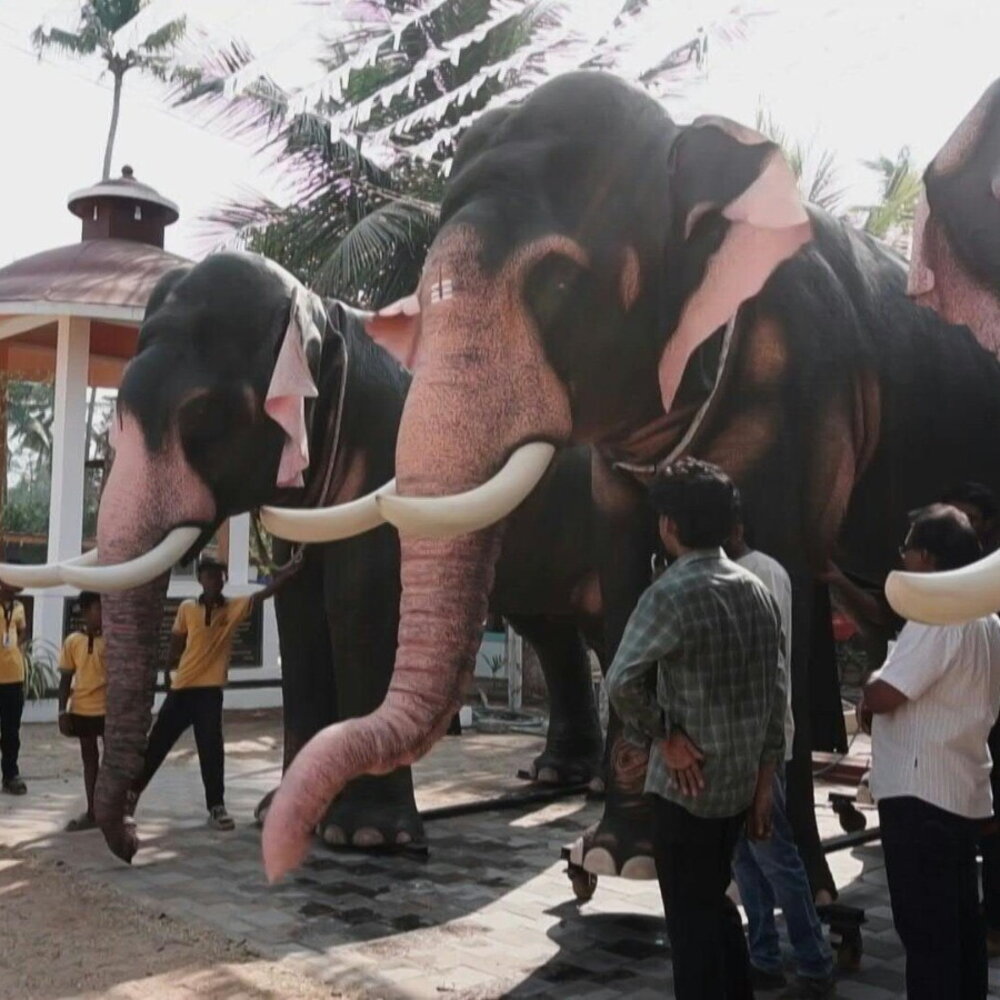
In Chalakudy, a city in southern India, Robot elephants are replacing live ones in Hindu rituals and festivals due to concerns about animal abuse and the tragedies caused by fleeing elephants, who are often frightened. But the more traditional faithful oppose the change, underlining the sacredness of the elephants that come associated with the deity Ganesha, symbol of wisdom and prosperity.
The new animatrons, which dominate the courtyard of the Indian mechanical engineer Prasanth Publicationsare made of life-size fiberglass, iron and rubber, and like real elephants have ears that move, tails that flap and trunks that spray water. A solution that has been successful among animal rights activistsbut which instead has irritated those who firmly believe that royal elephants are indispensable for celebrating temple rituals and festivals, where they are treated like real stars. As reported by the Associated Pressthe animal welfare group PETA and other nonprofit organizations have donated about 40 robot elephants, each costing about $6,000, to Indian temples to replace real elephants.
The mechanism
However, the differences between a robot elephant and a real animal are quite evident: the former is much lighter, but does not move as fluidly as a real pachyderm would. Parts of the body, such as the head and eyes, move thanks to electric motors and to get as close as possible to a realistic result, flexible materials were used. Prakashan himself is aware of the limitations of his “creatures” and stated: “You cannot perfectly reproduce an original elephant just as you cannot duplicate a human being. But we try to capture as much of the essence of this majestic animal as possible.” He adds that although the robots cannot walk yet, “they will soon. I’m working on it.”
The mechanical engineer made his first robot elephant by covering it only in rubber, before moving on to more resistant fiberglass molds. The moving rubber parts are modeled by artists who faithfully reproduce the smallest details of the real animalsuch as wrinkled skin and veins sprouting from fan-shaped ears. The entire process, from creating the mold to animating the elephant, takes Prakashan and his team around 15 days.
Prakashan, which builds animatronics mostly for shopping malls, parks and fairs, caught PETA’s attention in 2023 with a viral video of robotic elephants at a Dubai festival. In the same year, has already conquered the first temples with this innovationsuch as that of Irinjadapilly Sree Krishna in the state of Kerala, where preciselythe first example of a robot elephant arrived in 2023. Khushboo Gupta, vice president of policy at PETA India, said: “The elephants are forced to stay there for hours in the heat, with large crowds, drums and fireworks. Any stimulus could make them go into a rage.” And the fear of tragedies is always around the corner, as KI Purushottaman, president of the Cheekamundi Sri Mahavishnu temple in Thrissur, said that the robotic elephants brought tranquility to the sacred place because he and other administrators feared the possibility of a fatal attack by an elephant. “Now with this solution we are no longer afraid, we are much more relieved,” he said.
The opponents
On the other hand, however, there are the faithful most anchored to tradition and who struggle to accept this alternative. There are those who like itK.Mahesh who even rents out his real elephant for parties about 45 days a year. “If you don’t believe elephants are sacred, what’s the point of a robotic elephant in a temple?” he asked. Mahesh has had his elephant for 25 years and he now considers it “like a family member or a pet” that brings joy to everyone, as long as it is treated with care and attention. Although several temple administrators have spoken out against the use of robot elephants for Hindu rituals and festivals, animal rights activists have pointed out: “If we do not stop treating elephants as commodities, future generations will not be able to have them.”
Pike County, Mississippi Divorce Records | PikeCountyRecords.org
Pike County, Ohio Property Records | PikeOHRecords.us
Pike County, Ohio Arrest Records | PikeOHRecords.us
Pike County, Ohio Warrant Records | PikeOHRecords.us
Pike County, Ohio Divorce Records | PikeOHRecords.us
Pine County, Minnesota Property Records | PineRecords.us
Pine County, Minnesota Arrest Records | PineRecords.us
Pine County, Minnesota Criminal Records | PineRecords.us
Pine County, Minnesota Inmate Search | PineRecords.us
Pine County, Minnesota Court Records | PineRecords.us
Pine County, Minnesota Warrant Records | PineRecords.us
Pine County, Minnesota Divorce Records | PineRecords.us
Pittsburg County, Oklahoma Property Records | PittsburgRecords.us
Pittsburg County, Oklahoma Arrest Records | PittsburgRecords.us
Pittsburg County, Oklahoma Criminal Records | PittsburgRecords.us
Pittsburg County, Oklahoma Inmate Search | PittsburgRecords.us
Pittsburg County, Oklahoma Court Records | PittsburgRecords.us
Pittsburg County, Oklahoma Warrant Records | PittsburgRecords.us
Pittsburg County, Oklahoma Divorce Records | PittsburgRecords.us
Plaquemines County, Louisiana Property Records | PlaqueminesParishRecords.us
Plaquemines County, Louisiana Arrest Records | PlaqueminesParishRecords.us
Plaquemines County, Louisiana Court Records | PlaqueminesParishRecords.us
Plaquemines County, Louisiana Warrant Records | PlaqueminesParishRecords.us
Plaquemines County, Louisiana Divorce Records | PlaqueminesParishRecords.us
Platte County, Nebraska Property Records | PlatteRecords.org