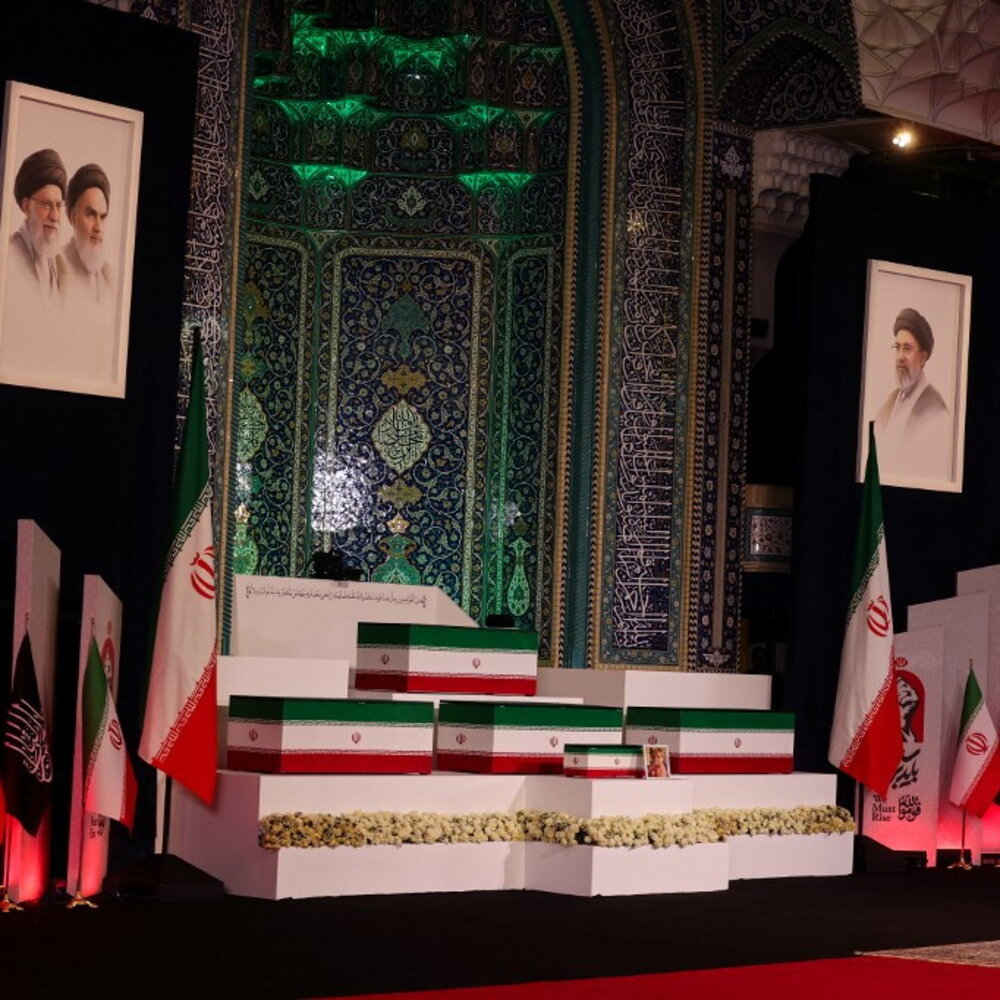
The body of the former Iranian Supreme Leader, Ali Khamenei arrived at the religious complex in Tehran where her funeral will take place – characterized by an unprecedented turnout – four months after her death, which occurred following a joint Israeli-US attack.
Iranian President Massoud Pezeshkian paid homage to the body of the supreme leader. At his side are members of the government, including the influential Mohammad Bagher Ghalibaf, president of Parliament and head of the Iranian negotiating team. The images broadcast by state television show Pezeshkian in prayer in front of the coffin of the former Supreme Leader, on which is placed a black turban.
Estimates of turnout and the political significance of the event
The authorities expect the participation of an inclusive number between 15 and 20 million people in Tehran alone for this three-day national tribute; the event, which kicks off on Saturday, is designed as a show of strength in the aftermath of a conflict that lasted nearly 40 days and cost the lives of numerous senior leaders and thousands of civilians.
The preparation of the Grand Mosalla for national mourning
Ali Khamenei’s coffin, wrapped in the Iranian flag, arrived at Grand Mosalla – a vast religious complex in the capital. The walls of the structure are adorned with large portraits of Ayatollah Khamenei, who remained in office as Supreme Leader for three decades, as well as with black flags, a sign of mourning, and red flags, a symbol of martyrdom and revenge.
Places and symbols of Khamenei’s funeral
Tomorrow, Saturday 4 July, the six days of ceremonies for the funeral of the former Supreme Leader will begin, Ali Khameneikilled on 28 February. The funeral procession will pass through various symbolic places for Shiite Islam: from the seat of power in Tehran to the holy cities of Qom, Karbala and Najaf in Iraq, before ending in Mashhad, its city of origin. Each stage of this journey has a particular meaning.
The central role of the Tehran mosque
The funeral chapel with the display of the body will be in the Tehran mosque, one of the most important places in the country from both a political and spiritual point of view. Designed to host major Friday prayers, official commemorations and religious gatherings, this vast complex has long united religious life and state authority. It was the site of national ceremonies, speeches by senior officials and large demonstrations aimed at demonstrating unity and popular support for the regime. Holding a public commemoration here highlights Khamenei’s role as both a religious authority and the head of a political system based on Islam.
The procession in the capital and the passage to Qom
The streets of Tehran will then, on Monday, be the scene of the funeral procession which marks the farewell of the Supreme Leader to the political center of the Islamic Republic. The capital is home to the presidency, parliament, judiciary, headquarters of the Armed Forces and most major state institutions. Large rallies are frequent in Tehran, often serving to demonstrate national solidarity and the power of the state. The procession will therefore express the mourning of the people and the continuity of the new leadership. On Tuesday the funeral procession will move to Qom, a city that occupies a unique place in the Iranian religious landscape. Home to the country’s most influential seminaries, it has trained generations of imams and officials and played a vital role in shaping the ideology of the Islamic Republic.
The theological meaning of religious stages
The ceremony in Qom aims to highlight the religious underpinnings of Khamenei’s authority, stemming in part from his position within the Shiite religious establishment. It also provides the opportunity for high-ranking religious dignitaries and seminary students to attend services honoring a figure who embodied both religious and political authority. The city is also home to one of the most important Shiite shrines: the mausoleum of Fatima Masoumeh, sister of Imam Reza, the eighth Shiite Imam. The funeral will also involve Karbala, the city of martyrdom. Located in Iraq, Karbala is among the holiest cities in Shia Islam. It houses the shrine of Hussein, the third Shiite imam, whose death in the 7th century remains the central event in Shiite history and tradition. Khamenei’s funeral thus fits into the broader spiritual dimension of Shiism. Themes of sacrifice, perseverance and resistance, all closely linked to the legacy of Imam Hussein, are likely to be central to the ceremonies held in this city.
International ties and the last stop in Mashhad
The long funeral program also includes Najaf, the Iraqi city which is the seat of Shiite authority and which hosts the sanctuary of Imam Ali, the first Shiite imam, and is one of the most prestigious centers of Shiite studies in the world. Holding the ceremonies in Najaf underlines Khamenei’s position in the Shiite world, beyond Iran’s borders. The city is of considerable religious importance and its inclusion in the program of ceremonies highlights the links between the Islamic Republic and the wider international Shia community. The last stop will be on July 9 in Mashhad, Iran’s holiest city and home to the shrine of Imam Reza, which houses his tomb, the country’s main pilgrimage site. Mashhad is also the hometown of Khamenei who spent much of his youth here and maintained close ties with its religious institutions. Imam Reza’s burial in the shrine combines his personal history with profound religious symbolism. His father, Ayatollah Sayyed Jawad Khamenei, also rests here. Symbolically, his journey ends where religious fervor, national identity and personal life converge.
Harris County Court Records Search – TexasStateCourts.us
Tarrant County Court Records Search – TexasStateCourts.us
Travis County Court Records Search – TexasStateCourts.us
Milwaukee County Court Records Search – WisconsinCourts.us
San Bernardino County Court Records Search – CaliforniaCourts.us
Denver County Court Records Search – ColoradoCourts.us
Brevard County Court Records Search – FloridaStateCourts.us
Escambia County Court Records Search – FloridaStateCourts.us
Lee County Court Records Search – FloridaStateCourts.us
Orange County Court Records Search – FloridaStateCourts.us
Pinellas County Court Records Search – FloridaStateCourts.us
Seminole County Court Records Search – FloridaStateCourts.us
Volusia County Court Records Search – FloridaStateCourts.us
Elkhart County Court Records Search – IndianaStateCourts.us
Marion County Court Records Search – IndianaStateCourts.us
Clark County Court Records Search – NevadaCourts.us
Philadelphia County Court Records Search – PennsylvaniaCourts.us
Charleston County Court Records Search – SouthCarolinaCourts.us
Greenville County Court Records Search – SouthCarolinaCourts.us
Knox County Court Records Search – TennesseeCourts.us
Anderson County Court Records Search – TexasStateCourts.us
Bexar County Court Records Search – TexasStateCourts.us
Collin County Court Records Search – TexasStateCourts.us
Hidalgo County Court Records Search – TexasStateCourts.us
Lubbock County Court Records Search – TexasStateCourts.us