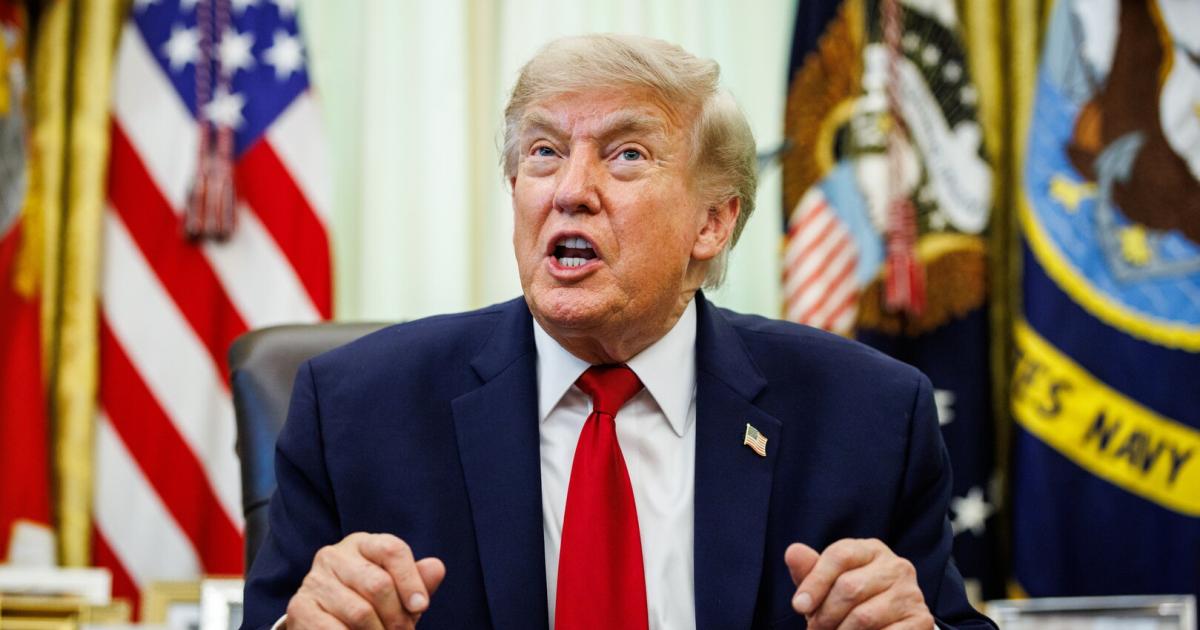
American If you want to understand, you shouldn’t go first Donald Trump but rather to the country that elected him to the White House twice. Axel Honneth does exactly that. The social philosopher, who has been at the for many years Columbia University in New York teaches, describes the United States as a democracy whose contradictions have long been suppressed and are now emerging with full force. For him, Trump is not the trigger of the crisis, but rather its clearest symptom, he says.
KURIER: Mr. Honneth, the United States celebrated its 250th birthday. Is the USA facing a new chapter or the end of its success story?
Axel Honneth: I fear that the United States is indeed at a historic turning point. My generation has always seen the United States as a country that stood for democracy, freedom and equality, despite all internal contradictions and external desires for domination. Today I see a country whose democratic foundations have become frighteningly fragile and which reveals serious weaknesses in its constitution.
What worries you the most?
What worries me most is how quickly a majority has rallied behind a president who systematically questions democratic rules. I’m also shocked at how much people take it for granted obscene language and how restrained public resistance has remained so far. I would have expected millions of Americans to take to the streets, similar to what happened during the civil rights movement. I am deeply disappointed that this has not happened so far.
Why does Trump reach so many people?
Because Donald Trump takes up two very different experiences. On the one hand, many people are uneasy about the profound social change. They had the impression that their country was changing culturally, that minorities were being more recognized and that many things were changing without them having any part in it. On the other hand, Trump appeals to those who see themselves as losers from globalization and have lost economic security. Trump has made political capital out of this mixture of cultural uncertainty and social disappointment, for example by promising to protect American jobs from foreign competition and to return to an America that is more oriented towards traditional family images and a nationally conservative self-image.
What’s left of the American dream?
Today he has two contrasting faces. One represents the idea of securing prosperity primarily for the white majority and sealing oneself off from the rest of the world. The other embodies the idea of equal opportunities and equal rights for all people. Both ideas have shaped the United States from the beginning: the insistence on white supremacy on the one hand, the moral claim of universal equality on the other. Today they collide harder than they have in decades.
Many Europeans have admired America for decades. How naive was that?
No. Europe has always viewed America through two different narratives. One actse from the land of freedom, immigration and the economic advancement opportunities. The other from imperial America, which supported dictatorships and often used its power ruthlessly. Both stories belong together and clearly show the two faces of this country.
America has been primarily a story of rise over the past 250 years. Is the time of descent now beginning?
Morally, we are experiencing a development that many would have considered impossible until a few years ago. It is not yet possible to assess whether the United States will therefore lose economic or geopolitical importance. It’s too early for that. However, we must take the moral decline seriously.
Many people explain America as Donald Trump. Is Trump explaining America or is America explaining Donald Trump?
Both. The fact that someone like Donald Trump could become president says a lot about the state of this country. I find it difficult to imagine that a politician with this obscenity and ruthlessness would win a majority in most European democracies. His success speaks of an America in which many people feel ignored, humiliated and alone.
Have the Democrats lost these people?
Yes. Democrats have made important progress on equality and minority rights. At the same time, they have lost sight of the social concerns of many working people. Donald Trump has recognized this gap. He combined the promise of economic security with a culturally conservative message, reaching many voters.
Can Europe be sure that we will be spared a similar development?
No. There are similar sentiments in Europe too. We should not believe that we are fundamentally immune. Unfortunately, history is much more unpredictable than we would like.
Donald Trump appears to many to be the most powerful man in the world. Is that even him?
In the long term, I believe that the power of big business is greater than that of a president. Trump is likely to be more dependent on Silicon Valley than Silicon Valley is on Trump. I think it is entirely understandable that some people are already talking about an oligarchy. We are witnessing the combination of an economic oligarchy and a president who shows clear authoritarian tendencies.
Today, Europe often looks at America with a certain arrogance. Still, is there anything we should envy about the United States?
Yes. To this day, I am impressed by the deep egalitarianism of everyday American life. People often encounter each other more directly and are far less influenced by class differences than in Europe. People speak to each other more easily and social status often plays a smaller role in everyday interactions. That’s something I envy America for to this day.
If we were to meet again for the 300th anniversary of the United States, what do you hope historians would write about our time?
I hope they will describe these years as a low point in American history. As a time when the worst of this country was exposed and the United States ultimately emerged from that low point. But it won’t be enough to simply wait for the time after Donald Trump. The Democratic Party must fundamentally renew itself. In the long term, American democracy would also become a multi-party system and a procedurally different Constitutional Court do well. Unfortunately, I think both are unlikely at the moment.
Laser, Lichtshows und Projektoren für Zuhause und Events
Lasershow mieten: Tipps, Kosten & Anbieterwahl
Top Lazer Lamps für Zuhause – Effiziente LED Beleuchtung
Hydroschild & Wasserleinwand für Events | Funktion, Einsatz & Projektion
Entdecke die Welt der Laserharfe: Bau & Funktion
Top Laser Projektoren für Hauswände – Vergleich & Kaufberatung