First come the commands. After that, the rocket accelerates and disappears almost in the blink of an eye in the fort of Fort d’Evegnée.
The fortress was built at the end of the 19th century to protect Belgium from possible German attacks, which then took place in both world wars. Today, inside the thick concrete walls of the fortress, rocket technology is being tested, which is designed for a different kind of war, i.e. defense against drones, which Finland still has challenges in combating.
The Defense Forces has estimated that it may not be able to detect all unmanned aerial vehicles. Fighting Drones also has its own difficulties. They are small, fly low and can approach from several directions at the same time or fly in flocks.
The rapid development of technology has changed the starting points of air defense throughout Europe. The change can also be seen concretely in Belgium, where one of the most important concentrations of rocket production in Europe is located.
Until a couple of years ago, anti-drone was not Belgian Thalesin the main focus of operations, but the war in Ukraine and conflicts in the Middle East changed the situation.
Now the company is rapidly increasing the production of its 70 millimeter rockets. The goal is to increase the annual production of laser-guided rockets from the current 10,000 to 20,000 by 2028.
Strict security measures
At Thales’s Herstalin factory, an international group of journalists will be presented with various parts of the rocket, from microcircuits and igniters to warheads and rocket engines.
Before entering the production facilities, stickers are attached to visitors’ shoes, the purpose of which is to discharge static electricity. Other security measures are also strict, for example filming is mostly prohibited.
Even though production has been made more efficient, the workers seem to focus on handling the components with precision and calmness. The systems must still be in top condition years from now if they have to be used in real operations.
Thales representatives say that when the laser-guided rocket is launched, it accelerates to more than twice the speed of sound. Next, we will present a device that tests how the folding control wings of the rocket open during the initial phase of the flight.
The latest addition to the Thales family of rockets is the newly launched laser-guided LGR275 Proxy, which includes a new type of LiDAR ranging sensor.
The sensor uses laser pulses to measure the distance to the target and enables the rocket to explode before the actual hit. It is especially important in combating Drones, where a direct hit is not always necessary.
Thales Belgium product line leader for 70 millimeter rockets Olivier Heuchen says the fight against drones is a system issue. According to him, a single rocket is not a solution, but only one “effector” among others.
“The rocket is not a universal effect. It is used together with, for example, electromagnetic jamming devices, missiles and cannons. The system selects what is needed at the right moment,” says Heuchen.
Introducing the rocket.
Thales Belgium product line manager Olivier Heuchen presents the operating principles of different rockets.
PHOTO: Kreeta Karvala
Cost and threat
Both unguided and laser-guided rockets will be presented to journalists at Herstal. Heuchen says that which rocket model makes sense to use to combat drones depends on the situation. An unguided rocket is better suited for shorter distances and is based on a preset detonation point. A laser-guided rocket, on the other hand, is capable of following a moving target and is effective at longer distances, even several kilometers away.
Heuchen reminds that in combating drones, the costs must be related to the threat assessment.
For example, the Iranian-made Shahed drones used by Russia in Ukraine are relatively cheap compared to many of the anti-aircraft missiles used to combat them, so the cost to the attacker can be a fraction of the cost to the defender.
It is not sustainable to fight drones that cost 10-20,000 euros with missiles that cost hundreds of thousands.
Thales aims to close this gap. According to Heuschen, the price of unguided rockets remains at a few thousand euros, and laser-guided rockets cost clearly less than one hundred thousand euros, while the prices of actual anti-aircraft missiles can rise from hundreds of thousands to millions of euros.
“It is not sustainable to fight drones that cost 10-20,000 euros with missiles that cost hundreds of thousands,” says Heuchen.
The cost-effectiveness of combating drones has also become central to the company’s strategy. According to Thales, the 70-millimeter laser-guided rockets bridge the gap between cheap unguided solutions and expensive missiles. For example, the FZ123 rocket is designed as a cost-effective solution that is capable of combating individual drones or swarms at an altitude of up to 2,500 meters.
Laser guidance also has the advantage of accuracy and immunity to interference. The rocket is able to follow a moving target and hit it precisely, which reduces collateral damage. According to the company, in the proxy version, the LiDAR sensor increases operational reliability in situations where a direct hit does not occur, when the rocket explodes near the target at the optimal moment.
Security issues are also central, especially in a civilian environment. According to Heuchen, the rockets are designed in such a way that they explode in a controlled manner and do not cause widespread destruction.
“After the explosion, shrapnel rains down on the ground, but not as much destruction as the actual hit would cause,” he says.
The brains of air defense.
The real brains of air defense are the command systems that decide how to respond to each threat. The picture shows the screen of Thales’ Ground Master 200 MM/C air defense and fire support radar system. Stock photo.
PHOTO: Joel Maisalmi
The brains of air defense
Vice President of Thales Europe Marc Darmon emphasizes that in modern air defense it is not a single sensor or a single weapon that is decisive.
According to him, the real “brains” of air defense are the management systems that decide how to react to each threat. If, for example, several drones appear in the airspace at the same time, the system tries to optimize the fight as efficiently as possible.
Thales markets the company’s own Sky Defender air defense concept, which is based on a layered defense where different sensors and weapons complement each other. A similar philosophy is applied, for example, in Israel’s Iron Dome system.
“The threat is constantly changing. That’s why the system must be able to integrate new sensors and means of influence quickly,” says Darmon.
Many kinds of tests
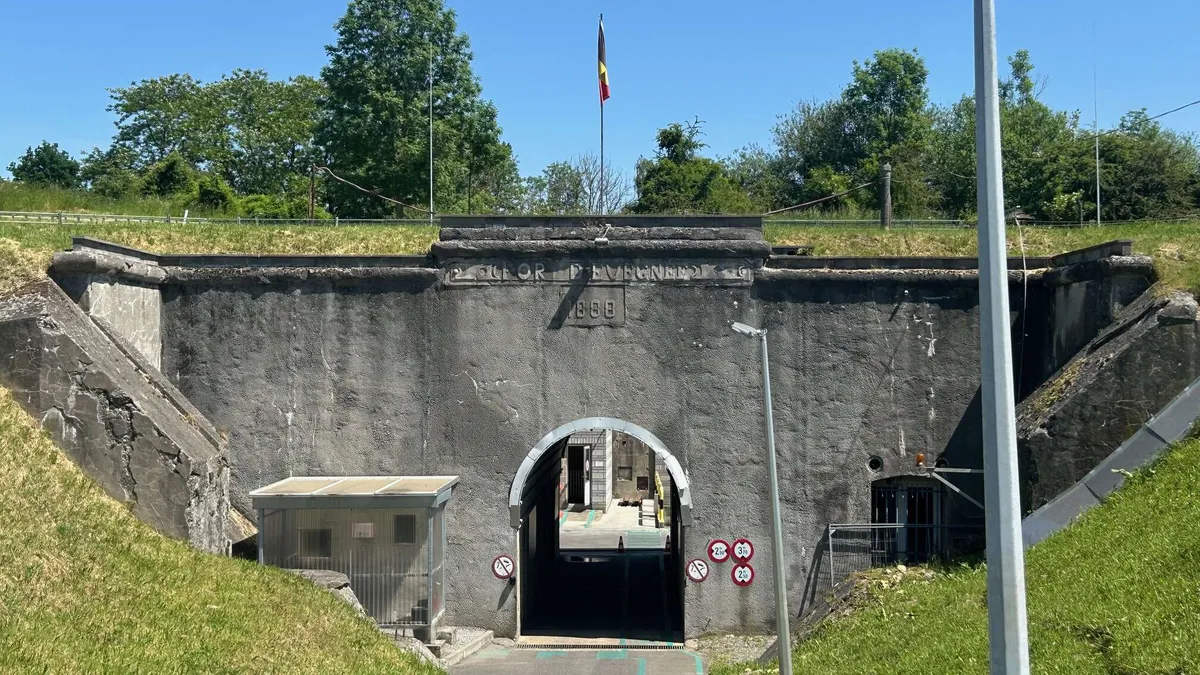
We move from the Herstal production plant to the fortress of Fort d’Evegnée, outside of which the Belgian countryside lives its peaceful life.
Inside the fortress, however, new threats are being prepared by assembling and testing systems that the builders of the fortress could hardly imagine.
Test site.
Thales’ 70 mm rocket systems are being tested at a fortress in Belgium.
PHOTO: Kreeta Karvala
We walk through narrow corridors that wind underground. Assembly, quality assurance and acceptance tests are carried out in more than 40 different rooms.
Components are tested, for example, at temperatures ranging from -45 degrees to +66 degrees. The effects of sea salt and shock resistance also have their own test sites.
Darmon wants to remind Europeans that the design, production and maintenance of key defense systems should take place as close as possible to the users.
“It’s important to be able to control design and production close to the threat. It’s not just an industrial issue, it’s a military issue.”
At Fort d’Evegnée, a worker closes the finished rocket in a protective case. In another room, rockets are packed for long-term storage. Each system must be ready for use in another decade.
The walls of the old fortress were once built to withstand artillery fire. Now a test rocket is launched inside the walls, leaving behind only the smell of gunpowder in the air.
THE FACTS
Thales rocket production
The listed defense company Thales is the European market leader in 70 mm rocket systems (2.75″ NATO standard).
The company has more than 55 years of experience in rocket technology, including propulsion, pyrotechnics, ballistics, guidance and simulation systems.
Thales rockets are in use in 55 countries and in about 70 armed forces.
The company manufactures rocket engines, warheads, launchers and fire control systems. It has delivered more than 8 million rockets worldwide.
Thales’ 70 mm rocket solutions have been integrated into more than 500 platforms, such as helicopters, airplanes, ships and ground vehicles.
According to Thales Belgium, the company is one of the few operators that can offer the entire 70 mm rocket system: ammunition, launchers, fire control, and integration and support services.
The range includes both unguided and laser-guided 70 mm rockets, which are used, for example, for precision strikes, fire support and combating drones.
Зворотний дзвінок (callback) ➤ переваги використання системи автообдзвону від IPTel
Інтеграція IPtel з Telegram
Автоматизація на мільйони: Як обленерго знизило кількість боржників на 11% завдяки автообдзвону
Технічна підтримка клієнтів ⬆️ IPTel орієнтована на клієнта
IP телефонія для медичних центрів ⬆️ IPTel
Аналітика дзвінків за допомогою ШІ: Блог IPtel
Блог та новини компанії ⬆️ IPTel
Телефонія та хмарні рішення для Держсектору ⬆️ IPTel
Як автоматичний обдзвін допоможе розширити базу клієнтів
Віртуальний кол-центр ⬆️ IP-телефонія для call-центру від IPTel
IP телефонія для медичних центрів ⬆️ IPTel
Блог та новини компанії ⬆️ IPTel
Блог та новини компанії ⬆️ IPTel
Інтеграція IPtel з WhatsUP через Twilio
Автообзвон. Що це і як послуга допоможе вашому бізнесу ⬆️ Блог IPTel
Мовна аналітика дзвінків (Speech Analytics) ⬆️ IPTel
Контроль работников колл центра: система контроля телефонии
Блог та новини компанії ⬆️ IPTel
Блог та новини компанії ⬆️ IPTel
Що таке хмарна атс і хмарний Call-центр>Переваги для бізнесу
⭐Розрахунок штату операторів call-центру (6 кроків)
10 способів покращити роботу контакт-центру: поради IPtel
Віртуальна АТС ⬆️ Підключіть хмарну АТС для бізнесу від IPTel
Віртуальна АТС ⬆️ Підключіть хмарну АТС для бізнесу від IPTel
Інформація про компанію ⬆️ IPTel