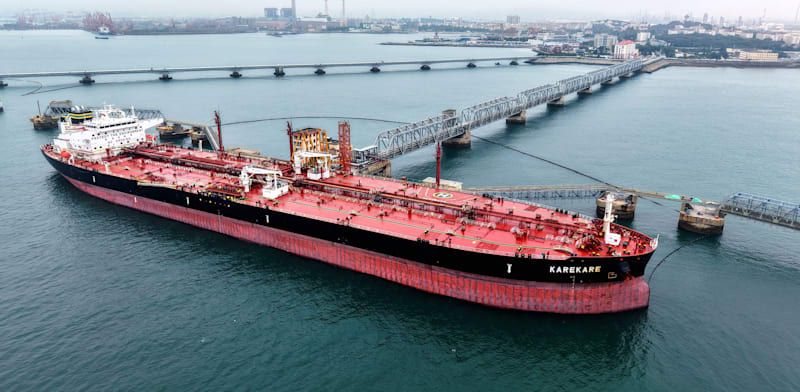
Oil prices are falling all over the world, and the market is discovering that this has unexpected consequences.
At the end of June, a memorandum of understanding was signed between the United States and Iran, which included the opening of the Strait of Hormuz for the passage of ships and led to the flooding of the oil market. The supply already exceeds the demand, the price of crude oil stands at 68.8 dollars per barrel and the fear is increasing that soon there will be a significant excess supply in the market.
● The Chinese solution to intercepting drones: a laser system for every soldier
● He studied the strongest currency in the world and is sure: the same will happen to the shekel
This is a dramatic change in the market. During the war, the price of oil reached a historic high of 112 dollars per barrel, and only a few weeks ago the senior officials of the energy industry warned that global oil stocks were dwindling to alarmingly low levels that could lead to a global recession.
And today, although it is not clear whether the agreement between Tehran and Washington will last and a significant part of the oil production in the Middle East has not yet returned to full activity, the Brent oil contracts have already erased all the increases recorded during the fighting period. Their price fell by 43% from the peak recorded at the end of April, while the physical oil market shows acute signs of weakness not seen since the Corona period.
The reasons for oversupply
For the major oil producers OPEC, the question is no longer how quickly output can be restored, but whether it will actually be necessary to reduce it to support prices, or be dragged into a global struggle for market shares.
Beyond the immediate impact of the reopening of the Strait of Hormuz, analysts from the investment houses Morgan Stanley and Goldman Sachs warned this week that the oil market may enter an oversupply (Glute) as early as next year.
In the weeks following the signing of the memorandum of understanding to open the Strait of Hormuz, the markets were flooded with more than 60 million barrels of oil that had been locked up since the outbreak of the war.
Saudi Arabia and the United Arab Emirates have already returned to the export levels that characterized them before the war with Iran, thanks, among other things, to the American military protection of vessels in the Strait and the use of bypass pipelines. Iranian oil, which for years was subject to heavy American sanctions, also returned to the market after Washington granted exemptions from sanctions.
At the same time as the opening of the Strait of Hormuz, many of the emergency solutions developed during the war are still operating.
China, which helped stabilize the market by sharply cutting its oil purchases, continues to largely stand by.
The reasons for the oversupply in the oil market
■ Opening the Strait of Hormuz for the passage of ships
■ The lifting of sanctions on Iranian oil
■ Pouring millions of barrels into the market
from the US emergency reserves
■ China’s decision to stop importing new oil
and relying on her emergency stockpile
Dr. Eili Retig, expert in energy and energy security, Department of Political Science and BSA Institute, at Bar-Ilan University, explains that “one of the main reasons for the rapid drop in oil prices is the decision by China, the largest oil importer in the world, to stop importing new oil at this stage and rely on its existing emergency stocks. This decision releases millions of barrels of oil to a world that does not need them at the moment.”
At the same time, every week millions of barrels are released into the market from the underground emergency reserves on the US Gulf Coast, as part of an unprecedented release of about 400 million barrels designed to deal with an energy crisis that no longer exists.
Dr. Eili Retig / Photo: Bar Ilan University Spokesperson
On this, Dr. Rettig says that “the very fact that oil prices are crashing will result in countries buying more of it, among other things to fill the emergency stocks that have been depleted in recent months, and then the price will rise again.”
Rinat Ashkenazi, Chief Economist, at Phoenix Investment House, explains that “the world went to sleep in the consciousness of ‘austerity’ in the energy market and woke up in a paradise of abundance, not to mention excessive abundance.”
According to her, “the sharp shift in the narrative in the oil market resulted from a combination of several factors that worked simultaneously: the release of emergency stocks by various countries, a faster than expected recovery of the flow of oil through the Strait of Hormuz after the market priced in a scenario of prolonged supply disruption. And finally, the resumption of Iranian exports, which returned additional barrels to the market earlier than expected.”
In addition, “OPEC countries continue to increase output, thus strengthening the estimates for excess supply in the second half of the year and possibly even in 2027.”
Stands for two weeks without a buyer
The excess supply is already evident on the trading screens on Wall Street and in the number of oil tankers crossing the oceans.
For example, the Bloomberg network reported that oil from the United Arab Emirates is currently being sent all the way to the United States and is being offered to buyers in Hawaii.
A tanker carrying oil from Venezuela sailed more than 16 thousand kilometers to the shores of India, but has been standing there for over two weeks without buyers. A cargo of oil from the Republic of Congo has also yet to be sold, despite being offered at an unprecedented discount of $14 per barrel compared to the Brent price.
The lack of demand from China is also evident in the prices of oil that is usually destined for the refineries. The physical price of Oman oil, one of the main types of oil in the Middle East, fell to the level of four dollars below the reference price of Dubai oil, the largest gap since 2020.
Ashkenazi adds that “at the same time, the contract curve has shifted to a contango structure, a situation where the price of oil for immediate delivery (spot) is lower than the prices of contracts for future delivery. Such a structure creates an incentive for producers to postpone sales and store the output, since it can be sold in the future at a higher price, minus storage and financing costs.”
The fears are gone
How does the change affect the global economy?
Ashkenazi: “For the global economy, the dramatic transition from scarcity to abundance means an almost complete decline of the fear of an inflationary surge originating from energy.
“The drop in energy prices acts as a kind of ‘tax reduction’ for consumers, supports private consumption and growth, and may even have a political impact in the US through improving the purchasing power of households.”
What about the impact on countries whose economy is built largely on oil exports?
“For OPEC producers, the picture is more complex,” says Ashkenazi. “The question arises as to whether they will be required to cut again to support prices, or enter into competition for market share if they continue to increase supply. The continuation largely depends on the rate of recovery of demand in China and the need for many countries to renew stocks.”
“In terms of the markets,” she adds. “The drop in inflation pressures gives the Fed and other central banks some breathing room and space to examine the continuation of policy without immediate pressure for further tightening.
“The bond market, which tends to act as the ‘responsible adult’ of the financial system, seems at this point to prefer to suspend conclusions and wait for the clarification of the monetary picture at the upcoming Fed meeting.”
For your attention: The Globes system strives for a diverse, relevant and respectful discourse in accordance with the code of ethics that appears in the trust report according to which we operate. Expressions of violence, racism, incitement or any other inappropriate discourse are filtered out automatically and will not be published on the site.
https://www.thinkbig815.org/group/think-big-group/discussion/f32fc215-2c85-425f-8e70-102d8924f880
Urgent warning issued by DVLA to motorists who passed their driving test before 2014
El uso generalizado de la mascarilla, un regalo para los delincuentes
online gaming
National Bandanna Day – Supporting Kids with Cancer
Merry Christmas
8594686.Htm
The Dark Mark – A Bravenet.com Forum
Can anybody advice me some cool online games?
ColdBlooded – Social Media for Reptile Enthusiasts
Recommend an entertainment site for relaxing after work
Diabetes vs. Prediabetes
online gaming – Incredible Genius Forums
Can anybody advice me some cool online games?
U.S. Coast Guard Questions
Someone from an old book club passed on https://www.datin
https://www.lynskeyperformance.com/group-page/my-site-1-group/discussion/4e1fa49a-88c0-4737-943d-30aa2dca2023
Where can I have fun on the Internet while I have free time?
Where can I have fun on the Internet while I have free time?
JPRO: online gaming | elearn
~~ qiirLspower ~~ do you have enouqh PoweR ?! – FoRum
17688
Can anybody advice me some cool online games?
online gaming
26 03 15 Spens Qorvex Cement