Despite receiving the green light from the US, Ukraine still faces many obstacles, it may take several months to several years to produce the first Patriot missile.
President Donald Trump announced on July 8 that the US would grant a license to build Patriot missiles to Ukraine so that the country “can’t complain that we don’t ship enough anymore”. The statement was made the day after Ukraine admitted it could not block Russian ballistic missiles because it had exhausted its Patriot ammunition stocks.
Mr. Trump said that businesses producing missiles for the Patriot complex were not informed of the decision in advance, but emphasized that “everything will be fine.” Defense corporation Lockheed Martin is in charge of Patriot’s most modern PAC-3 missile line, while the older PAC-2 line is manufactured by Raytheon.
Editor Howard Altman of the US military website War Zone and Becca Wasser, head of defense Bloomberg Economicswarned that it would take Ukraine at least several months to many years to start building Patriot missiles.
Technicians assemble PAC-3 missiles at Lockheed Martin’s factory. Video: Lockheed Martin
“This ambition will face many barriers, starting with administrative procedures and legal regulations, including the requirement that the agreement must be approved by the US Congress. This is just the smallest problem,” Altman said.
It is likely that the US will only provide separate components for Ukraine to assemble into complete missiles, instead of transferring technology and supply chains for Kiev to have complete autonomy in production. This option will place limits on the time and quantity of ammunition that Ukraine can release.
“The Patriot missile uses highly specialized components that take a long time to produce,” Altman noted.
Lockheed Martin, the world’s leading weapons manufacturing corporation, currently produces about 650 PAC-3 MSE missiles each year. In the contract signed with the Pentagon in January, Lockheed Martin committed to increasing production to 2,000 missiles per year in the near future.
“The time to build a PAC-3 MSE missile body is 24 months, and a solid fuel engine is 30 months. This long time is due to physical limitations on the line, including the time for solid fuel to vulcanize and the complex component evaluation process, which often lasts many years,” said the Foreign Policy Research Institute (FPRI), based in the US.
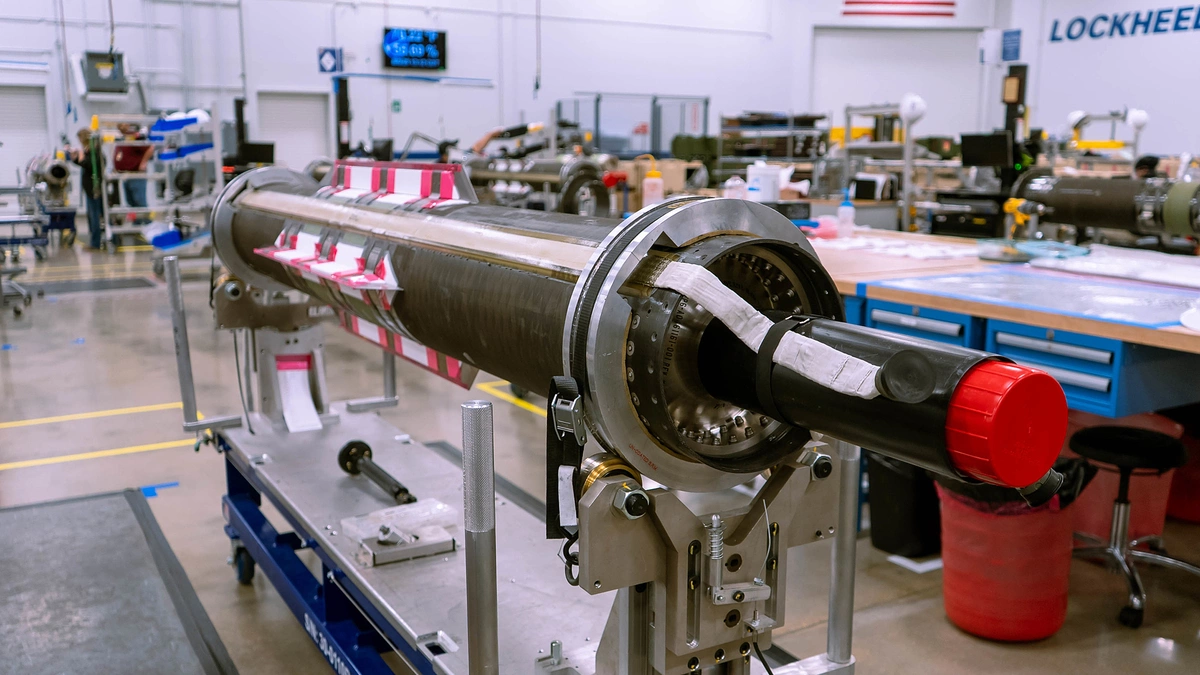
A part of the PAC-3 missile at the assembly plant. Image: Lockheed Martin
FPRI believes that there is also a bottleneck in the subcontractor providing equipment for Patriot. Boeing Corporation is in charge of manufacturing active radar detectors for the PAC-3 MSE missile, with the only facility in Huntsville city achieving an output of 650-700 sets of components in 2025.
“The Pentagon in April signed a framework agreement to triple probe output, admitting that missile assembly capacity is meaningless if subcontractors cannot keep up. A similar situation also occurred with solid fuel engines manufactured by Aerojet Rocketdyne of L3Harris,” FPRI said.
The supply chain for the existing line is already overloaded, while opening a new facility will require specialized equipment and training, increasing project implementation time. Ukraine is facing a similar problem when developing a domestic ballistic missile shield, which depends on European-developed radars, command centers, data links and probes.
Even after receiving the necessary parts, Ukraine still needs to find a location for an assembly plant. This is very difficult, because Kiev must disperse its weapons manufacturing facilities to limit damage from enemy missile and unmanned aerial vehicle (UAV) raids.
“This requirement is not consistent with the goal of building enough Patriot missiles to deal with Russia’s air attack campaign. It will take several years to build or convert a facility large enough to assemble Patriot missiles, while Russia will consider this place a top target and quickly attack,” Altman said.
Capabilities of the Patriot air defense complex. Graphics: Raytheon, RIA Novosti
Retired Colonel David Shank, former principal of the US Army Air Defense Artillery School, mentioned another issue: personnel. “I am absolutely concerned with anyone being allowed in and out of this facility. This also raises questions about the amount of information and willingness to share from the US for Ukraine to build Patriot missiles,” he said.
Altman believes that former Colonel Shank’s concerns are completely well-founded, as the US always strictly protects data about Patriot missiles and internal components. “The Patriot missile production line in Ukraine can help Russia obtain data and hardware,” the American writer warned.
Ukraine is not the first country licensed by the US to produce Patriot missiles. Japan is manufacturing about 30 shells per year under a contract with Lockheed Martin and planned to double production from 2024, but this plan has encountered obstacles because of supply chain problems.
It is unclear where Ukraine will get the budget from to assemble Patriot missiles domestically. Altman raised the possibility that European countries would shoulder part of the costs for Kiev.
The PAC-3 MSE rocket leaves the launch pad during a test in New Mexico state, USA, November 2013. Image: USAF
Ukraine is applying an accelerated manufacturing process with domestic missiles and UAVs, but will not be able to do this with the Patriot line due to strict control regulations from the US.
“Patriot production is limited by bottlenecks in the supply chain. Even if Ukraine builds a factory, it still needs to establish a network of component suppliers. This is a significant challenge for the country’s wartime defense industry,” Kelly Grieco, an expert at the US-based Stimson Center, stated his opinion.
TeleTrade Review 2026: Regulation, Fees, Platforms, Deposits
Crystalfunded Review 2026: Regulation, Fees, Platforms & Safety
AquaFunded Review 2026: Regulation, Fees, Platforms, Deposits
Funded Lion Review 2026: Safety, Regulation, Fees, Platforms
ForexTB Review 2026: Regulation, Fees, Platforms and Safety
Trade.com Review 2026: Regulation, Fees, Platforms & Safety
DeiFunded Review 2026: Safety, Regulation, Fees, Platforms
FOREX.com Review 2026: Regulation, Fees, Platforms and Safety
SVSFX Review 2026: Regulation, Safety, Fees, Platforms and Withdrawals
CM Trading Review 2026: Regulation, Fees, Platforms, Minimum Deposit
InvestLite Review 2026: Regulation, Fees, Platforms, Deposits
GPS Forex Robot Review 2026: Fees, Platforms, and Safety Check
Atom8 Review 2026: Regulation, Fees, Platforms and Safety
Multiverse Funding Review 2026: Safety, Regulation, Fees, Platforms
Astra Capital Funding Review 2026: Safety, Fees, Platforms & Payouts
NAGA Review 2026: Regulation, Fees, Platforms, Deposits & Withdrawals
HYCM Review 2026: Regulation, Fees, Platforms, Minimum Deposit
Funds for Traders Review 2026: Closure, Platforms, and Safety Check
One Financial Markets Review 2026: Regulation, Fees, Minimum Deposit,
Forex Diamond Review 2026: Safety, Regulation, Fees, Platforms
Xtrade Review 2026: Regulation, Fees, Minimum Deposit, Platforms
InstaForex Review 2026: Regulation, Fees, Platforms and Withdrawals
XGLOBAL Markets Review 2026: Regulation, Platforms, Fees & Safety
BrightFunded Review 2026: Fees, Platforms, Rules and Safety
OctaFX Review 2026: Regulation, Fees, Platforms, Deposits