Delays in electricity and water infrastructure construction projects could threaten the operations of memory chip factories and data centers in Korea’s plan to lead the AI and semiconductor industry.
Theo Bloombergin a speech in Seoul on June 29, Korean President Lee Jae Myung announced a super project worth at least 1,350 trillion won (880 billion USD) with the participation of two “giants” Samsung and SK Hynix to maintain a leading position in the era of artificial intelligence (AI). This huge budget, equivalent to about 5% of Korea’s 2024 GDP, will be used to build advanced memory chip factories and new generation AI data centers.
Samsung and SK Hynix will each build two new semiconductor chip factories in South Korea’s southwestern provinces of Gwangju and Jeolla with a total capital of 800 trillion won. In parallel, an investment worth 550 trillion won from domestic businesses, led by Naver Corp, will be poured into building an AI data center system with a total capacity of up to 8.4 gigawatts by 2029.
However, according to UPISouth Korea will need to re-plan electricity and water supply plans nationwide to meet demand from semiconductor factories and AI data centers.
Electricity shortage
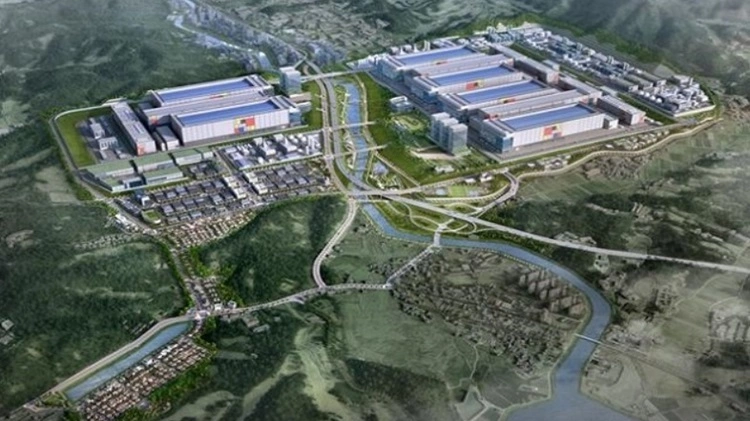
Theo Tom’s HardwareYongin National Semiconductor Industrial Complex, a large factory cluster of Samsung and SK Hynix in Gyeonggi Province, is estimated to require 15-16 GW of electricity when fully operational, nearly 25% of the total electricity demand of the Seoul metropolitan area while the local supply is only about 1.9 GW. However, as of January, about 6 of the 15 GW the complex needs still do not have a complete supply plan. Specifically, Samsung needs 9 GW (6 GW guaranteed) and SK Hynix needs 6 GW (3 GW guaranteed).
South Korea produces electricity in coastal areas, including nuclear power and liquefied natural gas (LNG) on the east coast and renewable energy in the southwestern Honam region while the cluster of plants is located further inland, near Seoul. Korea Electric Power Corporation (KEPCO) is conducting a $27 billion project to build a 345 kV high voltage transmission network about 1,153 km long, helping to transfer electricity from the east coast and Honam to Yongin, expected to be completed in 2036.
However, KEPCO’s ability to install long lines is very worrying. The Bukdangjin – Sintangjeong line alone cost 1.17 trillion won ($810 million) and took 22 years to complete, with site selection lasting more than a decade. The Donghaean – Dongseoul high-voltage one-way line stretching 280 km from Uljin to Hanam requires 436 transmission towers that are constantly delayed. In 2024, the Hanam city government refused to grant a permit to expand a KEPCO substation, putting the entire plan at risk.
Yongin National Semiconductor Industrial Complex seen from above. Image: Ministry of Land, Infrastructure and Transport of Korea
Meanwhile, SK Hynix has accelerated the completion of the fourth factory in Yongin 12 years early, from 2045 to 2033, meaning the factory is coming up faster than the power supply line.
The Korean government and KEPCO plan to build six LNG plants inside the Yongin complex, starting at 3 GW and expanding to 10 GW, to fill the gap when the power transmission network is completed. However, Samsung as well as SK Hynix both committed to using 100% renewable electricity by 2050 and the Carbon Neutral Committee of the Democratic Party of Korea has requested to cancel the plan to build an LNG plant.
Water shortage
In addition to electricity, large-scale memory chip factories consume 100,000 tons of water/day. It is expected that the Yongin complex will need about 800,000 tons of water/day when completed. The water supply plan is divided into several phases: about 200,000 tons of water/day from 2031 from the surplus at Paldang dam and treated wastewater. Next, new water collection works and pipelines will increase the supply to 600,000 tons/day by 2034. However, the water pipeline built to serve SK Hynix’s fourth factory will be completed a year later than when the factory opened.
Local water disputes including opposition from Yeoju City and Hanam City also delayed pipeline construction. Water shortages are worse for the new southwest cluster near Gwangju province because the Yeongsan and Seomjin river basins contain only half the amount of water that the Han River supplies to Yongin. The four southwest factories are expected to require about 430,000 m3 of industrial water per day. Government forecasts show the Yeongsan basin will have a shortfall of about 219 million cubic meters per year by 2030 before any factories use water from it.
Deltacasino
Svyatoslav Kidik
Deltacasino
steelheart3123 הפרופיל של — The Movie Database (TMDB)
fallsviewcasino fallsviewcasino
steelheart – Scholistico
Presentations and Templates by fallsviewcasino fallsviewcasino
CineD
WP Tavern
Substance 3D Community Assets
MobileSheets Forums – Profile of greyeaglecasinoo
Etherscan User Profile
Find A Spring – Members
Kananaskiscasino
⇪ kananaskiscasino
listography: kananaskiscasino
kananaskiscasino |
Substance 3D Community Assets
lethbridgecasino – Swap-bot
Lethbridge
lethbridge
@seriousshovel4495435's Profile – websim.com
Member Profile: livingskycas | Blurb Books
Default.Aspx
¡Un error ha ocurrido!